
Understanding Your Audience's Decision-Making Process
Understanding your audience's decision-making process is crucial for improving outcomes. Focus on decision completion within messages rather than just increasing conversation volume to lower costs and enhance customer experience.
Most teams invest in messaging volume to feel closer to their customers, but Understanding Your Audience's Decision-Making Process starts with measuring completion, not conversations. When a billing, collections, or compliance task ends in a portal or a call, intent decays and costs rise. The fix is making the message the place decisions happen, with proof written back to your systems.
We have seen this pattern across large financial services operations. The stack looks automated, yet agents still reconcile outcomes by hand and customers still switch channels at the last mile. If you want lower unit cost and faster cycle times, focus on how decisions get made and finished inside the message.
Key Takeaways:
Outcome beats activity: decisions count only when they complete and write back
The last mile is the leak: handoffs and logins break intent and add cost
Define completion upfront: objective outcomes and evidence reduce ambiguity
Centralize rules and context so only valid choices appear to customers
Use channel-native self-service to remove friction at the moment of action
Prove it with metrics that matter: completion rate, time-to-resolution, deflection
Start with one high-volume workflow to show impact before scaling
Why More Conversations Miss the Point in Understanding Your Audience's Decision-Making Process
More messages do not mean better outcomes. Decisions complete when customers can act inside the message and the result writes back to your system of record. Measuring resolution, not conversation volume, aligns your operation to cost, risk, and customer outcomes. A collections reminder that ends in a hold queue is still a failure.
Resolution Beats Volume
Decision-making in financial services is constrained by policy, eligibility, and timing. When you ask customers to switch channels to act, you add steps that do not improve the choice, they just slow it. A clean path inside the message reduces cognitive load and shortens the gap between intent and action. That is the difference between a promise and a posted payment.
Most teams still count opens, replies, and containment. Those are activity metrics. Outcome metrics, like completion rate and successful writebacks, show whether a decision actually happened. We have watched teams celebrate click-through spikes while agents rekeyed card updates into the core system later. That gap is where money and time are lost.
Customers also make simple tradeoffs, like convenience over formality. If acting requires a login reset, a phone call, or a separate app, the moment passes. Even motivated customers abandon. It is not a motivation problem, it is a path problem.
The Last Mile Blocks Decisions
Intent detection is common. Completing the transaction is not. Portals and chatbots often stop one step short of touching core systems, which is where real decisions post. That final step is where risk controls, data validation, and writebacks live. Without it, you get conversations about action, not action.
Handoffs multiply failure points. Customers bounce from SMS to a portal, then to a call. Each hop adds friction and delay. On the ops side, teams juggle partial data across tools and patch results together later. It is brittle. And expensive.
The fix is not more reminders. It is fewer steps and a direct path to a valid next action in the same channel. Shorter journeys win. Always.
Outcome Metrics, Not Activity Metrics
The numbers that matter are simple and unforgiving. Completion rate shows whether decisions happen. Time-to-resolution shows how fast. Deflection shows what would have hit your contact center if you had not closed the loop in-channel. Writeback success shows whether systems reflect reality.
Activity metrics mask waste. A campaign can look healthy on opens and replies while unit cost keeps rising. That mismatch is a warning sign that your decision path is broken. Fix the path, then keep the vanity metrics in context.
Switch your weekly dashboard to resolution-first and you will spot the leaks immediately. They are usually at the last mile.
The Real Bottleneck in Audience Decisions: Handoffs and Missing Writebacks
Audience decisions fail most often at the handoff between outreach and action because identity, policy, and writebacks are split across tools. The result is stalled choices, manual wrap-up, and inconsistent records. When completion happens inside the message with guaranteed writebacks, decisions stick and costs fall.
Context Switching Kills Intent
Every extra step taxes attention. Customers weigh effort against urgency in seconds. A secure link that opens a focused action is easy to accept. A portal login with forgotten credentials is not. Even a short wait in a call queue can be the difference between a posted payment and a broken promise.
Intent decays fast with context switches. You can see it in drop-off curves. The first click looks good, then the slope steepens at login, and again at payment details. Reduce the number of cliffs and completion rises.
Ops leaders feel this too. Each hop introduces reconciliation work when systems capture different pieces of the journey. That work does not add value. It hides the cost.
Integration Is the Hard Part
Most tools can start a conversation. Safely updating balances, flags, notes, and documents in your core systems is where many projects stall. Authentication, schema mapping, error handling, and idempotency are not side tasks. They are the backbone of reliable decisions at scale.
Teams often underestimate this. No-code pilots look great in a sandbox, then hit a wall at the writeback layer. Without managed integration, you invite manual steps back into the flow. And you lose the evidence trail compliance teams expect.
The takeaway is clear. Solve integration early or the journey will break where it matters most.
Completion Requires System Updates
A decision is real only when systems of record show the outcome. That means payments posted, plans created, attestations stored, and notes attached. Anything less is operational debt you will pay down later with time and people.
Writeback failures also erode trust. Customers who acted reasonably expect to see updated balances. When they do not, they call. Now your team pays twice: once in rework and again in avoidable calls.
Close the loop where the action starts. Inside the message. Then prove it with writebacks you can audit.
The Hidden Costs of Misreading the Decision-Making Process
Misreading how customers decide leads to waste you can measure: time, unit cost, compliance risk, and lost revenue. Teams that optimize for conversation volume while ignoring completion see rising costs despite healthy activity dashboards. The data backs it up across channels and industries.
Time, Unit Cost, And Manual Rework
Every manual handoff adds minutes. Multiply that by your daily volume and the cost is material. Research on engagement shows customers prefer low-friction digital journeys, and channel-switching introduces delay that compounds across queues. Evidence from Twilio's 2024 State of Customer Engagement highlights customer preference for messaging with quick paths to action.
Manual reconciliation also destroys predictability. Leaders plan capacity on averages that hide spikes. When systems do not update automatically, you need more buffers. Buffers are cost. And they do not fix the root issue.
The fix is not more staff during peaks. It is fewer touches per case through closed-loop flows that do not bounce between tools.
Trust, Compliance, And Audit Burden
Customers notice when outcomes do not show up. A missing writeback looks like a broken promise. In regulated environments, it is more than a service miss. It becomes an audit gap that can trigger remediation work.
Regulators have sharpened expectations on fair outcomes and recordkeeping. The UK’s FCA Consumer Duty raised the bar on evidence that customers can act easily and outcomes are recorded correctly. That means identity proof, consent capture, and a defensible log of what was sent, what was done, and when.
Without automated evidence, you rely on people to stitch records together after the fact. That is slow and risky.
Lost Revenue And Missed Opportunities
When customers want to pay but cannot act in the moment, you lose revenue you should have collected. The same is true for policy renewals, KYC refreshes, and document collection. A stalled decision is a missed window.
Banks that design journeys for the choice at hand consistently outperform peers on conversion and churn, according to McKinsey research on customer decision journeys. The pattern is consistent: reduce friction at the moment of action and the numbers move.
Design for completion and your revenue line will show it.
What It Feels Like When Decisions Stall
When decisions stall, operations leaders feel it first as noise, then as cost. Dashboards look busy, but backlogs grow and exceptions pile up. Customers repeat themselves because the system did not remember what they did. Your best people spend energy on work a system should finish.
Nights Spent Reconciling Records
You know the drill. A customer updated card details in a portal and then called because the balance did not change. Your teams update the note, fix the flag, and attach the document. Now two channels touched the same case with different truths.
It is exhausting. It is also unnecessary. Rework is a symptom of missing writebacks and split journeys. Once you see it that way, the fix becomes clearer.
Leaders do not mind hard problems. They mind avoidable ones.
Agents Handling Work Rules Could Do
Most collections and compliance flows are policy-bound. That means rules can present valid options without a person in the loop. Yet agents still handle plan selection, address confirmation, or doc re-uploads. Those are structured tasks. The system should offer eligible paths and capture consent.
Agents thrive on nuance and judgment. Let them spend time there. Push the repeatable work into self-service paths that never leave the message.
Morale improves when people focus on edge cases instead of copy-paste tasks.
Dashboards Without Clear Resolution
You might have beautiful visualizations of sends, opens, and replies. They look good in reviews. They do not tell you what finished. You still ask teams to estimate completion from partial data across tools.
That uncertainty drives cautious planning. Caution becomes capacity buffers. Buffers become cost. All because the last mile is opaque.
When you flip to resolution metrics, the fog lifts. You see where to fix the journey instead of where to boost volume.
A Resolution-First Way to Understand and Influence Decisions
A resolution-first approach aligns how you understand decisions with how you design the path to complete them. Define what “done” means, centralize rules and context, and let customers act in the same channel where they read your message. Then prove it with writebacks and audit trails.
Define Completion and Evidence Upfront
Start by defining the exact outcome that counts as completion for each workflow. A posted payment, a plan on file, an attestation captured, or a verified address are all distinct, objective states. Tie each to the evidence you must retain, like consent timestamps or document hashes.
When everyone shares the same definition of done, debates shrink. Your QA teams test real outcomes, not texts. Your performance reviews shift from activity to resolution. And you can draw a straight line from changes in the journey to business impact.
Make the evidence part of the design, not an afterthought.
Centralize Context, Rules, And Eligibility
Customers make better choices when the interface only shows valid options. That requires context, eligibility rules, and policy logic in one place. If a customer is ineligible for a plan, do not show it. If a document expired, ask for the right one with clear validation.
Centralized rules also keep risk teams comfortable. They know what the system will and will not do. Changes are explicit and testable. Auditors gain confidence because the same logic applies everywhere the workflow runs.
Fewer exceptions reach agents. And the ones that do arrive with clear context.
Design Channel-Native Self-Service That Fits Moments
People act where they are. If your outreach is in SMS, email, or WhatsApp, the next action should live there too. A secure mini-app that opens inside the conversation lets customers complete the task without switching tools. Identity checks keep it safe. Focused UI keeps it simple.
After you get the principles right, sequence them like this:
Confirm identity with a one-time code or known-fact check
Present only policy-eligible options with clear labels
Validate inputs as customers progress to avoid late-stage errors
Capture consent and show a clear confirmation
Write outcomes back and show the updated state
That flow is fast to use and easy to trust.
Ready to make this your new baseline? Ready for customer communication workflows on autopilot? Get in touch.
How RadMedia Turns Decision Understanding Into In-Message Completion
RadMedia turns decision understanding into closed-loop outcomes by wiring your systems, presenting secure in-message actions, and writing results back automatically. Managed integration handles the hard parts, while mini-apps and policy-aware orchestration remove last-mile friction. The result is higher completion and lower unit cost without extra headcount.
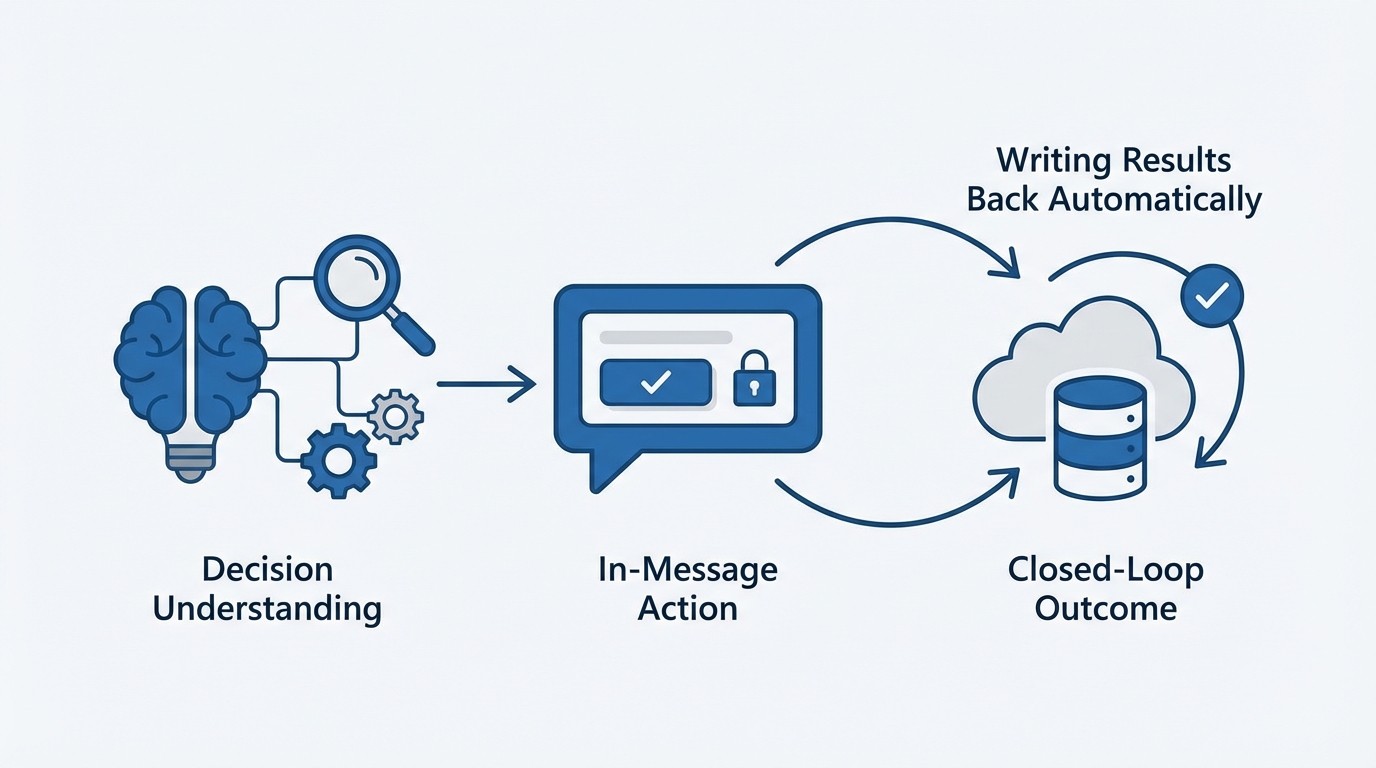
RadMedia starts by owning back-end adapters and error handling so outcomes post reliably. In-message self-service then lets customers complete tasks where they already are. The Autopilot engine enforces rules and handles exceptions so people focus on edge cases. Closed-loop writebacks update your systems of record with an audit trail you can trust.
Here is what changes in practice:
Managed back-end integration eliminates fragile handoffs, so outcomes post to core systems reliably
In-message self-service mini-apps let customers act in one flow, without portals or downloads
Autopilot workflow engine encodes policy and routes exceptions with full context
Closed-loop resolution and writeback capture evidence and reduce manual wrap-up
When earlier we tallied minutes lost to handoffs and reconciliation, those go away because the writeback is automatic and idempotent. Where trust and audit exposure felt risky, security and logging provide a defensible record for regulators and internal audit.
See how it works on your real workflows. Ready for customer communication workflows on autopilot? Get in touch.
Conclusion
Understanding Your Audience's Decision-Making Process means aligning your operation to completion, not conversation. Define what “done” looks like, remove the last-mile friction, and prove outcomes with reliable writebacks. Start with one high-volume workflow, measure completion, time-to-resolution, and deflection, then expand. The message should be where decisions happen, and your systems should always show the result.
If you want to compress cycle times and reduce unit cost without asking your team to build and maintain brittle integrations, that is exactly what RadMedia is built to do.