
Understanding the Role of Consultative Partnerships in Customer Service
Consultative partnerships enhance customer service by transforming advice into actionable outcomes, ensuring tasks are completed smoothly. By co-owning metrics and designing for completion, businesses can reduce handoffs and improve efficiency.
Understanding the Role of Consultative Partnerships in Customer Service starts with a simple idea: advice only matters when it changes how work gets done. The point of customer communication automation is resolution, not merely conversation. When partners help you design for completion, writebacks, and audit, customers finish tasks where they start and your systems show the truth. By writebacks, we mean reliably posting outcomes to systems of record with evidence you can audit.
Customers feel the difference. So do your teams. A consultative partner connects strategy to operating detail, from identity checks to policy rules to outcomes posted in systems of record. The result is fewer handoffs, fewer avoidable calls, and fewer manual reconciliations. You stop measuring chatter and start measuring completion.
Key Takeaways:
Treat consultative partners as operators, not advisors. Co-own outcomes and hold them to resolution metrics.
Frame every initiative around a closed loop: trigger, action inside the message, writeback with audit.
Quantify costs of old patterns: rework, avoidable calls, cycle time, integration debt, and compliance exposure.
Co-design policies and exceptions so agents handle edge cases. Routine work should complete without handoffs.
Build telemetry for completion rate, time to resolution, writeback success/latency, and agent deflection by outcome.
Start with one high-volume workflow to prove deflection, cost reduction, and data integrity fast.
Consultative Partnerships Drive Resolution in Customer Service
Consultative partnerships improve customer service when they turn guidance into operational change that customers can complete in one flow. The partner helps you design for identity, policy, and writebacks so outcomes appear in systems of record. Think card updates completed in-message that post instantly to balances.
From Advisory Talk to Operational Change
Consultative work often dies in slideware. The fix is simple but strict. Define what completion means for each case, then design every step backward from that moment. Identity verification, eligibility checks, and policy paths come first. Channel, timing, and copy choices serve those rules, not the other way around.
In practice, you want a partner who understands the cost of missed writebacks and who plans for them from day one. That means idempotent operations (safe to retry without double-posting), retries with backoff, circuit breaking, and clear error handling. Too many projects stall because the last mile is pushed to a later phase. Later rarely comes. Build it in now.
When the advisory model shifts to operational delivery, your numbers change. Cycle times compress. Avoidable calls drop. Internal trust rises because operators can audit the result. The pattern repeats across billing, collections, and compliance because the work is structured and policy-bound.
Resolution as the North Star Metric
Conversation metrics look busy but can mislead. Resolution metrics tell the truth. If the outcome does not show up in your systems, you are carrying operational debt. You pay for that debt in rework, escalations, and angry customers who acted reasonably but cannot see updated balances.
Measure what matters:
Completion rate per workflow, not per message
Time to resolution, not time to first response
Writeback success and latency, not just delivery and open rates
Deflection from agents by outcome type, not generic containment
The Real Role of Consultative Partners: From Advice to Measurable Resolution
The real role of a consultative partner is to co-own outcomes and design the closed loop that proves them. That means mapping triggers, eligibility, and actions to writebacks you can audit. Advice is useful only when it reduces rework, risk, and unit cost at scale.
Root Cause: Fragmented Stacks and No Writebacks
Most teams struggle because their stack treats messaging as outreach and portals as action. That split forces context switching at the moment of decision, a mistake that drives abandonment. Then comes the second failure: even when customers act, outcomes do not post reliably to systems of record. You are left with manual wrap-up.
A good partner confronts this head on. They start with integration and writebacks, not copy and channel. They design for consent, identity, and policy so only valid choices appear. When customers act, results post idempotently to the ledger of truth. You stop asking agents to rekey outcomes that already happened.
Consultative Means Owning the Last Mile
Owning the last mile is not a slogan. It is a set of behaviors. Partners document data contracts with back-end systems, define acceptable error handling, and commit to audit trails that stand up to regulators. They orchestrate channels to drive action, not noise. They accept that if it did not write back, it did not happen.
Expect clear deliverables:
A resolution blueprint that encodes policies and exceptions with explicit completion definitions
Data contracts for triggers and writebacks, including identity, consent, and idempotency guarantees
Channel orchestration plans tuned for completion, not send volume
Telemetry definitions for completion, latency, writeback reliability, and outcome-based deflection
The Cost of Skipping Consultative Partnership in Customer Service
Skipping a true consultative partner raises cost, risk, and customer frustration because you repeat the same broken patterns. You launch more channels without closing loops, then wonder why queues persist. Research on solution selling shows advice must reshape process to drive outcomes, not just messaging tone, as argued in Harvard Business Review.
Hidden Costs: Rework, Calls, and Compliance Risk
Every missed writeback creates rework. Agents chase customers who already acted. Customers call because balances look wrong. Supervisors approve exceptions that policy already allowed, just not in the channel where the decision happened. You burn hours on follow up that should not exist.
Compliance risk shows up next. Without strong identity and audit trails, you cannot defend what was sent, what was done, and how it was recorded. Auditors do not care about your intent. They care about evidence. If your systems do not agree, you face findings, fines, or both. Teams then scramble to recreate proof they should have captured automatically.
Integration Debt and Missed Opportunities
Integration gets deferred because it feels slow. That is the trap. When you defer it, you pay twice. First in engineering time as bespoke adapters multiply. Then in business value as campaigns stall at the last mile. A 2022 review of contact center performance highlights that end-to-end design, not isolated touchpoints, predicts outcomes and cost.
Common failure modes:
Messaging that points to portals customers will not use
Identity checks that fail on mobile, then push to agents
Policies encoded in slide decks, not systems
Outcomes captured in notes, not posted to systems of record
What It Feels Like Without a Consultative Partner
Operating without a consultative partner feels like running with ankle weights. Your team ships campaigns that create inquiries, not completions. Customers try to act and hit roadblocks. The queue grows. Leaders ask for more channels, more bots, more staff, and still the core problems remain.
Late-Night Fixes and Team Fatigue
You know the pattern. A campaign launches on Monday, complaints spike by Wednesday, and by Friday your team is rewriting flows after hours. The root cause rarely lives in copy. It lives in eligibility rules, identity checks, and writebacks that were never designed for the real world. Morale slides when good people spend nights patching edge cases.
The fix is not heroics. It is structure. Put identity, policy, and writebacks first. Then let channel and copy follow. When the foundation is right, volume does not break you. When it is wrong, every spike becomes a fire drill.
Customer Trust on the Line
Customers who act reasonably expect to see outcomes reflected quickly. When they do not, they call. That creates a double cost: rework and avoidable support calls. Trust is slow to earn and fast to lose. Design to keep it. Confirm identity, present only valid choices, and post outcomes immediately.
Signals you are losing trust:
Repeated calls after action taken
Chargebacks or disputes rising on routine cases
Complaints about portal logins or app downloads
Agents rekeying outcomes that should be automatic
Understanding the Role of Consultative Partnerships in Customer Service, Applied
A consultative partnership works when you co-design for closed-loop resolution. Start with the outcome, define the rules, and build the flow customers can finish in one move. Then prove it with writebacks and telemetry that your operators and auditors can trust.
Co-Design the Outcome Blueprint
Map triggers, identity steps, policy paths, and valid actions before you write a single message. Agree on what completion means for each workflow. In collections, that might be pay now, promise to pay, or submit a dispute. In compliance, that might be document upload or attestation signed. Keep options policy-eligible and context-aware.
Then specify the data contract for both sides of the loop: what fields personalize outreach, what inputs the mini-app collects, and what writebacks update balances, flags, notes, and documents. Without this, you risk generic experiences that confuse customers and create manual work. With it, you build a path customers can complete.
Build for Closed-Loop Resolution
With outcomes and data defined, design the experience customers use inside the message. Validate identity with one-time codes or known facts. Present only valid choices. Capture consent and inputs with timestamps. Post outcomes to systems of record with idempotent guarantees so retries do not double-apply a result.
To operationalize this approach:
Define completion and exceptions by workflow
Document trigger payloads and writeback schemas
Design channel sequences to drive action, not awareness
Instrument telemetry for completion, latency, and deflection
How RadMedia Operationalizes Consultative Partnerships in Customer Service
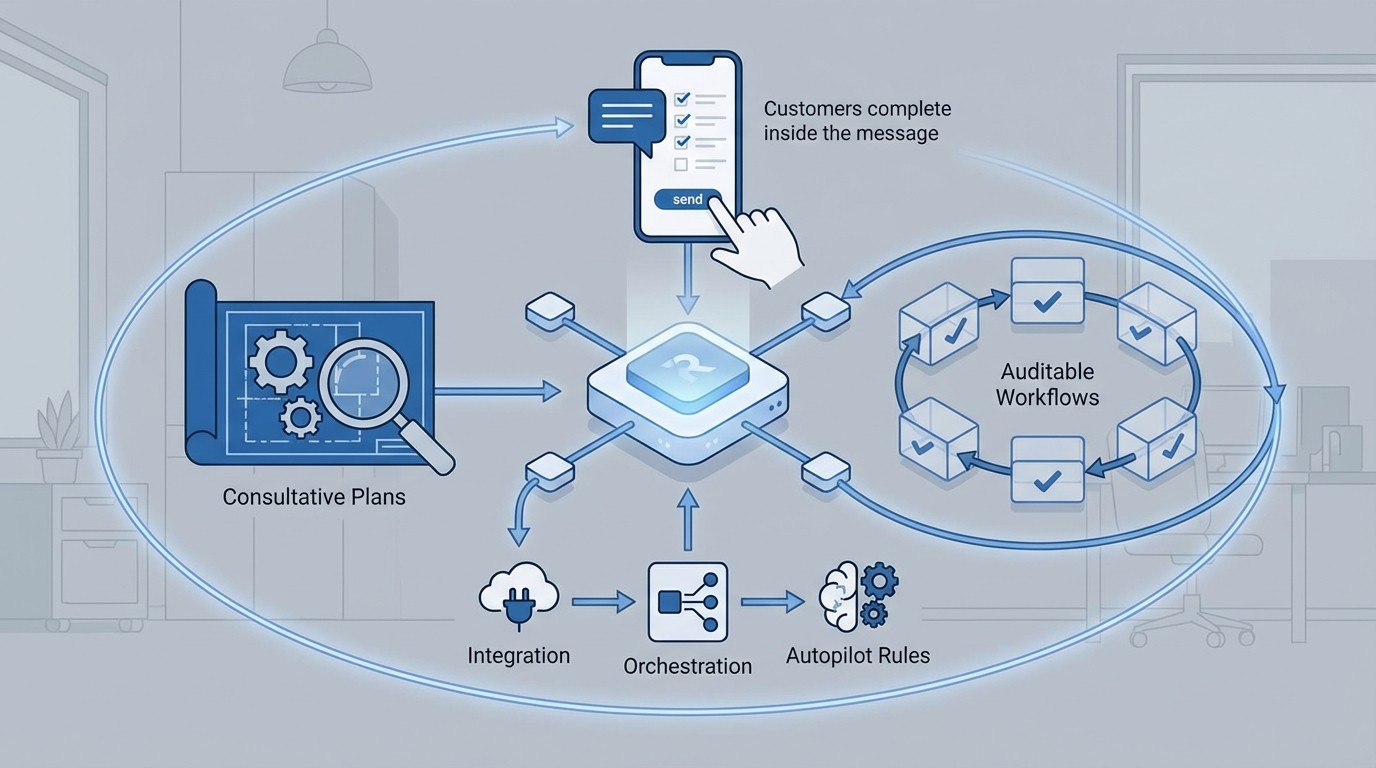
RadMedia turns consultative plans into working, auditable workflows that customers complete inside the message. The platform manages integration, orchestrates channels, runs rules on autopilot, and writes outcomes back to your systems. You measure resolution, time to completion, writeback success, and deflection, not just sends.
Managed Integration and Autopilot Orchestration
RadMedia handles the heavy lifting most teams avoid. Managed Back-End Integration connects legacy cores and modern APIs, owns authentication and schema mapping, and posts results idempotently. The Autopilot Workflow Engine models eligibility, arrangement policies, and compliance checks, then advances each case from trigger to completion with time-based logic and exception routing.
When a business rule blocks completion, the engine escalates with full context so agents start at understanding, not discovery. That reduces rework and shortens cycle times. The practical benefit is simple: you stop paying for manual wrap-up on routine, policy-bound work and focus people on true edge cases.
Ready for customer communication workflows on autopilot? Let’s chat.
In-Message Self-Service and Guaranteed Writebacks
In-Message Self-Service Mini-Apps let customers update cards, authorize payments, choose compliant plans, confirm details, upload documents, or sign attestations without portals or downloads. Identity is validated with one-time codes, known facts, or signed deep links. Actions are limited to policy-eligible paths, which prevents wrong choices and failed outcomes.
Closed-Loop Resolution and Writeback ensures results appear where they matter most: in your systems of record. Balances update, arrangements post, flags clear, and notes or documents attach automatically. Idempotent writebacks with retries and circuit breakers protect consistency and downstream stability. Late-night reconciliations and repeat calls fade because the system finishes the task and proves it.
Security, Telemetry, and Proof You Can Audit
RadMedia is built for regulated financial services. Security, Identity, and Audit Controls include TLS in transit, encryption at rest, role-based access, and optional SSO. Messages use signed deep links and one-time codes before exposing actions. Every consent, input, and writeback is timestamped and logged for defensible audit trails.
Telemetry, Reliability, and Data Export make resolution measurable. Every step emits events, from deliveries and opens to validations, writebacks, and completions. You can track completion rate, time to resolution, and deflection, then export outcomes and logs to your data lake or SIEM. That evidence closes the loop on cost, quality, and compliance. Before you wrap up planning, decide what proof you need to show progress and risk control, then make sure the platform emits it by default.
To see it in action, get in touch with us.
Conclusion
Consultative partnerships matter when they change operations, not when they generate decks. Start with outcomes, identity, and policy. Design the path customers can finish in one move. Post results to systems of record and capture evidence. When you do that, queues shrink, costs drop, and trust grows because your numbers reflect reality.