
Top 6 Exception‑Handling Patterns That Reduce Agent Escalations by 80%
Implementing exception-handling patterns can reduce agent escalations by 80% by classifying failures and automating resolutions. This approach allows teams to focus on true issues while improving efficiency through clear rules and automatic outcome tracking.
Complex operations need clear patterns, not more tickets. Exception handling patterns turn unpredictable incidents into predictable outcomes by classifying failures, applying rules, and reserving humans for true breakages. We’ll walk you through why patterns matter, how to spot the hidden costs of ignoring them, and the six patterns that deflect noise and speed resolution.
We’ll discuss the specific ways these patterns change daily work for leaders and agents, then show how RadMedia operationalizes them in financial services. The through line is simple: measure resolution, not conversation volume, and close the loop inside the message so outcomes write back automatically with full audit trails.
Key Takeaways:
Classify exceptions into transient, policyable, and true breakages to prevent noisy escalations
Encode rules and eligibility so the system resolves routine cases without agents
Redefine success as completion in-message, writeback success, and time to resolution
Build phase-aware handling: validate early, retry safely, compensate when needed
Use staged retries with backoff and circuit breakers to avoid cascades
Escalate only with full context so agents start at resolution, not discovery
Close the loop by writing outcomes back to systems of record automatically
Why Exception Handling Patterns, Not People, Should Resolve Most Failures
Most failures should resolve through patterns that the system executes, not through agents opening tickets. Start by classifying exceptions and routing them by type, then measure resolution inside the message and automatic writeback to systems. This approach reduces queue noise and preserves agent time for issues that truly need judgment.
Classify Failures Before You Route Work
Treating every hiccup as an agent task is a costly mistake. Transient issues, like timeouts or short-lived dependency errors, usually clear with disciplined retries. Policyable cases, such as eligibility or consent checks, resolve with rules. Only true breakages, like schema changes or missing data contracts, require people.
In practice, this means building a first gate that tags exceptions by nature and severity. Your engine should inspect error surfaces, check policy, and decide whether to retry, fall back, or escalate. That first gate prevents routine noise from landing in a queue where it will waste time and bury real problems.
Leaders often ask where to start. Begin with high-volume use cases like payment updates or plan setup. Catalog common failure modes and map them to handling logic. Simple classification cuts unit cost because fewer incidents become tickets and more resolve automatically.
Flip Escalation From Default to Last Resort
Escalation should be rare. When your system encodes business rules and remediation paths, the majority of exceptions can complete without people. The trade is clear: invest in policy and automation upfront to avoid the ongoing cost of repetitive escalations.
Encode eligibility, consent capture, and remediation steps so the engine can make deterministic decisions. For example, if a payment attempt fails due to an expired card, present a secure in-message update flow and retry payment after capture. No agent needed, no queue created.
For teams evaluating approaches, it helps to see concrete patterns others use. Overviews of exception handling in agent systems, like this framework, show how classification and policy-driven flows reduce noise and improve reliability.
Measure Resolution, Not Conversation Volume
Conversation metrics can hide failure. Success is completion inside the message, time-to-resolution, and writeback success to systems of record. When exceptions resolve where they occur and outcomes sync automatically, you deflect routine tickets and free agents to handle complex work.
Focus on measures that reflect outcomes, not activity. Completion rate shows whether customers finish the task. Time-to-resolution shows speed from trigger to close. Writeback success confirms the loop is closed. These metrics align with cost, risk, and customer trust.
Shifting to resolution-first metrics also improves prioritization. Queues get shorter because routine cases never arrive. Agents see fewer, clearer escalations with context. Leaders gain a true view of operational health instead of a count of conversations that went nowhere.
The Real Bottleneck is Missing Exception Handling Patterns
Exception noise usually signals missing rules, not poor agent performance. The root cause is unmodeled policy and absent handling logic that forces customers into portals and agents into manual wrap-up. Build cross-channel rules and phase-aware handling so the system resolves predictable exceptions and humans handle only true breakages.

Noise Points to Unmodeled Policy
Escalation spikes often come from eligibility gaps, unclear severity tiers, or missing compensations. The system doesn’t know what a senior agent already knows, so it forwards everything. That is why queues swell and handle times stretch during incidents.
Map your top exception scenarios and document how your best agents resolve them. Convert that playbook into rules: eligibility checks, remediation paths, and safe fallbacks. When policy lives in the engine, exceptions shrink and outcomes standardize across channels and shifts.
This change reduces risk as well. Standardized handling means consistent consent capture, reliable document storage, and clear audit trails. You cut manual steps that often lead to error, rework, and compliance exposure.
Rules Beat Channels When Volume Spikes
Adding channels without clear rules multiplies queues. Messages get distributed faster, but resolution still stalls at the last mile. Rules deliver outcomes. Channels only deliver messages.
Build exception handling that works across SMS, email, and WhatsApp, then let the engine decide when to retry, route, or escalate. The key is to keep customers in the message and complete the task there. When outcomes write back automatically, you avoid reconciliation work and reduce unit cost.
If you are comparing design approaches, research on agentic patterns for production systems, such as this practitioner guide, can help you structure cross-channel rules that scale.
Build Phase-Aware Handling Across the Lifecycle
Design handling where failure occurs. Validate inputs and policies before work starts so you don’t spin up tasks that can’t complete. During execution, apply retries and circuit breaking to prevent cascades. After partial success, run compensations to restore consistency.
A phase-aware design reduces hidden costs. You avoid wasted cycles on doomed tasks during planning, prevent overload during execution, and clear backlog with compensations after a blip. Customers see consistent behavior during incidents, which protects trust and conversion.
For deeper background on phase-aware recovery, explore research like this overview, then translate the principles into your operational rules and telemetry.
The Cost of Ignoring Exception Handling Patterns
Ignoring structured handling creates avoidable cost, risk, and customer frustration. Escalation noise buries real issues, cascades reduce trust and conversion, and manual reconciliation invites audit exposure. Quantifying these costs makes the change urgent and sets a baseline for measuring improvement.
Escalation Noise Drives Up Unit Cost
When every transient error creates a ticket, agents spend time on predictable, low-value work. Manual wrap-up, rekeying, and toggling between systems expand handle times and increase variance. Noise also distracts from the few cases that truly need expertise.
A better pattern routes transients to safe retries and policyable cases to rules. Agents then work fewer tickets with more context, which reduces average handling time and error rates. Cost drops because you remove repetition at its source.
If you need a structure for analyzing deflection and escalation trends, the Microsoft guidance on deflection and escalation analysis offers a helpful starting point.
Failure Cascades Break Trust and Conversion
Poor handling creates misroutes, long queues, and abandonment. One retail bank saw abandonment jump from under 10 percent to over 50 percent after scaling a campaign without guardrails. Customers wanted to resolve accounts but were lost to delays and friction.
Cascades also hide the real incident. When downstream services degrade, undisciplined retries and unstructured escalations create storms of tickets. The result is slower recovery, more rework, and lost revenue opportunities during the window that matters most.
The fix is disciplined retries, circuit breakers, and clear fallback paths. Customers should complete the task inside the message and see consistent behavior, even during partial outages.
Manual Reconciliation Creates Compliance Risk
When writebacks and compensations are manual, evidence trails fragment. Consent capture becomes inconsistent, documents go missing, and audit logs scatter across tools. Small outages then produce large reconciliation backlogs that linger for weeks.
Automated writebacks, idempotency, and compensations prevent these failures. Every action records timestamps, consent, and outcomes. Cases close with complete evidence, which reduces risk and avoids expensive after-the-fact clean up.
The downstream effect is real. You protect customers and reduce time spent on non-value work, while giving auditors what they need without a scramble.
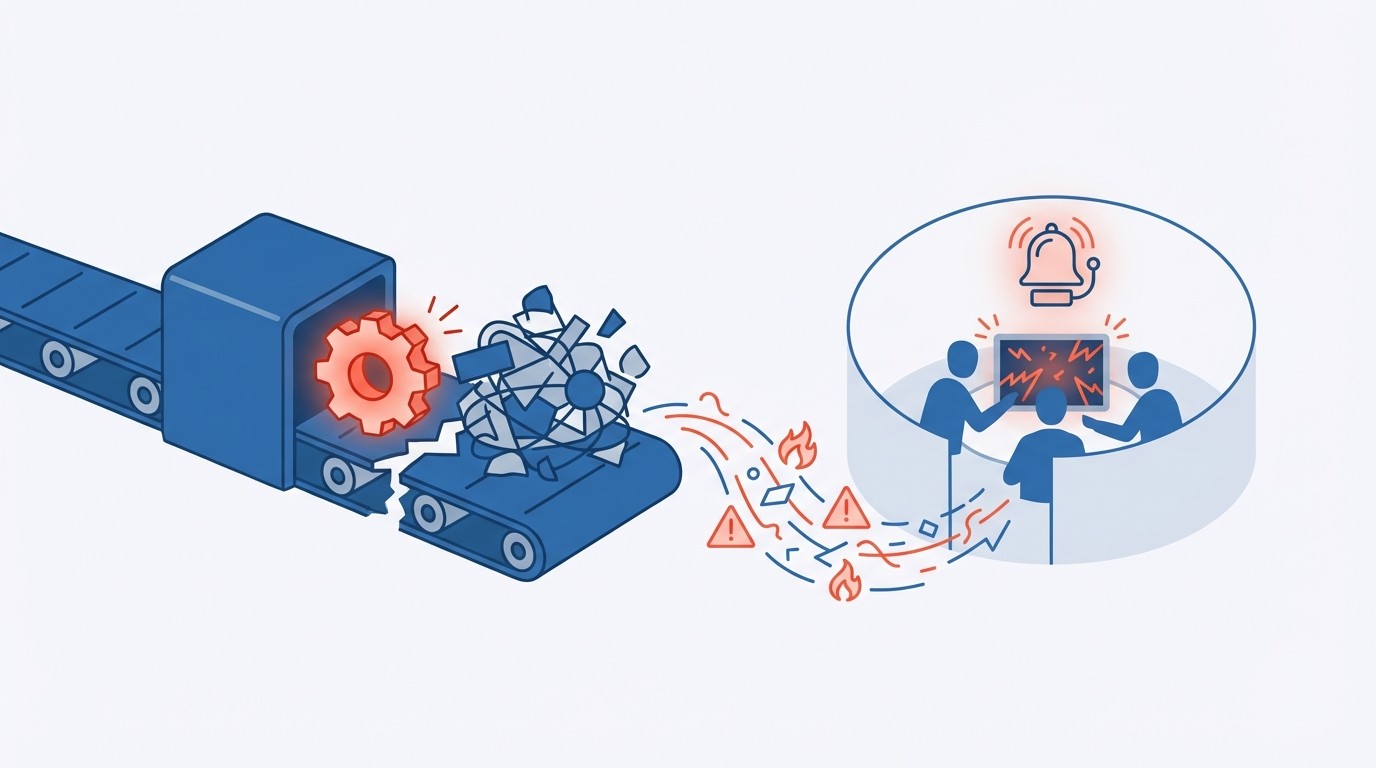
How Broken Exception Handling Patterns Create Fire Drills
Broken patterns turn daily operations into triage. Leaders see SLAs slip and standups turn into war rooms. Agents start at discovery instead of resolution. Adding people under stress usually makes the problem worse because tacit knowledge doesn’t transfer fast enough.
What Leaders See During Exception Floods
When exceptions flood the queue, high-severity lanes fill with routine issues. The few incidents that need urgent attention wait behind noise. Standups become fire drills as priorities shift hourly. Predictability disappears.
Leaders don’t lack effort or care. They lack structured rules that prevent bad tickets and standardized payloads that help agents resolve fast. Investing in rules is the fastest way to reclaim attention and restore throughput. It also makes performance more resilient during spikes.
This isn’t only about workload. It’s also about risk. Prolonged floods raise the chance of missed deadlines, compliance gaps, and customer churn. The cost compounds until teams rebuild the handling layer.
What Agents Experience Without Context
Agents receive vague tickets and chase history across tools. Without the message timeline, inputs, validation results, or attempted writebacks, they start cold. Every missing detail adds minutes. Minutes add up to hours across a book of business.
Provide agents with full context. That includes error surfaces, retry counts and timing, eligibility results, and pre-approved remediation steps. When they start at context, not discovery, resolution takes minutes, not hours. Morale improves because work feels solvable.
This shift also reduces variance. When suggested remediations are built into the payload, outcomes standardize across shifts and teams. Customers get predictable experiences and fewer callbacks.
Why More Headcount Masks the Real Problem
“Just add people” can stabilize a backlog for a week, then it fails under stress. New agents lack tacit knowledge, which creates inconsistent outcomes and more rework. You end up paying for noise rather than removing its source.
The fix is better patterns. Build the rules that stop repeat tickets, capture context automatically, and define compensations. Then staff for true breakages that need human judgment. You protect cost, quality, and customer trust at the same time.
Industry research on human factors and operational complexity highlights how cognitive load and system design affect performance. If you are exploring this, this [literature review] offers broad context you can translate into practical safeguards.
Six Exception Handling Patterns That Reduce Escalations by 80 Percent
Six patterns resolve most exceptions without agents when applied together. Validate early, retry safely, prevent cascades, and fix partial success with compensations. Then, if you must escalate, send full context so humans can resolve quickly and prevent repeats.
Eligibility Gating and Preflight Validation
Run policy and data checks before work starts. Validate identity, consent, account state, and plan eligibility upfront to avoid spinning up tasks that can’t complete. Preflight validation also catches missing fields, expired tokens, and blocked scenarios early, which saves time and protects customer trust.
When validation fails, present compliant alternatives rather than forwarding dead-ends to agents. For example, if a customer isn’t eligible for a certain plan, offer eligible options with clear terms inside the message. That approach resolves the request without a queue forming.
This early gate also creates cleaner telemetry. You’ll know which checks fail most often and can refine copy, data flows, or policy over time. That prevents repeat tickets and improves conversion.
To implement these six patterns end to end:
Define validation rules and data contracts before work starts.
Classify exceptions by type and severity, then route by policy.
Implement retries with backoff and caps for transient errors.
Add circuit breaking to prevent cascades when dependencies degrade.
Design compensations for partial success to restore consistency.
Package full context for escalations so agents can resolve fast.
Staged Retries With Backoff and Circuit Breaking
Treat transient failures with disciplined retries that escalate interval and cap attempts. Backoff prevents hot loops that hammer a struggling service. Caps ensure you don’t create a backlog that overwhelms recovery. Pair retries with circuit breakers to shed load and protect the customer experience.
When dependency health degrades, fall back gracefully. Queue work safely, inform the customer of the updated path, and avoid promises you can’t keep during an incident. Only escalate after quantified exhaustion, and include telemetry about error surfaces and timing.
These practices are well established in reliable systems. Use them here to protect both cost and trust. If you need to align with teams new to this, pointing to standard retry and circuit breaker references can help reach agreement on thresholds and behavior.
Compensating Transactions and Agent Contextualization
When partial success occurs, run compensations to restore state. If a payment posts but a downstream flag doesn’t clear, execute a compensating update and attach evidence. This restores consistency and prevents reconciliation backlogs that drain hours.
If escalation is required, send everything an expert would ask for. That includes the message timeline, inputs, validation results, attempted writebacks, error traces, and pre-approved remediation steps. Confidence and severity signals help agents prioritize. This shortens handle time and prevents repeat escalations.
For background, compensating transactions are a proven pattern for distributed consistency, as outlined in this [foundational work]. Adapting the idea to operations removes a common source of waste and risk.
How RadMedia Operationalizes Exception Handling Patterns for Deflection and Speed
RadMedia makes these patterns real for financial services by encoding policy, executing retries with safeguards, and closing the loop in-message. Customers act inside a secure mini-app, and outcomes write back to systems of record automatically. The result is fewer escalations, faster resolution, and reliable audit trails.
Policy and Eligibility Engine With In-Message Completion
RadMedia encodes business rules and eligibility, then presents only compliant actions inside secure mini-apps. Customers update cards, select plans, or submit documents in the message. The moment they act, outcomes write back to core systems so balances update, flags clear, and evidence stores.
This removes dead-end escalations and prevents abandonment spikes that happen when portals or call routing fail. It also standardizes outcomes because policy lives in the engine. In short, routine cases complete without agents, and exceptions escalate only when necessary.
If your team wants a reference for structuring deflection and escalation, this Microsoft guide on deflection and escalation design aligns with the approach RadMedia implements.
Autopilot Retries, Idempotent Writebacks, and Safe Fallbacks
RadMedia applies staged retries with backoff and caps, then uses circuit breaking to prevent cascades when downstream systems degrade. Idempotency keys and retry policies ensure writebacks are safe and consistent even during intermittent failures. When partial success occurs, compensations run to restore state and attach evidence.
This replaces manual reconciliation that used to consume agent hours. It also reduces unit cost by eliminating rework and removing the risk of duplicate updates. Telemetry at every step gives operations clear insight into where failures occur and how they recover.
By handling the integration work, RadMedia removes a major source of delay. Teams don’t burn quarters wiring systems, then watching exceptions pile up while they wait for fixes.
Context-Packed Escalations That Resolve in Minutes
If escalation is necessary, RadMedia sends full context to agents: message history, inputs collected, validation results, attempted writebacks, error traces, and pre-approved remediation steps. Confidence and severity signals help prioritize. Agents start at context, not discovery.
This directly counters the costs outlined earlier. Handle times drop because the first five minutes aren’t spent reconstructing history. Repeat escalations fade because suggested remediations standardize outcomes. SLAs stabilize because noise no longer buries the real issues.
RadMedia’s approach keeps people focused on the work only people can do. The system handles the rest with consistency, auditability, and speed.
Conclusion
Exception handling patterns are the lever that turns chaos into predictable resolution. Classify failures, encode rules, validate early, retry safely, and compensate when needed. Then escalate with context only when human judgment is required. When outcomes complete inside the message and write back automatically, you reduce cost, protect trust, and keep teams focused on real problems.
Discover 6 proven exception handling patterns that reduce agent escalations by 80%. Enhance efficiency and resolution speed in your operations today.
Top 6 Exception‑Handling Patterns That Reduce Agent Escalations by 80% - RadMedia professional guide illustration
[{"q":"How do I implement exception handling patterns with RadMedia?","a":"To implement exception handling patterns using RadMedia, start by classifying exceptions into types like transient and policyable. Next, model your business rules and eligibility criteria within RadMedia's Autopilot Workflow Engine. This allows the system to resolve routine cases automatically without agent intervention. Finally, ensure that your workflows are designed to close the loop by writing outcomes back to your systems of record, which helps maintain a seamless customer experience and reduces escalations."},{"q":"What if my customers need to update payment details?","a":"If customers need to update payment details, you can use RadMedia's in-message self-service apps. These secure, no-download mini-apps allow customers to update their information directly within the message they receive, without needing to log into a separate portal. This process not only simplifies the experience for your customers but also ensures that the updates write back to your core systems automatically, keeping everything synchronized and reducing the need for agent involvement."},{"q":"Can I track the resolution time of customer issues?","a":"Yes, you can track resolution times with RadMedia by measuring key metrics like completion rate and time-to-resolution. RadMedia's system captures these metrics automatically as customers interact with the in-message self-service apps. By focusing on these metrics instead of just conversation volume, you can gain insights into how effectively issues are being resolved and identify areas for improvement in your workflows."},{"q":"When should I escalate issues to an agent?","a":"You should escalate issues to an agent when exceptions occur that the system cannot resolve automatically. RadMedia is designed to handle routine cases independently, but if a situation arises that requires human judgment—such as complex disputes or policy exceptions—the workflow will escalate to an agent with full context. This means the agent will have all the necessary information to start at resolution rather than discovery, making the process more efficient."},{"q":"Why does my team need to focus on resolution instead of conversations?","a":"Focusing on resolution rather than conversation volume is crucial because it directly impacts operational efficiency and customer satisfaction. With RadMedia, you can automate routine tasks, allowing your team to concentrate on complex issues that require human intervention. This shift reduces the workload on agents, minimizes operational costs, and enhances the overall customer experience by ensuring that issues are resolved quickly and effectively."}]
17 Feb 2026
8f4d8d4b-1ee4-4380-adbb-ef0d8f642f33
{"@graph":[{"@id":"https://radmedia.co.za/top-6-exception-handling-patterns-that-reduce-agent-escalations-by-80#article","@type":"Article","image":"https://jdbrszggncetflrhtwcd.supabase.co/storage/v1/object/public/article-images/6dca98ae-107d-47b7-832f-ee543e4b5364/top-6-exception-handling-patterns-that-reduce-agent-escalations-by-80-hero-1771333168837.png","author":{"name":"RadMedia","@type":"Organization"},"headline":"Top 6 Exception‑Handling Patterns That Reduce Agent Escalations by 80%","keywords":"exception handling patterns","publisher":{"name":"RadMedia","@type":"Organization"},"wordCount":2692,"description":"Top 6 Exception‑Handling Patterns That Reduce Agent Escalations by 80%","dateModified":"2026-02-17T12:59:05.261+00:00","datePublished":"2026-02-17T12:55:41.512535+00:00","mainEntityOfPage":{"@id":"https://radmedia.co.za/top-6-exception-handling-patterns-that-reduce-agent-escalations-by-80","@type":"WebPage"}},{"@id":"https://radmedia.co.za/top-6-exception-handling-patterns-that-reduce-agent-escalations-by-80#itemlist","name":"Top 6 Exception‑Handling Patterns That Reduce Agent Escalations by 80%","@type":"ItemList","itemListElement":[{"name":"Why Exception Handling Patterns, Not People, Should Resolve Most Failures","@type":"ListItem","position":1},{"name":"The Real Bottleneck is Missing Exception Handling Patterns","@type":"ListItem","position":2},{"name":"The Cost of Ignoring Exception Handling Patterns","@type":"ListItem","position":3},{"name":"How Broken Exception Handling Patterns Create Fire Drills","@type":"ListItem","position":4},{"name":"Six Exception Handling Patterns That Reduce Escalations by 80 Percent","@type":"ListItem","position":5},{"name":"Define validation rules and data contracts before work starts.","@type":"ListItem","position":6},{"name":"[Classify exceptions](https://arxiv.org/html/2508.07935v1?utm_source=oleno&utm_medium=internal-link&utm_campaign=top-6-exception-handling-patterns-that-reduce-agent-escalations-by-80) by type and seve","@type":"ListItem","position":7},{"name":"Implement retries with backoff and caps for transient errors.","@type":"ListItem","position":8},{"name":"Add circuit breaking to prevent cascades when dependencies degrade.","@type":"ListItem","position":9},{"name":"Design compensations for partial success to restore consistency.","@type":"ListItem","position":10},{"name":"Package full context for escalations so agents can resolve fast.","@type":"ListItem","position":11},{"name":"How RadMedia Operationalizes Exception Handling Patterns for Deflection and Speed","@type":"ListItem","position":12}]},{"@id":"https://radmedia.co.za/top-6-exception-handling-patterns-that-reduce-agent-escalations-by-80#breadcrumb","@type":"BreadcrumbList","itemListElement":[{"item":"https://radmedia.co.za","name":"Home","@type":"ListItem","position":1},{"item":"https://radmedia.co.za/top-6-exception-handling-patterns-that-reduce-agent-escalations-by-80","name":"Top 6 Exception‑Handling Patterns That Reduce Agent Escalati","@type":"ListItem","position":2}]}],"@context":"https://schema.org"}
[{"url":"https://jdbrszggncetflrhtwcd.supabase.co/storage/v1/object/public/article-images/6dca98ae-107d-47b7-832f-ee543e4b5364/top-6-exception-handling-patterns-that-reduce-agent-escalations-by-80-inline-0-1771333190011.png","alt":"How Broken Exception Handling Patterns Create Fire Drills concept illustration - RadMedia","filename":"top-6-exception-handling-patterns-that-reduce-agent-escalations-by-80-inline-0-1771333190011.png","position":"after_h2_1","asset_id":null,"type":"ai_generated","dimensions":{"width":1024,"height":1024}},{"url":"https://jdbrszggncetflrhtwcd.supabase.co/storage/v1/object/public/article-images/6dca98ae-107d-47b7-832f-ee543e4b5364/top-6-exception-handling-patterns-that-reduce-agent-escalations-by-80-inline-1-1771333207997.png","alt":"How RadMedia Operationalizes Exception Handling Patterns for Deflection and Speed concept illustration - RadMedia","filename":"top-6-exception-handling-patterns-that-reduce-agent-escalations-by-80-inline-1-1771333207997.png","position":"after_h2_2","asset_id":null,"type":"ai_generated","dimensions":{"width":1024,"height":1024}}]
87
2692
Complex operations need clear patterns, not more tickets. Exception handling patterns turn unpredictable incidents into predictable outcomes by classifying failures, applying rules, and reserving humans for true breakages. We’ll walk you through why patterns matter, how to spot the hidden costs of ignoring them, and the six patterns that deflect noise and speed resolution.
We’ll discuss the specific ways these patterns change daily work for leaders and agents, then show how RadMedia operationalizes them in financial services. The through line is simple: measure resolution, not conversation volume, and close the loop inside the message so outcomes write back automatically with full audit trails.
Key Takeaways:
Classify exceptions into transient, policyable, and true breakages to prevent noisy escalations
Encode rules and eligibility so the system resolves routine cases without agents
Redefine success as completion in-message, writeback success, and time to resolution
Build phase-aware handling: validate early, retry safely, compensate when needed
Use staged retries with backoff and circuit breakers to avoid cascades
Escalate only with full context so agents start at resolution, not discovery
Close the loop by writing outcomes back to systems of record automatically
Why Exception Handling Patterns, Not People, Should Resolve Most Failures
Most failures should resolve through patterns that the system executes, not through agents opening tickets. Start by classifying exceptions and routing them by type, then measure resolution inside the message and automatic writeback to systems. This approach reduces queue noise and preserves agent time for issues that truly need judgment.

Classify Failures Before You Route Work
Treating every hiccup as an agent task is a costly mistake. Transient issues, like timeouts or short-lived dependency errors, usually clear with disciplined retries. Policyable cases, such as eligibility or consent checks, resolve with rules. Only true breakages, like schema changes or missing data contracts, require people.
In practice, this means building a first gate that tags exceptions by nature and severity. Your engine should inspect error surfaces, check policy, and decide whether to retry, fall back, or escalate. That first gate prevents routine noise from landing in a queue where it will waste time and bury real problems.
Leaders often ask where to start. Begin with high-volume use cases like payment updates or plan setup. Catalog common failure modes and map them to handling logic. Simple classification cuts unit cost because fewer incidents become tickets and more resolve automatically.
Flip Escalation From Default to Last Resort
Escalation should be rare. When your system encodes business rules and remediation paths, the majority of exceptions can complete without people. The trade is clear: invest in policy and automation upfront to avoid the ongoing cost of repetitive escalations.
Encode eligibility, consent capture, and remediation steps so the engine can make deterministic decisions. For example, if a payment attempt fails due to an expired card, present a secure in-message update flow and retry payment after capture. No agent needed, no queue created.
For teams evaluating approaches, it helps to see concrete patterns others use. Overviews of exception handling in agent systems, like this framework, show how classification and policy-driven flows reduce noise and improve reliability.
Measure Resolution, Not Conversation Volume
Conversation metrics can hide failure. Success is completion inside the message, time-to-resolution, and writeback success to systems of record. When exceptions resolve where they occur and outcomes sync automatically, you deflect routine tickets and free agents to handle complex work.
Focus on measures that reflect outcomes, not activity. Completion rate shows whether customers finish the task. Time-to-resolution shows speed from trigger to close. Writeback success confirms the loop is closed. These metrics align with cost, risk, and customer trust.
Shifting to resolution-first metrics also improves prioritization. Queues get shorter because routine cases never arrive. Agents see fewer, clearer escalations with context. Leaders gain a true view of operational health instead of a count of conversations that went nowhere.
The Real Bottleneck is Missing Exception Handling Patterns
Exception noise usually signals missing rules, not poor agent performance. The root cause is unmodeled policy and absent handling logic that forces customers into portals and agents into manual wrap-up. Build cross-channel rules and phase-aware handling so the system resolves predictable exceptions and humans handle only true breakages.

Noise Points to Unmodeled Policy
Escalation spikes often come from eligibility gaps, unclear severity tiers, or missing compensations. The system doesn’t know what a senior agent already knows, so it forwards everything. That is why queues swell and handle times stretch during incidents.
Map your top exception scenarios and document how your best agents resolve them. Convert that playbook into rules: eligibility checks, remediation paths, and safe fallbacks. When policy lives in the engine, exceptions shrink and outcomes standardize across channels and shifts.
This change reduces risk as well. Standardized handling means consistent consent capture, reliable document storage, and clear audit trails. You cut manual steps that often lead to error, rework, and compliance exposure.
Rules Beat Channels When Volume Spikes
Adding channels without clear rules multiplies queues. Messages get distributed faster, but resolution still stalls at the last mile. Rules deliver outcomes. Channels only deliver messages.
Build exception handling that works across SMS, email, and WhatsApp, then let the engine decide when to retry, route, or escalate. The key is to keep customers in the message and complete the task there. When outcomes write back automatically, you avoid reconciliation work and reduce unit cost.
If you are comparing design approaches, research on agentic patterns for production systems, such as this practitioner guide, can help you structure cross-channel rules that scale.
Build Phase-Aware Handling Across the Lifecycle
Design handling where failure occurs. Validate inputs and policies before work starts so you don’t spin up tasks that can’t complete. During execution, apply retries and circuit breaking to prevent cascades. After partial success, run compensations to restore consistency.
A phase-aware design reduces hidden costs. You avoid wasted cycles on doomed tasks during planning, prevent overload during execution, and clear backlog with compensations after a blip. Customers see consistent behavior during incidents, which protects trust and conversion.
For deeper background on phase-aware recovery, explore research like this overview, then translate the principles into your operational rules and telemetry.
The Cost of Ignoring Exception Handling Patterns
Ignoring structured handling creates avoidable cost, risk, and customer frustration. Escalation noise buries real issues, cascades reduce trust and conversion, and manual reconciliation invites audit exposure. Quantifying these costs makes the change urgent and sets a baseline for measuring improvement.
Escalation Noise Drives Up Unit Cost
When every transient error creates a ticket, agents spend time on predictable, low-value work. Manual wrap-up, rekeying, and toggling between systems expand handle times and increase variance. Noise also distracts from the few cases that truly need expertise.
A better pattern routes transients to safe retries and policyable cases to rules. Agents then work fewer tickets with more context, which reduces average handling time and error rates. Cost drops because you remove repetition at its source.
If you need a structure for analyzing deflection and escalation trends, the Microsoft guidance on deflection and escalation analysis offers a helpful starting point.
Failure Cascades Break Trust and Conversion
Poor handling creates misroutes, long queues, and abandonment. One retail bank saw abandonment jump from under 10 percent to over 50 percent after scaling a campaign without guardrails. Customers wanted to resolve accounts but were lost to delays and friction.
Cascades also hide the real incident. When downstream services degrade, undisciplined retries and unstructured escalations create storms of tickets. The result is slower recovery, more rework, and lost revenue opportunities during the window that matters most.
The fix is disciplined retries, circuit breakers, and clear fallback paths. Customers should complete the task inside the message and see consistent behavior, even during partial outages.
Manual Reconciliation Creates Compliance Risk
When writebacks and compensations are manual, evidence trails fragment. Consent capture becomes inconsistent, documents go missing, and audit logs scatter across tools. Small outages then produce large reconciliation backlogs that linger for weeks.
Automated writebacks, idempotency, and compensations prevent these failures. Every action records timestamps, consent, and outcomes. Cases close with complete evidence, which reduces risk and avoids expensive after-the-fact clean up.
The downstream effect is real. You protect customers and reduce time spent on non-value work, while giving auditors what they need without a scramble.
How Broken Exception Handling Patterns Create Fire Drills
Broken patterns turn daily operations into triage. Leaders see SLAs slip and standups turn into war rooms. Agents start at discovery instead of resolution. Adding people under stress usually makes the problem worse because tacit knowledge doesn’t transfer fast enough.
What Leaders See During Exception Floods
When exceptions flood the queue, high-severity lanes fill with routine issues. The few incidents that need urgent attention wait behind noise. Standups become fire drills as priorities shift hourly. Predictability disappears.
Leaders don’t lack effort or care. They lack structured rules that prevent bad tickets and standardized payloads that help agents resolve fast. Investing in rules is the fastest way to reclaim attention and restore throughput. It also makes performance more resilient during spikes.
This isn’t only about workload. It’s also about risk. Prolonged floods raise the chance of missed deadlines, compliance gaps, and customer churn. The cost compounds until teams rebuild the handling layer.
What Agents Experience Without Context
Agents receive vague tickets and chase history across tools. Without the message timeline, inputs, validation results, or attempted writebacks, they start cold. Every missing detail adds minutes. Minutes add up to hours across a book of business.
Provide agents with full context. That includes error surfaces, retry counts and timing, eligibility results, and pre-approved remediation steps. When they start at context, not discovery, resolution takes minutes, not hours. Morale improves because work feels solvable.
This shift also reduces variance. When suggested remediations are built into the payload, outcomes standardize across shifts and teams. Customers get predictable experiences and fewer callbacks.
Why More Headcount Masks the Real Problem
“Just add people” can stabilize a backlog for a week, then it fails under stress. New agents lack tacit knowledge, which creates inconsistent outcomes and more rework. You end up paying for noise rather than removing its source.
The fix is better patterns. Build the rules that stop repeat tickets, capture context automatically, and define compensations. Then staff for true breakages that need human judgment. You protect cost, quality, and customer trust at the same time.
Industry research on human factors and operational complexity highlights how cognitive load and system design affect performance. If you are exploring this, this [literature review] offers broad context you can translate into practical safeguards.
Six Exception Handling Patterns That Reduce Escalations by 80 Percent
Six patterns resolve most exceptions without agents when applied together. Validate early, retry safely, prevent cascades, and fix partial success with compensations. Then, if you must escalate, send full context so humans can resolve quickly and prevent repeats.
Eligibility Gating and Preflight Validation
Run policy and data checks before work starts. Validate identity, consent, account state, and plan eligibility upfront to avoid spinning up tasks that can’t complete. Preflight validation also catches missing fields, expired tokens, and blocked scenarios early, which saves time and protects customer trust.
When validation fails, present compliant alternatives rather than forwarding dead-ends to agents. For example, if a customer isn’t eligible for a certain plan, offer eligible options with clear terms inside the message. That approach resolves the request without a queue forming.
This early gate also creates cleaner telemetry. You’ll know which checks fail most often and can refine copy, data flows, or policy over time. That prevents repeat tickets and improves conversion.
To implement these six patterns end to end:
Define validation rules and data contracts before work starts.
Classify exceptions by type and severity, then route by policy.
Implement retries with backoff and caps for transient errors.
Add circuit breaking to prevent cascades when dependencies degrade.
Design compensations for partial success to restore consistency.
Package full context for escalations so agents can resolve fast.
Staged Retries With Backoff and Circuit Breaking
Treat transient failures with disciplined retries that escalate interval and cap attempts. Backoff prevents hot loops that hammer a struggling service. Caps ensure you don’t create a backlog that overwhelms recovery. Pair retries with circuit breakers to shed load and protect the customer experience.
When dependency health degrades, fall back gracefully. Queue work safely, inform the customer of the updated path, and avoid promises you can’t keep during an incident. Only escalate after quantified exhaustion, and include telemetry about error surfaces and timing.
These practices are well established in reliable systems. Use them here to protect both cost and trust. If you need to align with teams new to this, pointing to standard retry and circuit breaker references can help reach agreement on thresholds and behavior.
Compensating Transactions and Agent Contextualization
When partial success occurs, run compensations to restore state. If a payment posts but a downstream flag doesn’t clear, execute a compensating update and attach evidence. This restores consistency and prevents reconciliation backlogs that drain hours.
If escalation is required, send everything an expert would ask for. That includes the message timeline, inputs, validation results, attempted writebacks, error traces, and pre-approved remediation steps. Confidence and severity signals help agents prioritize. This shortens handle time and prevents repeat escalations.
For background, compensating transactions are a proven pattern for distributed consistency, as outlined in this [foundational work]. Adapting the idea to operations removes a common source of waste and risk.
How RadMedia Operationalizes Exception Handling Patterns for Deflection and Speed
RadMedia makes these patterns real for financial services by encoding policy, executing retries with safeguards, and closing the loop in-message. Customers act inside a secure mini-app, and outcomes write back to systems of record automatically. The result is fewer escalations, faster resolution, and reliable audit trails.
Policy and Eligibility Engine With In-Message Completion
RadMedia encodes business rules and eligibility, then presents only compliant actions inside secure mini-apps. Customers update cards, select plans, or submit documents in the message. The moment they act, outcomes write back to core systems so balances update, flags clear, and evidence stores.
This removes dead-end escalations and prevents abandonment spikes that happen when portals or call routing fail. It also standardizes outcomes because policy lives in the engine. In short, routine cases complete without agents, and exceptions escalate only when necessary.
If your team wants a reference for structuring deflection and escalation, this Microsoft guide on deflection and escalation design aligns with the approach RadMedia implements.
Autopilot Retries, Idempotent Writebacks, and Safe Fallbacks
RadMedia applies staged retries with backoff and caps, then uses circuit breaking to prevent cascades when downstream systems degrade. Idempotency keys and retry policies ensure writebacks are safe and consistent even during intermittent failures. When partial success occurs, compensations run to restore state and attach evidence.
This replaces manual reconciliation that used to consume agent hours. It also reduces unit cost by eliminating rework and removing the risk of duplicate updates. Telemetry at every step gives operations clear insight into where failures occur and how they recover.
By handling the integration work, RadMedia removes a major source of delay. Teams don’t burn quarters wiring systems, then watching exceptions pile up while they wait for fixes.
Context-Packed Escalations That Resolve in Minutes
If escalation is necessary, RadMedia sends full context to agents: message history, inputs collected, validation results, attempted writebacks, error traces, and pre-approved remediation steps. Confidence and severity signals help prioritize. Agents start at context, not discovery.
This directly counters the costs outlined earlier. Handle times drop because the first five minutes aren’t spent reconstructing history. Repeat escalations fade because suggested remediations standardize outcomes. SLAs stabilize because noise no longer buries the real issues.
RadMedia’s approach keeps people focused on the work only people can do. The system handles the rest with consistency, auditability, and speed.
Conclusion
Exception handling patterns are the lever that turns chaos into predictable resolution. Classify failures, encode rules, validate early, retry safely, and compensate when needed. Then escalate with context only when human judgment is required. When outcomes complete inside the message and write back automatically, you reduce cost, protect trust, and keep teams focused on real problems.
