
SMS Campaign Scaling Failure: Turnaround Strategies
This case study reveals that SMS campaign failures often stem from hidden dependencies rather than volume itself. To ensure success, automate routine tasks within messages, reducing reliance on agents and improving completion rates.
A fourfold increase in SMS sends didn’t break the campaign. The dependency behind it did. When replies were routed to new inbound lines with long waits, motivated customers stalled in queues, abandoned calls, and the program’s previous success vanished. We’ll walk you through what actually failed, how to diagnose it early, and a practical path to closed‑loop, in‑message resolution.
We’ll discuss the specific ways that volume exposes hidden couplings—to call queues, to portal logins, to manual wrap‑up—and why “good delivery rates” can mask a completion problem. This is a case study, but the patterns are common: routine, policy‑bound scenarios should resolve inside the message, write back to core systems, and escalate only exceptions—with context. That’s the difference between more conversations and more completed tasks.
Key Takeaways:
Treat volume as a stress test that reveals fragile dependencies, not the root cause
Diagnose where completion happens; if it’s a queue or portal, expect abandonment at scale
Measure outcomes beyond delivery: completion rate, writeback success, time‑to‑resolution, deflection
Decouple outreach from call centers; complete routine actions inside the message
Use eligibility rules, identity, and writeback guarantees to standardize outcomes and reduce risk
Start with one high‑volume workflow; ship a minimal Instant App; expand after writeback reliability is proven
Why Volume Was Not the Problem in This SMS Scale-Up
Volume didn’t cause the failure; it exposed a weak link between outreach and a human bottleneck. A sudden 4x send revealed new inbound lines with two‑minute queues, where customers hung up despite good intent. The right lesson is structural: scale outreach only when completion doesn’t depend on agent capacity—for example, when tasks finish in‑message.
The coupling that collapsed the campaign
When you tie engagement directly to live agents, any spike becomes a queue. The original SMS‑to‑call program worked at lower volumes because human capacity matched demand. When volume jumped, queue time did too, and abandonment followed. This wasn’t a copy problem or a timing mistake. It was an architectural coupling that made completion depend on the thinnest part of the system: a phone line.
The practical fix starts with mapping the path to completion. Ask where identity is validated, where the payment or promise is captured, and how results get written back. If those steps require a phone call or portal login, you’ve introduced friction at the worst moment—when the customer is motivated to act. Decoupling outreach from agent availability is non‑negotiable if you want scale without hidden costs.
What do most teams miss when scaling SMS?
Teams tune message content and sending windows carefully. That’s useful, but incomplete. The overlooked question is: where, exactly, does the task complete? If “completion” means a customer leaves the message to sit in a queue or recover a password, velocity creates drop‑offs. Delivery and open rates can look healthy while outcomes crater.
What’s often missing is an in‑message path that carries identity, policy, and payment safely through to the system of record. Without that, motivated customers face unnecessary steps. Motivation decays fast—every extra tap or minute of waiting increases the risk you lose them. Resolution should happen where the conversation starts.
Why delivery rates are necessary but not sufficient
Delivery and read rates are prerequisites, not proofs of success. They tell you someone saw the message, not that the task finished. Use delivery as a health check, then track completion rate, writeback success, and time‑to‑resolution as primary outcomes. Industry primers on SMS delivery rate benchmarks are helpful, but they’re the start of the story, not the end.
In the failed scale‑up, delivery stayed high while abandonment spiked. The disconnect was predictable: customers reached the queue, waited, and left. If you only monitor delivery, you miss the moment friction appears. Build instrumentation that follows the customer from trigger to outcome, so success reflects completed work, not just sent messages.
The Real Bottleneck, Coupling Outreach to Fragile Call Queues
The fragile link was routing replies to new inbound lines with two‑minute waits, turning intent into abandonment. Completion must be decoupled from agent availability and portal logins so routine cases finish inside the message. A closed loop—trigger to in‑message action to writeback—removes the bottleneck entirely.
How routing changes turned into abandonment
Changing the routing path seemed minor—new lines, same plan. In practice, it created a hard limit. Two‑minute queues at scale meant customers dropped before agents ever picked up. The program paid for outreach and attention, then lost both at the gate. That’s an expensive way to learn that human capacity doesn’t scale linearly with sends.
The lesson is straightforward: never scale outreach faster than the system that completes the task. If the “system” is a person, you’ve capped throughput and increased variability. Teams that treat routing as a technical afterthought miss how quickly minor wait times compound into material abandonment. There’s a reason many teams discover why messaging rollouts fail and how to fix them only after customer patience runs out.
Where should resolution actually happen?
Resolution belongs in‑channel. If identity checks, payments, or plan setup depend on a login or a call, you’ve inserted handoffs and delay. A secure, branded link to a mini‑app inside the message keeps context intact, confirms identity in‑flow, and presents only the actions a customer is eligible to take.
That structure isn’t just convenient—it’s operationally resilient. It reduces agent load, eliminates manual wrap‑up, and standardizes outcomes with audit trails. Instead of reconciling disparate tools, your system writes results back as part of completion. Customers get immediate resolution. Teams get fewer exceptions and cleaner data.
The Hidden Costs of a Broken Scale-Up
A broken last mile creates a compounding tax: you pay to send, you pay when customers wait, and you pay again when outcomes require manual wrap‑up. The right metrics quantify that tax clearly and early. Watch queue times, abandonment, completion, writeback success, and deflection—not just sends and opens.
Quantifying the abandonment tax
Abandonment isn’t just a disappointing statistic; it’s a material cost. You fund outreach, lose motivated customers in queues, and still carry the revenue at risk until the case resolves. Meanwhile, those who do wait consume agent minutes and introduce variability that increases rework. The unit cost per completed case rises even as volume grows.
Track pre‑ and post‑scale abandonment, time‑to‑resolution, and unit cost rigorously. Compare the number of sends to completed transactions and the writeback rate to your system of record. A flat delivery curve with falling completion tells you the “last‑mile” is broken. It’s a measurable leak, not an anecdote. Many teams only confront these dynamics after running into common SMS scale pitfalls, but you don’t need to wait.
The operational drag across teams
When routine completion depends on people, operations absorb the drag. Agents toggle between systems, rekey data, and manually reconcile outcomes. Even with strong training, variability creeps in. Compliance evidence scatters across notes and inboxes. Leaders feel this as longer cycle times and rising unit costs, especially during spikes.
That drag isn’t inevitable. Closed‑loop writebacks remove rekeying and standardize outcomes. When a payment posts or a plan is scheduled as part of an in‑message flow, balances and flags update immediately. Exceptions escalate with context instead of discovery. The shift frees capacity without sacrificing control, and it reduces the risk of inconsistent wrap‑up.
Still seeing these patterns internally? A structured pilot beats another meeting. If you prefer working sessions to theory, consider a focused design review of one high‑volume workflow and a small cohort rollout. Request a 30‑Minute Working Session and we’ll outline a pilot that measures completion, writeback success, and deflection clearly.
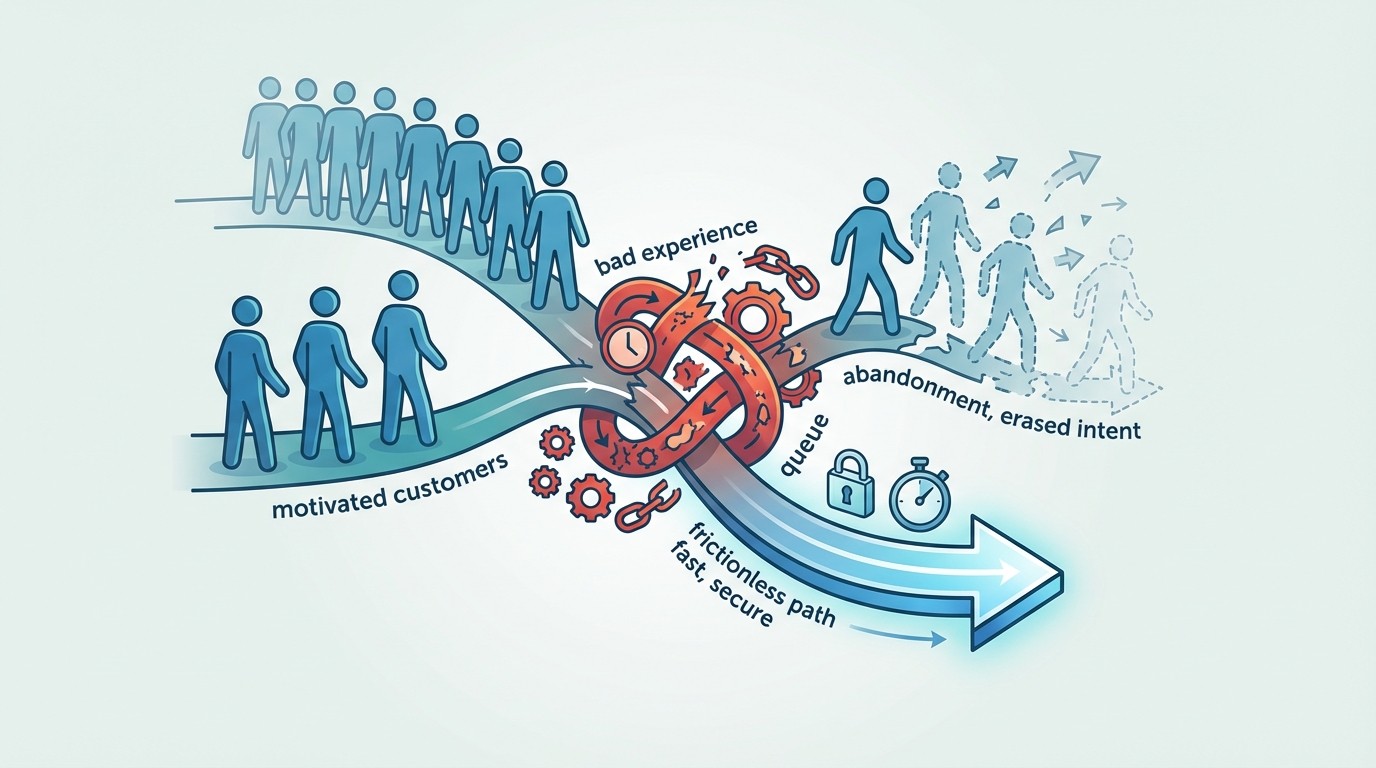
When Good Customers Hit a Bad Experience
Motivated customers abandoned because the experience broke at the queue. Wait times above two minutes erased intent and trust, spiking abandonment over 50%. A frictionless path is fast, secure, and respectful: identity in‑flow, eligible choices in‑message, instant writeback, and receipts—no downloads, no logins, no hold music.
The two minute wait that lost thousands
Two minutes doesn’t sound long in a vacuum. In a live queue, it’s enough to lose people who showed up ready to act. The campaign that had performed reliably at lower volumes became unpredictable. Abandonment surged beyond 50%, and the previous investment in outreach yielded fewer completed resolutions.
It’s a demoralizing outcome for teams that did the right groundwork. The issue wasn’t lack of care; it was a brittle dependency that surfaced under stress. This is common in financial services environments shaped by legacy constraints. Even well‑planned efforts struggle when the path to completion passes through a narrow human bottleneck.
What does a frictionless path feel like?
A message arrives with a secure, branded link. The mini‑app opens without a download or login. Identity is confirmed in seconds via signed link or one‑time code. The customer sees exactly three options—pay now, promise to pay, or dispute—and completes the task in the same channel they used to read the message.
The experience feels respectful and immediate. Payments process, plans schedule, or disputes log for agent follow‑up with context. The system writes outcomes back automatically and issues a receipt. For leaders, the difference shows up as shorter cycle times and higher deflection; for customers, it’s simply “I handled it already.” If you’re aligning SMS with other channels, resources on SMS marketing for sales best practices can help, but completion inside the message is what changes outcomes.
Designing an In-Channel Self-Service Pivot
A closed‑loop design connects back‑end triggers to in‑message apps and guaranteed writebacks. Start with one high‑volume workflow, model outcomes and rules, and ship the smallest Instant App that completes the task. Measure completion, writeback success, and deflection before expanding segments and actions.
Blueprint architecture for closed-loop resolution
Design from the outcome backwards. Define what “done” means—a processed payment, a plan on file, a dispute captured with consent—and the fields that must update. Then connect triggers from your core systems to a channel‑orchestrated message that launches a secure, in‑message mini‑app. Identity, eligibility, and policy live inside the flow, not in a script.
On completion, results write back to the system of record with idempotency and retries. Telemetry anchors every step so you can see where anything stalls. Exceptions—eligibility failures, payment declines—follow predefined paths and escalate with full context. This blueprint turns outreach into resolution and trims the manual reconciliation that slows teams down.
Decision checkpoints to govern the pivot
Decisions are what keep scale under control. Encode eligibility rules for pay‑now and plan options. Establish identity thresholds for each action. Pick payment providers and configure fallbacks. Define what triggers an escalation and what context moves with it. These guardrails standardize completion while leaving room for policy change.
Monitoring is part of governance. Instrument delivery, time‑to‑first action, completion, writeback success, and deflection. Set alert thresholds—queue time above 60–90 seconds or writeback failure spikes should trigger routing changes automatically. If the environment shifts, the workflow adapts without emergency meetings or ad‑hoc patches.
Replication checklist for your next scale-up
Successful pivots share a predictable setup motion. We’ll walk you through the core elements and why they matter, so your next scale‑up adds throughput without adding risk. Two principles frame the work: model outcomes first, and prove writebacks before broadening scope.
Map triggers and data contracts
Model outcomes and policy rules
Compose channel sequences with copy and timing
Configure identity, consent, and signed links
Integrate payment and ledger writebacks with idempotency
Test failure modes, retries, and exception routing
Stand up dashboards and alerts
Pilot on a slice, then scale by cohort
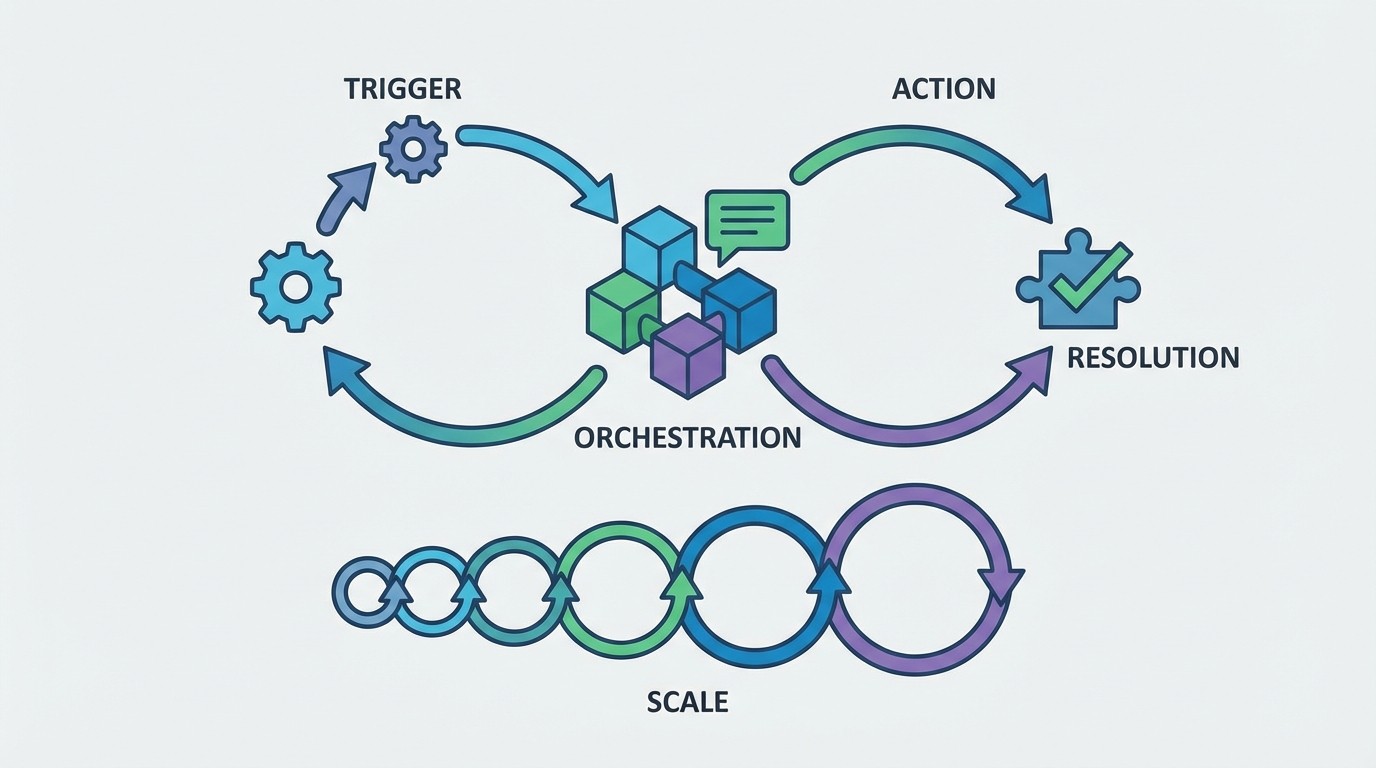
How RadMedia Delivers Closed-Loop Resolution at Scale
RadMedia enables resolution‑first operations by handling integration, in‑message apps, and orchestration as a managed service. We connect triggers to channel‑native actions, capture identity and consent, and write outcomes back reliably—so routine cases finish without agents and exceptions escalate with context.
Managed back-end integration with writeback guarantees
RadMedia owns the adapters, authentication, schema mapping, retries, and idempotent writebacks. That means when a customer updates details or sets a plan in‑message, balances update, flags clear, notes log, and documents attach—without client engineering. Writeback guarantees reduce error risk and remove the manual wrap‑up that quietly inflates unit cost.
This is where the earlier costs unwind. The reconciliation overhead disappears because completion and record updates are the same step. Telemetry at each stage makes issues visible and actionable. For regulated teams, audit logs capture consent, timestamps, and outcomes as part of the flow. You get consistency without slowing down.
In-message Instant App actions customers trust
RadMedia’s secure, branded mini‑apps present only eligible actions—pay now, promise to pay, or dispute—based on policy and context. Identity is validated in‑flow with signed links or one‑time codes. Customers act where they already are, without downloads or passwords, so motivation doesn’t decay at the last mile.
This design improves completion and deflection. Routine cases resolve automatically; exceptions route to people with history and inputs attached. Your agents start at context, not discovery. The result is fewer parallel queues and more completed tasks by design. If you coordinate messaging across channels, guides on coordinating SMS with other channels are useful, and RadMedia’s orchestration layer puts them into practice for resolution.
Omni-channel orchestration that adapts to consent and timing
RadMedia sequences SMS, email, and WhatsApp to respect quiet hours, consent, and known responsiveness. We optimize send windows and cadence for action, not just opens. The engine can pace nudges over days or weeks and adjust the channel mix when a customer doesn’t respond, so you avoid pushing traffic into queues at the wrong moment.
Dashboards track completion, writeback success, and time‑to‑resolution, with alerts for anomalies. Exceptions escalate with full context—messages sent, inputs collected, validation results, and writeback attempts—so people intervene precisely where human judgment adds value. This transforms the abandonment, rework, and compliance risks we outlined earlier into predictable, managed operations.
Still reconciling outcomes by hand or watching queue times swing with every campaign? It’s a solvable problem. Let RadMedia handle the plumbing while you focus on policy and outcomes. Start a Guided Pilot to see a closed‑loop workflow running on a real slice of your book.
Conclusion
The SMS scale‑up didn’t fail because of volume; it failed because completion depended on a fragile queue. When you move resolution inside the message—and guarantee the writeback—you remove the bottleneck, reduce abandonment, and free agents for the work that actually needs them. Start small, prove writebacks, and expand with confidence.
We’ve seen this pivot launch in under 30 days: one high‑volume workflow, a minimal Instant App, managed integrations, and telemetry that makes success visible. If you want help mapping your first closed‑loop path, we’ll walk you through outcome modeling, eligibility rules, and the simplest route to measurable deflection and faster time‑to‑resolution.
Discover how to turn an SMS campaign scaling failure into success. Learn practical steps for in-channel self-service and measurable results.
Case Study: Turning an SMS Campaign Scaling Failure into Automated Resolution Success - RadMedia professional guide illustration
[{"q":"How do I set up automated workflows with RadMedia?","a":"To set up automated workflows with RadMedia, start by identifying a high-volume use case, like failed payments or KYC refreshes. Next, connect your back-end systems using RadMedia’s managed integration, which handles the technical details for you. Then, define the completion criteria and business rules for your workflow. Finally, use RadMedia’s in-message self-service apps to allow customers to take action directly within the message, ensuring that outcomes write back to your systems automatically."},{"q":"What if my customers prefer different communication channels?","a":"RadMedia supports omni-channel communication, allowing you to reach customers via SMS, email, and WhatsApp. You can configure channel preferences based on customer data, ensuring that messages are sent through their preferred channels. This flexibility helps improve engagement and completion rates, as customers can act where they are most comfortable. By using RadMedia’s messaging orchestration, you can optimize timing and cadence to drive action effectively."},{"q":"Can I track the effectiveness of my SMS campaigns?","a":"While RadMedia doesn’t provide traditional analytics or dashboards, you can measure the effectiveness of your SMS campaigns by focusing on completion rates, time-to-resolution, and writeback success. These metrics give you insight into how well your workflows are performing. By analyzing these outcomes, you can refine your messaging strategies and improve customer interactions over time."},{"q":"When should I escalate customer issues to agents?","a":"You should escalate customer issues to agents when exceptions occur that prevent a workflow from completing. RadMedia is designed to handle routine tasks automatically within the message, but if there’s a problem—like a payment decline or missing information—the case will escalate to an agent with full context. This ensures that agents can quickly address the issue without having to gather background information, improving efficiency."},{"q":"Why does my campaign need to focus on resolution, not just volume?","a":"Focusing on resolution rather than just volume is crucial because high conversation numbers don’t necessarily translate to successful outcomes. RadMedia emphasizes closed-loop resolution, which means ensuring that tasks are completed within the message itself. This approach reduces customer friction, minimizes abandonment rates, and ultimately leads to better customer satisfaction and lower operational costs."}]
22 Jan 2026
c53d9217-e4ae-490e-8bbb-e447c0926883
{"@graph":[{"@id":"https://radmedia.co.za/case-study-turning-an-sms-campaign-scaling-failure-into-automated-resolution-success#article","@type":"Article","image":"https://jdbrszggncetflrhtwcd.supabase.co/storage/v1/object/public/article-images/6dca98ae-107d-47b7-832f-ee543e4b5364/case-study-turning-an-sms-campaign-scaling-failure-into-automated-resolution-success-hero-1769040545168.png","author":{"name":"RadMedia","@type":"Organization"},"headline":"Case Study: Turning an SMS Campaign Scaling Failure into Automated Resolution Success","keywords":"SMS campaign scaling failure turnaround","publisher":{"name":"RadMedia","@type":"Organization"},"wordCount":2414,"description":"Case Study: Turning an SMS Campaign Scaling Failure into Automated Resolution Success","dateModified":"2026-01-22T00:05:01.437+00:00","datePublished":"2026-01-22T00:02:33.147746+00:00","mainEntityOfPage":{"@id":"https://radmedia.co.za/case-study-turning-an-sms-campaign-scaling-failure-into-automated-resolution-success","@type":"WebPage"}},{"@id":"https://radmedia.co.za/case-study-turning-an-sms-campaign-scaling-failure-into-automated-resolution-success#breadcrumb","@type":"BreadcrumbList","itemListElement":[{"item":"https://radmedia.co.za","name":"Home","@type":"ListItem","position":1},{"item":"https://radmedia.co.za/case-study-turning-an-sms-campaign-scaling-failure-into-automated-resolution-success","name":"Case Study: Turning an SMS Campaign Scaling Failure into Aut","@type":"ListItem","position":2}]}],"@context":"https://schema.org"}
[{"url":"https://jdbrszggncetflrhtwcd.supabase.co/storage/v1/object/public/article-images/6dca98ae-107d-47b7-832f-ee543e4b5364/case-study-turning-an-sms-campaign-scaling-failure-into-automated-resolution-success-inline-0-1769040560260.png","alt":"How RadMedia Delivers Closed-Loop Resolution at Scale concept illustration - RadMedia","filename":"case-study-turning-an-sms-campaign-scaling-failure-into-automated-resolution-success-inline-0-1769040560260.png","position":"after_h2_1","asset_id":null,"type":"ai_generated","dimensions":{"width":1024,"height":1024}},{"url":"https://jdbrszggncetflrhtwcd.supabase.co/storage/v1/object/public/article-images/6dca98ae-107d-47b7-832f-ee543e4b5364/case-study-turning-an-sms-campaign-scaling-failure-into-automated-resolution-success-inline-1-1769040575142.png","alt":"When Good Customers Hit a Bad Experience concept illustration - RadMedia","filename":"case-study-turning-an-sms-campaign-scaling-failure-into-automated-resolution-success-inline-1-1769040575142.png","position":"after_h2_2","asset_id":null,"type":"ai_generated","dimensions":{"width":1024,"height":1024}}]
95
2414
A fourfold increase in SMS sends didn’t break the campaign. The dependency behind it did. When replies were routed to new inbound lines with long waits, motivated customers stalled in queues, abandoned calls, and the program’s previous success vanished. We’ll walk you through what actually failed, how to diagnose it early, and a practical path to closed‑loop, in‑message resolution.
We’ll discuss the specific ways that volume exposes hidden couplings—to call queues, to portal logins, to manual wrap‑up—and why “good delivery rates” can mask a completion problem. This is a case study, but the patterns are common: routine, policy‑bound scenarios should resolve inside the message, write back to core systems, and escalate only exceptions—with context. That’s the difference between more conversations and more completed tasks.
Key Takeaways:
Treat volume as a stress test that reveals fragile dependencies, not the root cause
Diagnose where completion happens; if it’s a queue or portal, expect abandonment at scale
Measure outcomes beyond delivery: completion rate, writeback success, time‑to‑resolution, deflection
Decouple outreach from call centers; complete routine actions inside the message
Use eligibility rules, identity, and writeback guarantees to standardize outcomes and reduce risk
Start with one high‑volume workflow; ship a minimal Instant App; expand after writeback reliability is proven
Why Volume Was Not the Problem in This SMS Scale-Up
Volume didn’t cause the failure; it exposed a weak link between outreach and a human bottleneck. A sudden 4x send revealed new inbound lines with two‑minute queues, where customers hung up despite good intent. The right lesson is structural: scale outreach only when completion doesn’t depend on agent capacity—for example, when tasks finish in‑message.

The coupling that collapsed the campaign
When you tie engagement directly to live agents, any spike becomes a queue. The original SMS‑to‑call program worked at lower volumes because human capacity matched demand. When volume jumped, queue time did too, and abandonment followed. This wasn’t a copy problem or a timing mistake. It was an architectural coupling that made completion depend on the thinnest part of the system: a phone line.
The practical fix starts with mapping the path to completion. Ask where identity is validated, where the payment or promise is captured, and how results get written back. If those steps require a phone call or portal login, you’ve introduced friction at the worst moment—when the customer is motivated to act. Decoupling outreach from agent availability is non‑negotiable if you want scale without hidden costs.
What do most teams miss when scaling SMS?
Teams tune message content and sending windows carefully. That’s useful, but incomplete. The overlooked question is: where, exactly, does the task complete? If “completion” means a customer leaves the message to sit in a queue or recover a password, velocity creates drop‑offs. Delivery and open rates can look healthy while outcomes crater.
What’s often missing is an in‑message path that carries identity, policy, and payment safely through to the system of record. Without that, motivated customers face unnecessary steps. Motivation decays fast—every extra tap or minute of waiting increases the risk you lose them. Resolution should happen where the conversation starts.
Why delivery rates are necessary but not sufficient
Delivery and read rates are prerequisites, not proofs of success. They tell you someone saw the message, not that the task finished. Use delivery as a health check, then track completion rate, writeback success, and time‑to‑resolution as primary outcomes. Industry primers on SMS delivery rate benchmarks are helpful, but they’re the start of the story, not the end.
In the failed scale‑up, delivery stayed high while abandonment spiked. The disconnect was predictable: customers reached the queue, waited, and left. If you only monitor delivery, you miss the moment friction appears. Build instrumentation that follows the customer from trigger to outcome, so success reflects completed work, not just sent messages.
The Real Bottleneck, Coupling Outreach to Fragile Call Queues
The fragile link was routing replies to new inbound lines with two‑minute waits, turning intent into abandonment. Completion must be decoupled from agent availability and portal logins so routine cases finish inside the message. A closed loop—trigger to in‑message action to writeback—removes the bottleneck entirely.

How routing changes turned into abandonment
Changing the routing path seemed minor—new lines, same plan. In practice, it created a hard limit. Two‑minute queues at scale meant customers dropped before agents ever picked up. The program paid for outreach and attention, then lost both at the gate. That’s an expensive way to learn that human capacity doesn’t scale linearly with sends.
The lesson is straightforward: never scale outreach faster than the system that completes the task. If the “system” is a person, you’ve capped throughput and increased variability. Teams that treat routing as a technical afterthought miss how quickly minor wait times compound into material abandonment. There’s a reason many teams discover why messaging rollouts fail and how to fix them only after customer patience runs out.
Where should resolution actually happen?
Resolution belongs in‑channel. If identity checks, payments, or plan setup depend on a login or a call, you’ve inserted handoffs and delay. A secure, branded link to a mini‑app inside the message keeps context intact, confirms identity in‑flow, and presents only the actions a customer is eligible to take.
That structure isn’t just convenient—it’s operationally resilient. It reduces agent load, eliminates manual wrap‑up, and standardizes outcomes with audit trails. Instead of reconciling disparate tools, your system writes results back as part of completion. Customers get immediate resolution. Teams get fewer exceptions and cleaner data.
The Hidden Costs of a Broken Scale-Up
A broken last mile creates a compounding tax: you pay to send, you pay when customers wait, and you pay again when outcomes require manual wrap‑up. The right metrics quantify that tax clearly and early. Watch queue times, abandonment, completion, writeback success, and deflection—not just sends and opens.
Quantifying the abandonment tax
Abandonment isn’t just a disappointing statistic; it’s a material cost. You fund outreach, lose motivated customers in queues, and still carry the revenue at risk until the case resolves. Meanwhile, those who do wait consume agent minutes and introduce variability that increases rework. The unit cost per completed case rises even as volume grows.
Track pre‑ and post‑scale abandonment, time‑to‑resolution, and unit cost rigorously. Compare the number of sends to completed transactions and the writeback rate to your system of record. A flat delivery curve with falling completion tells you the “last‑mile” is broken. It’s a measurable leak, not an anecdote. Many teams only confront these dynamics after running into common SMS scale pitfalls, but you don’t need to wait.
The operational drag across teams
When routine completion depends on people, operations absorb the drag. Agents toggle between systems, rekey data, and manually reconcile outcomes. Even with strong training, variability creeps in. Compliance evidence scatters across notes and inboxes. Leaders feel this as longer cycle times and rising unit costs, especially during spikes.
That drag isn’t inevitable. Closed‑loop writebacks remove rekeying and standardize outcomes. When a payment posts or a plan is scheduled as part of an in‑message flow, balances and flags update immediately. Exceptions escalate with context instead of discovery. The shift frees capacity without sacrificing control, and it reduces the risk of inconsistent wrap‑up.
Still seeing these patterns internally? A structured pilot beats another meeting. If you prefer working sessions to theory, consider a focused design review of one high‑volume workflow and a small cohort rollout. Request a 30‑Minute Working Session and we’ll outline a pilot that measures completion, writeback success, and deflection clearly.
When Good Customers Hit a Bad Experience
Motivated customers abandoned because the experience broke at the queue. Wait times above two minutes erased intent and trust, spiking abandonment over 50%. A frictionless path is fast, secure, and respectful: identity in‑flow, eligible choices in‑message, instant writeback, and receipts—no downloads, no logins, no hold music.
The two minute wait that lost thousands
Two minutes doesn’t sound long in a vacuum. In a live queue, it’s enough to lose people who showed up ready to act. The campaign that had performed reliably at lower volumes became unpredictable. Abandonment surged beyond 50%, and the previous investment in outreach yielded fewer completed resolutions.
It’s a demoralizing outcome for teams that did the right groundwork. The issue wasn’t lack of care; it was a brittle dependency that surfaced under stress. This is common in financial services environments shaped by legacy constraints. Even well‑planned efforts struggle when the path to completion passes through a narrow human bottleneck.
What does a frictionless path feel like?
A message arrives with a secure, branded link. The mini‑app opens without a download or login. Identity is confirmed in seconds via signed link or one‑time code. The customer sees exactly three options—pay now, promise to pay, or dispute—and completes the task in the same channel they used to read the message.
The experience feels respectful and immediate. Payments process, plans schedule, or disputes log for agent follow‑up with context. The system writes outcomes back automatically and issues a receipt. For leaders, the difference shows up as shorter cycle times and higher deflection; for customers, it’s simply “I handled it already.” If you’re aligning SMS with other channels, resources on SMS marketing for sales best practices can help, but completion inside the message is what changes outcomes.
Designing an In-Channel Self-Service Pivot
A closed‑loop design connects back‑end triggers to in‑message apps and guaranteed writebacks. Start with one high‑volume workflow, model outcomes and rules, and ship the smallest Instant App that completes the task. Measure completion, writeback success, and deflection before expanding segments and actions.
Blueprint architecture for closed-loop resolution
Design from the outcome backwards. Define what “done” means—a processed payment, a plan on file, a dispute captured with consent—and the fields that must update. Then connect triggers from your core systems to a channel‑orchestrated message that launches a secure, in‑message mini‑app. Identity, eligibility, and policy live inside the flow, not in a script.
On completion, results write back to the system of record with idempotency and retries. Telemetry anchors every step so you can see where anything stalls. Exceptions—eligibility failures, payment declines—follow predefined paths and escalate with full context. This blueprint turns outreach into resolution and trims the manual reconciliation that slows teams down.
Decision checkpoints to govern the pivot
Decisions are what keep scale under control. Encode eligibility rules for pay‑now and plan options. Establish identity thresholds for each action. Pick payment providers and configure fallbacks. Define what triggers an escalation and what context moves with it. These guardrails standardize completion while leaving room for policy change.
Monitoring is part of governance. Instrument delivery, time‑to‑first action, completion, writeback success, and deflection. Set alert thresholds—queue time above 60–90 seconds or writeback failure spikes should trigger routing changes automatically. If the environment shifts, the workflow adapts without emergency meetings or ad‑hoc patches.
Replication checklist for your next scale-up
Successful pivots share a predictable setup motion. We’ll walk you through the core elements and why they matter, so your next scale‑up adds throughput without adding risk. Two principles frame the work: model outcomes first, and prove writebacks before broadening scope.
Map triggers and data contracts
Model outcomes and policy rules
Compose channel sequences with copy and timing
Configure identity, consent, and signed links
Integrate payment and ledger writebacks with idempotency
Test failure modes, retries, and exception routing
Stand up dashboards and alerts
Pilot on a slice, then scale by cohort
How RadMedia Delivers Closed-Loop Resolution at Scale
RadMedia enables resolution‑first operations by handling integration, in‑message apps, and orchestration as a managed service. We connect triggers to channel‑native actions, capture identity and consent, and write outcomes back reliably—so routine cases finish without agents and exceptions escalate with context.
Managed back-end integration with writeback guarantees
RadMedia owns the adapters, authentication, schema mapping, retries, and idempotent writebacks. That means when a customer updates details or sets a plan in‑message, balances update, flags clear, notes log, and documents attach—without client engineering. Writeback guarantees reduce error risk and remove the manual wrap‑up that quietly inflates unit cost.
This is where the earlier costs unwind. The reconciliation overhead disappears because completion and record updates are the same step. Telemetry at each stage makes issues visible and actionable. For regulated teams, audit logs capture consent, timestamps, and outcomes as part of the flow. You get consistency without slowing down.
In-message Instant App actions customers trust
RadMedia’s secure, branded mini‑apps present only eligible actions—pay now, promise to pay, or dispute—based on policy and context. Identity is validated in‑flow with signed links or one‑time codes. Customers act where they already are, without downloads or passwords, so motivation doesn’t decay at the last mile.
This design improves completion and deflection. Routine cases resolve automatically; exceptions route to people with history and inputs attached. Your agents start at context, not discovery. The result is fewer parallel queues and more completed tasks by design. If you coordinate messaging across channels, guides on coordinating SMS with other channels are useful, and RadMedia’s orchestration layer puts them into practice for resolution.
Omni-channel orchestration that adapts to consent and timing
RadMedia sequences SMS, email, and WhatsApp to respect quiet hours, consent, and known responsiveness. We optimize send windows and cadence for action, not just opens. The engine can pace nudges over days or weeks and adjust the channel mix when a customer doesn’t respond, so you avoid pushing traffic into queues at the wrong moment.
Dashboards track completion, writeback success, and time‑to‑resolution, with alerts for anomalies. Exceptions escalate with full context—messages sent, inputs collected, validation results, and writeback attempts—so people intervene precisely where human judgment adds value. This transforms the abandonment, rework, and compliance risks we outlined earlier into predictable, managed operations.
Still reconciling outcomes by hand or watching queue times swing with every campaign? It’s a solvable problem. Let RadMedia handle the plumbing while you focus on policy and outcomes. Start a Guided Pilot to see a closed‑loop workflow running on a real slice of your book.
Conclusion
The SMS scale‑up didn’t fail because of volume; it failed because completion depended on a fragile queue. When you move resolution inside the message—and guarantee the writeback—you remove the bottleneck, reduce abandonment, and free agents for the work that actually needs them. Start small, prove writebacks, and expand with confidence.
We’ve seen this pivot launch in under 30 days: one high‑volume workflow, a minimal Instant App, managed integrations, and telemetry that makes success visible. If you want help mapping your first closed‑loop path, we’ll walk you through outcome modeling, eligibility rules, and the simplest route to measurable deflection and faster time‑to‑resolution.
