
Design Outcome-First Messaging Workflows That Close the Loop
Design outcome-first messaging workflows by defining completion and writebacks upfront. This approach reduces costs and enhances customer experience, transforming notifications into resolutions that drive real task completion without manual follow-up.
Most teams chase messaging volume and miss the metric that matters: resolution inside the message. Costs fall when each case finishes where it starts and writes back to core systems without manual wrap‑up. This guide shows how to design outcome‑first messaging workflows that close the loop so your outreach turns into completed tasks, not chatter.
We’ll discuss the specific ways open loops create waste, risk, and customer friction, then show a practical way to flip the build order. Define completion and writebacks first, encode policy and eligibility, and only then craft outreach and in‑message steps. That order sounds counterintuitive at first. It is the difference between notifications and real outcomes.
Key Takeaways:
Start by defining completion and writeback fields, not messages and flows
Encode policy and eligibility so customers only see valid options
Treat identity, idempotency, retries, and audit trails as first‑class design inputs
Orchestrate SMS, WhatsApp, and email to drive action, not clicks
Track completion rate, time‑to‑resolution, writeback success, and deflection
Pilot one high‑volume workflow to target ≥70% straight‑through in 60 days
Outcome‑First Messaging Means Defining Completion and Writebacks Upfront
Outcome‑first messaging means you define the finished state and the exact writeback fields before you draft copy or draw flows. That design flips the build order so policy, eligibility, identity, and idempotent writebacks shape everything that follows. Done right, customers complete tasks inside the message and systems update automatically.
Notifications vs. Resolutions
Notifications tell customers something happened. Resolutions let them finish the task without switching channels. The gap sounds small, yet it is the line between vanity metrics and cost reduction. When outreach links to in‑message steps that validate identity, present only eligible actions, and write back, you close the loop and measure real outcomes.
Teams often assume stronger copy or more channels will fix stalled journeys. The real shift is architectural. Move the finish line into the message, then prove it by mapping the fields that must change in the system of record. You stop counting conversations and start counting completions, which is what actually reduces queues and rework.
Why Writebacks Are the Hard Part
Writebacks are hard because they touch regulated data, legacy schemas, and brittle integrations. Idempotency, retries, and error handling are not optional when money moves or compliance flags change. Identity and consent must be captured and logged. Without these foundations, journeys escalate to agents or die in the last mile.
You know the pattern: a customer tries to update a card through a portal, gets blocked at login, then phones the contact centre. An agent rekeys data and hopes nothing double‑posts overnight. That is operational debt. A closed‑loop design avoids those detours by committing the outcome safely and proving it in the audit trail.
Red flags you are open‑loop:
No single list of completion fields per workflow
Writebacks depend on agents or nightly jobs
Identity checks vary by channel
Error handling and retries are undefined
The Root Cause: Data Contracts Before Copy
Open loops persist because teams start with messages and UI, not with the data that proves completion. The fix is to define data contracts first, including identity, consent, policy eligibility, and the exact writeback payload. Copy and flows then follow the rules, which lowers exceptions and speeds resolution.
Map Fields, Not Flows
Start with a blank page and list the fields that must change when a case is truly done. For collections, that might include arrangement type, schedule, first‑installment date, and consent artifact. For billing, it might include tokenized card reference, address lines, and risk flags. When those fields are clear, flows become straightforward.
Teams that map flows first often discover missing data late. That mistake forces rework and one‑off exceptions that never end. A field‑first approach exposes gaps early: identity proofing strength, allowed plan ranges, and concurrency rules. It also makes QA real, since you can test whether systems changed as designed rather than eyeballing screens.
Policy and Eligibility Shape the Experience
Policy is the backbone of a good in‑message experience. If a customer is only eligible for plans up to six months, do not show nine. If a KYC refresh must collect two specific documents, do not present a free‑form upload field. Eligibility eliminates wrong paths and lowers exception rates.
Operations leaders often worry that strict eligibility will reduce conversions. Experience shows the opposite. When customers only see valid options and can act immediately, completion rises and escalations fall. You also earn cleaner data, since inputs are constrained and validated at the point of entry, not patched by agents later.
Elements to define before copy:
Eligibility thresholds and disallowed paths
Required identity checks and consent artifacts
Field‑level validation and acceptable ranges
What to log for audit, including timestamps and user action
The Cost of Open Loops in Billing, Collections, and Compliance
Open loops raise cost‑to‑serve, elongate cycle times, and increase risk. Every handoff, rekey, and manual writeback adds minutes and error potential. Research on customer care shows large, sustained cost reductions when straight‑through processing replaces manual steps, especially at scale, which aligns with outcome‑first design (McKinsey research on cost to serve in customer care).
Where the Minutes Go
Most of the waste hides in coordination. Customers switch channels, fail logins, and call. Agents validate identity, collect details, and rekey into back‑end screens. Supervisors review exceptions, then reconcile mismatches when systems disagree. None of that creates value. It is the price you pay for an open loop.
A closed loop collapses those touches. Identity is verified inside the message. Inputs are validated at the edge. Only policy‑eligible options appear. Outcomes commit idempotently. You replace five steps with one, and the one step leaves a clean audit trail. That is where time‑to‑resolution drops, often dramatically, especially on high‑volume tasks.
Risk, Audit, and Rework
Risk lives in last‑mile gaps. If your process cannot prove who acted, what was authorized, and how systems changed, audit findings mount and rework follows. Reliability patterns matter here: retries with backoff, circuit breaking, and idempotency prevent double‑posts and partial states (AWS guidance on exponential backoff and jitter).
Identity strength matters too. A one‑time code or known‑fact check can be enough for low‑risk updates, while higher‑risk actions demand stronger proofing. Regulators expect you to match verification to risk and to retain evidence that proves it. Nailing those basics reduces exceptions and calms audit conversations (NIST Digital Identity Guidelines).
Signs risk is creeping in:
Evidence of consent is not linked to the writeback
Duplicate transactions appear during spikes
Exception queues grow after campaign launches
Audit trails are spread across tools
What Open Loops Feel Like on the Ground
Open loops feel like pressure without progress. Leaders see send volumes climbing while completion stays flat, and budgets chase more channels, more bots, more dashboards. Agents feel the strain as routine work piles up, and customers give up at the last mile. Everyone is busy. Little gets finished.
Leaders Under Pressure
You field the same questions each month: Why are queues still growing? Why is rework so high? Where did the budget savings go? It is hard to defend numbers that track messages sent and calls handled when cases still end up with people, screens, and spreadsheets. That stress is real. You are not imagining it.
Shifting the metric from contact to resolution is liberating. You can finally see where work completes, where it stalls, and why. Decisions improve because evidence is tied to outcomes. Investments move from louder notifications to better completion, with less debate and fewer surprises in steering meetings.
Customers Stuck at the Last Mile
Customers want to fix the issue and move on. Password resets, portal detours, and long holds feel like punishment when someone is trying to pay or update details. That friction erodes trust and delays resolution. Reduce steps, and people act. Put the action where the message is, and completion rises.
Channel fit matters too. If your customers live in WhatsApp, meet them there. Respect consent, quiet hours, and timing windows to earn responses. When the link leads to a secure mini‑app that already knows who they are and what they can do, the path feels obvious and safe (WhatsApp Business Policy).
Friction patterns to remove:
Forced portal creation for simple tasks
Channel switches at the moment of decision
Free‑form inputs where structured fields are required
Identity checks that reset mid‑flow
How to Design Outcome‑First Messaging Workflows That Close the Loop
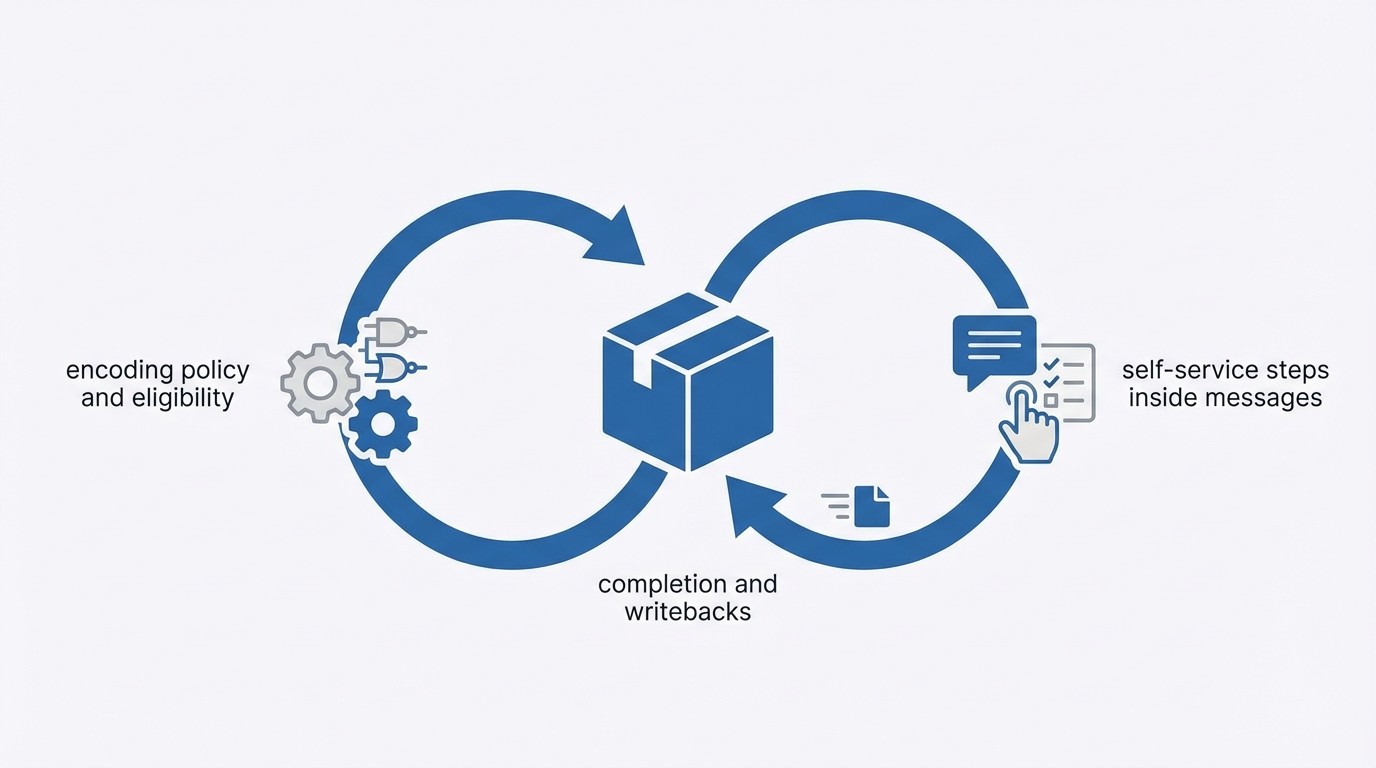
Design closed‑loop workflows by defining completion and writebacks first, encoding policy and eligibility, and embedding self‑service steps inside messages. With identity, validation, and idempotent commits in place, channel orchestration becomes a lever for action, not noise. The result is straight‑through processing you can prove and improve.
Define Completion and Data First
Start with the end state. For each workflow, write a one‑sentence definition of completion and list the fields that must change in your systems. Include consent artifacts and documents that must attach. Capture who did what and when. When that list is concrete, you have a north star for design and QA.
Then decide what identity proof and validation you need to accept the action, strong enough to manage risk, light enough to encourage completion. Structure every input so it validates at entry and maps cleanly to back‑end schemas. You are designing a transaction, not a conversation. That mindset prevents hidden work later.
After you pin down proofing and fields, outline the error cases: payment declines, ineligible requests, missing documents. Decide which paths stay in message and which escalate with context. Define retry and backoff rules and what to log. You are building in resilience, so production stays smooth during spikes.
To implement this approach:
Write the completion statement and field list
Choose identity checks matched to risk
Define validation and acceptable ranges per field
Model policy, eligibility, and exception paths
Plan idempotency, retries, and audit logging
Only then draft outreach and in‑message steps
QA by asserting the writebacks and evidence, not just UI
Encode Policy, Then Compose Outreach
Policy and eligibility should gate the experience, not appear as footnotes. If your rules do not allow a plan, it should not be visible. If two documents are required, present only those two, with clear capture and verification steps. Make the right path the only path a customer can see.
When the rules are encoded, composing messages gets simpler. Personalize content with trigger data and explain exactly what will happen if the customer taps the link. Keep copy plain. Reduce choice to what policy allows. When you do that, you save customers from wrong turns and save agents from preventable follow‑ups.
Outreach principles that work:
Be explicit about the action and outcome
Show only eligible options
Place the secure mini‑app one tap away
Sequence channels and times proven to drive action
How RadMedia Makes the New Model Real
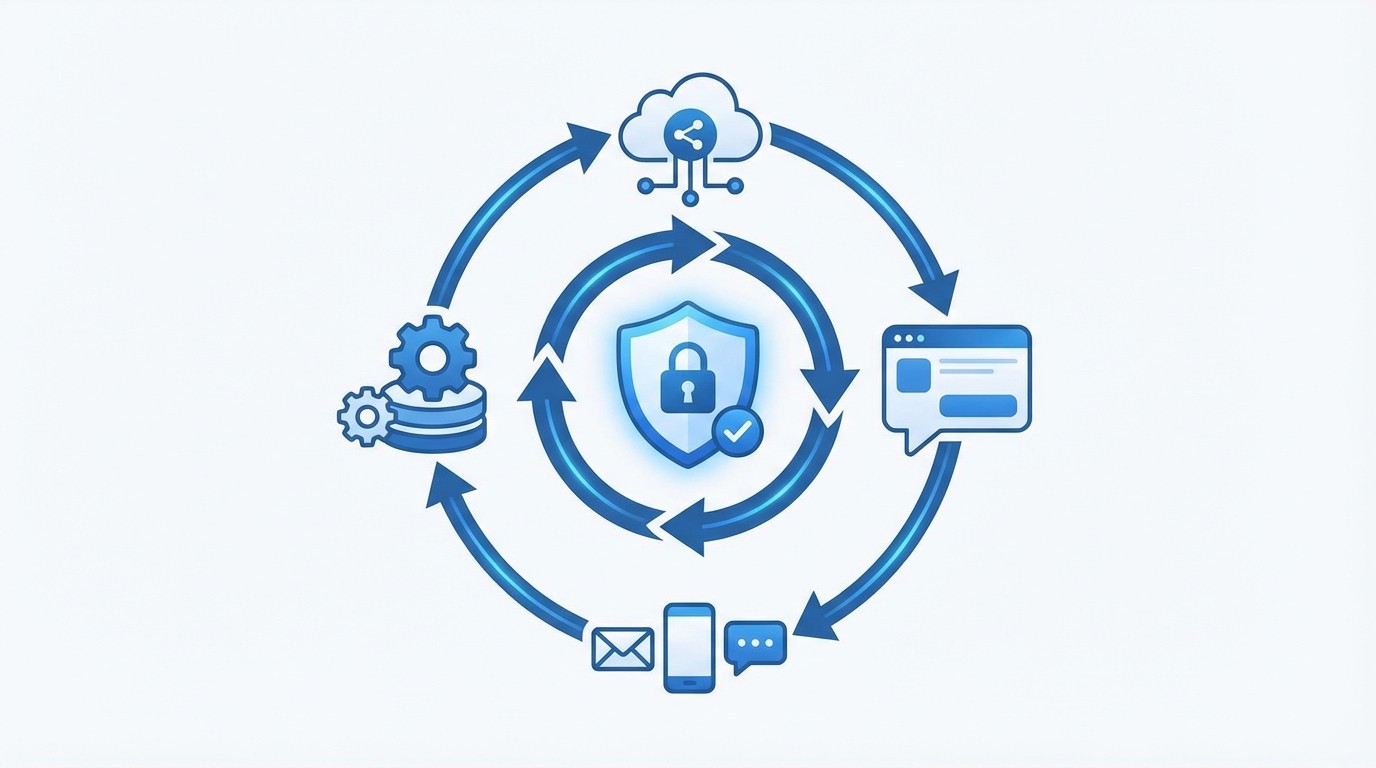
RadMedia enables closed‑loop, outcome‑first workflows by handling back‑end integrations, delivering secure in‑message mini‑apps, orchestrating channels for completion, and writing results back safely with audit‑ready evidence. You design the outcome; RadMedia wires the path, executes the rules, and records what happened so operations lead with resolution.
Integration and Writebacks You Can Trust
Managed Back‑End Integration removes the slowest, riskiest work. RadMedia owns adapters, authentication, schema mapping, and error handling across legacy cores and modern APIs. Triggers from billing, collections, policy, and compliance feed context into outreach and mini‑apps. When customers act, Closed‑Loop Resolution and Writeback posts outcomes idempotently to systems of record, updating balances, clearing flags, and attaching notes and documents, while preserving full audit logs.
Autopilot Workflow Engine advances each case with policy‑aware rules, time‑based logic, and exception routing. Valid paths appear in the mini‑app; invalid ones never do. If a decline or missing data blocks completion, the case follows a defined path and escalates with full context. That’s how straight‑through processing increases while rework falls, without losing control of eligibility and compliance.
Telemetry, Reliability, and Data Export provide proof. Every step emits signals you can track, including deliveries, opens, actions, validations, writebacks, and time‑to‑resolution. Reliability controls such as retries with backoff, idempotent operations, and circuit breaking protect downstream systems during spikes and intermittent conditions. You measure resolution, not just sends, and export outcomes and logs to your data lake or SIEM for enterprise reporting.
In‑Message Apps and Autopilot That Finish the Job
In‑Message Self‑Service Mini‑Apps let customers complete tasks inside SMS, WhatsApp, or email without portals or downloads. Identity is validated with one‑time codes, known‑fact checks, or signed links, then only policy‑eligible actions appear: update card, authorize a payment, choose a plan, confirm details, upload documents, or sign an attestation.
Omni‑Channel Messaging Orchestration sequences SMS, email, and WhatsApp for action, not volume. The system respects consent and preferences, tunes timing and cadence, and always points to the secure mini‑app. Customers act where they already are, which reduces unnecessary touches and drives cleaner completion with fewer exception handoffs.
Security, Identity, and Audit Controls keep regulated workflows safe. TLS in transit, encryption at rest, role‑based access, optional SSO, and full audit trails protect sensitive operations. Every consent, input, and writeback is timestamped and tied to the case. You get fewer exceptions, cleaner audits, and the confidence to scale the model across use cases.
Before you roll out broadly, pilot one high‑volume workflow. Measure completion rate, writeback success, time‑to‑resolution, and deflection, then use the telemetry to tune rules, channel sequences, and exception paths as you expand. RadMedia is built to close the loop inside the message and prove each outcome end to end.
Ready for customer communication workflows on autopilot? Get in touch.
Conclusion
Outcome‑first design flips messaging from noise to resolution. Define completion and writebacks first, encode policy and eligibility, then embed the action inside the conversation. When identity, validation, and idempotent commits are in place, omnichannel outreach becomes a reliable path to completion, not a detour to portals or agents.
Start with one high‑volume workflow. Map the fields, choose the proofing, set the rules, and measure the numbers that matter: completion rate, time‑to‑resolution, writeback success, and deflection. Target ≥70% straight‑through in 60 days, then expand with confidence as you turn conversations into outcomes at scale.