
Design In‑Message Self‑Service for Failed Payments in Emerging Markets

Failed payments are fixable, yet recovery often stalls at the last mile. The extra steps are the problem, not customer intent. In-message self-service closes that gap by letting customers resolve the issue inside the channel they already use, with outcomes written back to your systems automatically. You cut handoffs, reduce risk, and protect revenue.

We’ll walk you through the approach for emerging markets where mobile devices, local rails, and fragile networks define the constraints. You’ll see how to design flows that respect consent and regulation, authenticate securely inside the message, and complete payment capture without a portal or app. We’ll discuss the specific ways to instrument writebacks, handle retries safely, and escalate only true exceptions.

Key Takeaways:

  • Treat the message as the app, then write outcomes back automatically to close the loop

  • Cut context switching that causes most drop-off, and measure completion, time-to-resolution, and deflection

  • Authenticate in-flow with signed links, one-time codes, or known-fact checks to reduce fraud risk

  • Prioritize local rails, present only eligible options, and explain settlement timing clearly

  • Engineer for weak networks with small payloads, local caching, idempotent calls, and safe retries

  • Escalate exceptions with full context so agents resolve, not rediscover

  • Prove value with cohort comparisons: instant app vs portal journeys

Stop Losing Failed Payments to Portals: Complete Them with In-Message Self-Service

In-message self-service recovers more failed payments because customers complete the fix where they already are, then the outcome writes back to your core systems. This removes logins, app installs, and channel hops that drive abandonment. The result is fewer retries, lower unit cost, and higher first-attempt recovery.
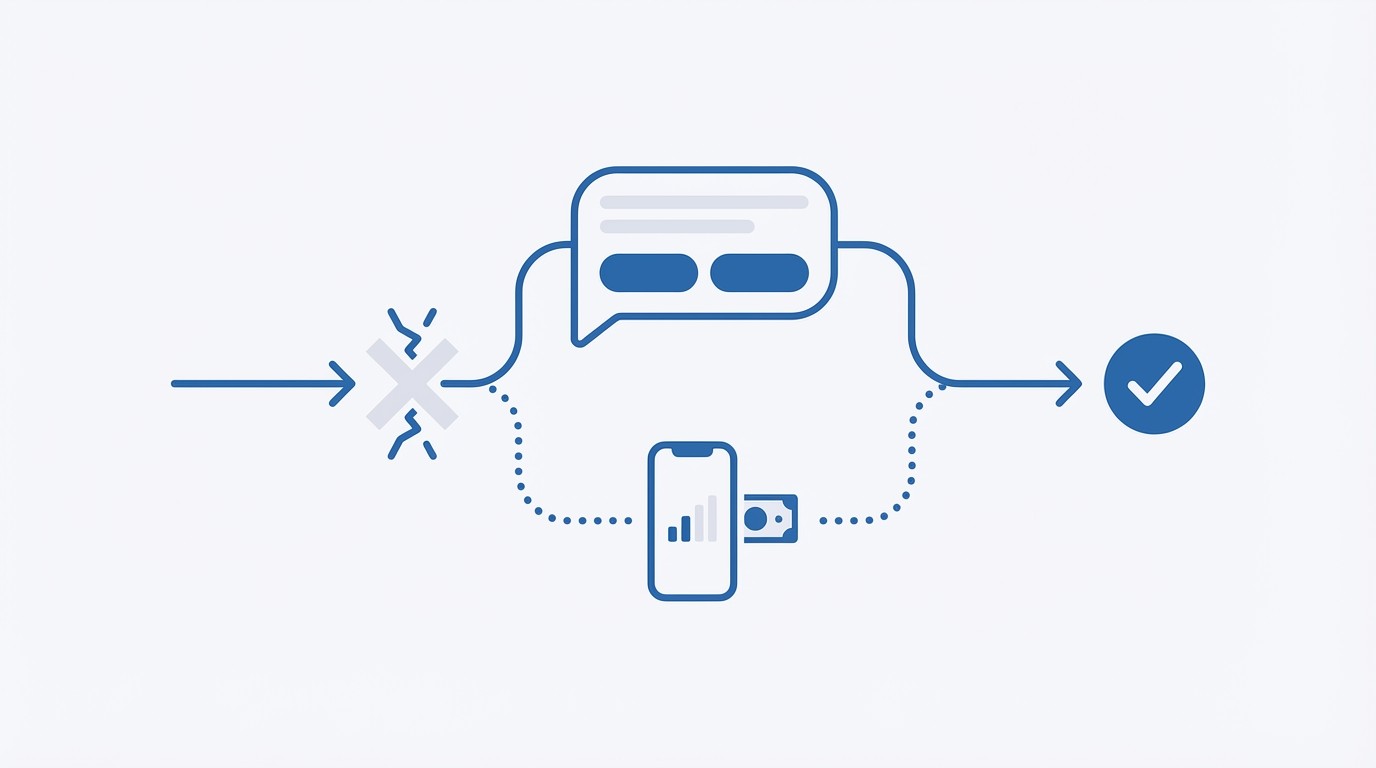
How to Design In-Message Self-Service for Failed Payments in Emerging Markets concept illustration - RadMedia

The overlooked truth about failed payment recovery

Recovery improves when outreach and completion live in the same channel, and actions sync to systems immediately. The friction that kills completion often hides in small steps like logins or page loads. Remove those, and customers finish the task on the first try far more often.

Most teams already send notices, but the fix sits elsewhere in a portal or app. That is where people drop. Design a small, focused mini-app that presents only policy-eligible actions, such as update card, select plan, or authorize a one-time charge. Capture consent, process payment, and confirm the result in the same session. Then post the outcome to your ledger, CRM, and audit store so follow-ups stop.

When you close the loop inside the message, you also stabilize operations. You reduce duplicate tickets, eliminate manual wrap-up, and cut the mistakes that come with rekeying. Customers see a predictable path to resolution. Your team sees clean records without reconciliation work.

Why portals and app downloads fail in mobile-first markets

Portals and app installs add steps customers will not take when data is limited and storage is tight. Intermittent connectivity makes slow pages and password flows even more punishing. The risk is clear: every extra step invites abandonment and wasted outreach.

Design authentication inside the message. Use signed deep links that bind to the case, then add one-time codes or known-fact checks for assurance. Keep the flow under three screens. Preload what you can, cache progress locally, and minimize asset size so each step advances even when networks degrade. Confirm outcomes with a receipt and update the balance live so trust grows with every action.

A practical pattern looks like this:

  • Use a signed link tied to the failed payment record, then verify with a one-time code

  • Present two eligible options based on policy, not a long catalog of methods

  • Post results to the system of record, then display a receipt with the new status

What “the message is the app” requires technically

Closing the loop requires more than a form. You need event-driven triggers, identity verification in-flow, embedded payment capture, and guaranteed writebacks. Failures must be safe to retry without double charging or double posting.

At minimum, model completion fields and idempotency keys first. Instrument telemetry for each step, including outreach delivery, app open, form completion, authorization result, and writeback success. Auto-retry transient failures with backoff, and flag stuck states for review. Exceptions should route to agents with full context. For context on how often customers, not systems, surface failures, see this analysis on incident discovery in payments from Retail Banker International.

The Hidden Cause of Recovery Failure Is Context Switching, Not Channel Reach

Recovery fails when customers must jump between channels or tools to fix a payment. Each hop restarts identity checks, adds delay, and multiplies drop-off risk. Keeping the full journey in-message avoids rekeying and shrinks time-to-resolution.
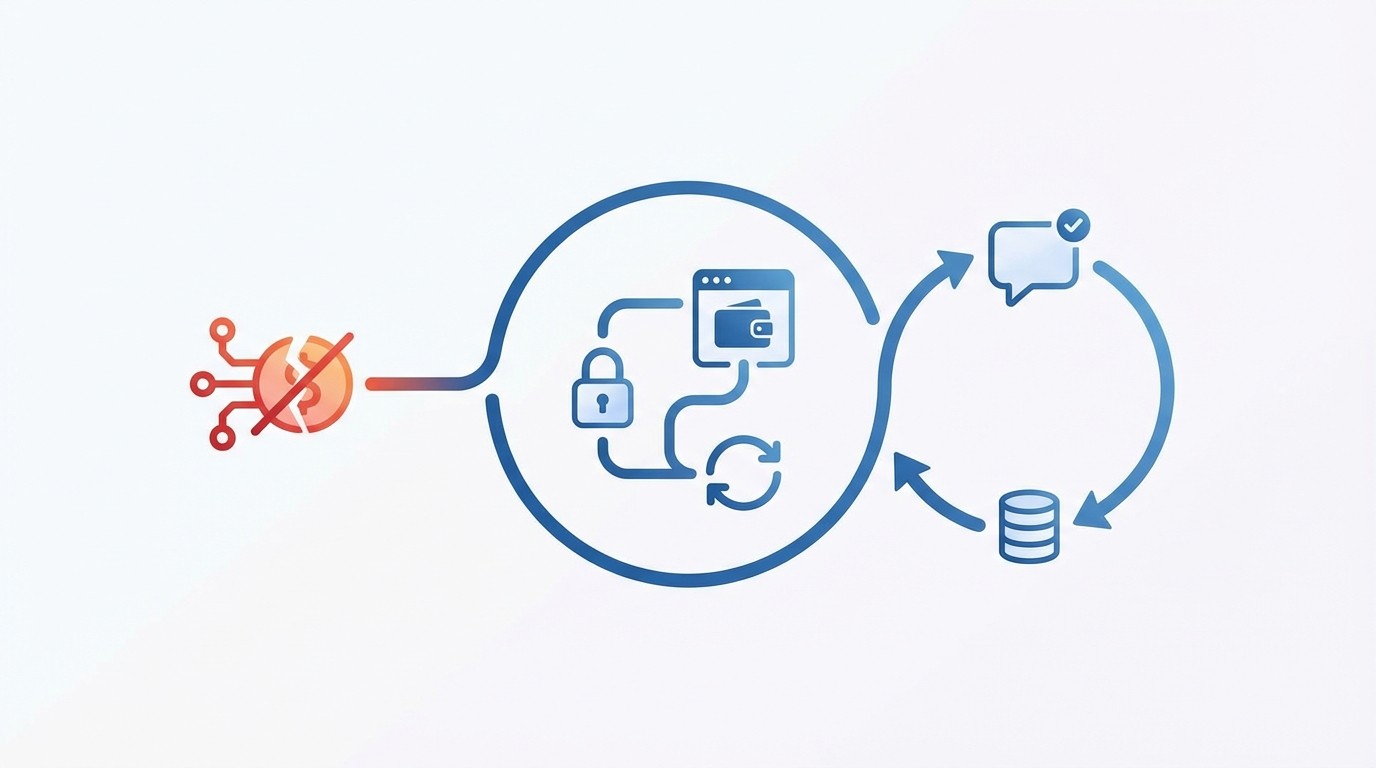
How RadMedia Automates In-Message Self-Service for Failed Payments concept illustration - RadMedia

Why do customers ignore “fix your payment” emails and SMS?

Most customers already tried to pay. They expect a direct path to resolve it, not a new login or an app download. Generic notices without a clear, trusted action feel like noise. People delay, then miss deadlines, and you lose revenue you could have saved.

Make the first screen do real work. Personalize the amount, due date, and eligible options. Explain plainly what will happen next, including fees or settlement windows. Capture digital consent inline and show a confirmed status when done. When people see a simple path, they act. When they see a maze, they bounce.

After launch, compare cohorts. The in-message flow should show higher completion and lower cost per resolution than portal links. If not, the design still leaks effort. Fix the leaks before you add more reminders.

How context switching inflates cost-to-serve

Every hop invites re-verification, rekeying, and manual wrap-up. That waste compounds across thousands of cases. You pay in agent minutes and error correction while customers sit in queues or churn.

Closing the loop inside the message compresses all of that. Systems update automatically, audit records attach to the case, and exceptions surface with context. Track unit cost, time-to-resolution, and deflection. Those numbers should move in the right direction when context switching disappears. If they do not, there is still a hidden handoff in your flow.

A simple tracking set helps:

  • Unit cost per resolved case

  • Median time-to-resolution from trigger to writeback

  • Deflection rate from agents to straight-through processing

In-message self-service beats “more reminders”

More reminders without a clear, immediate action erode trust. People start to tune out, and deliverability can suffer. Quality of the next step matters more than quantity of nudges.

Sequence outreach across SMS, WhatsApp, and email only to steer people into the embedded flow. Respect quiet hours and consent. Use timing and content that make the action obvious. In emerging markets, merchants are already feeling the cost of failed checkouts and fees, which magnify the stakes for every retry, as covered by IBS Intelligence. Clarity wins. Noise loses.

The Cost of Getting This Wrong: Declines, Fraud Exposure, and Wasted Retries

Weak flows cost real money through unrecovered declines, fraud, and rework. Confusing journeys waste retries and frustrate customers. Strong identity, safe retries, and guaranteed writebacks prevent those losses.

Quantify revenue leakage from failed and abandoned remediation

Start with a clean baseline. Measure first-attempt declines recovered, recovery within seven days, and net revenue saved. Split cohorts between portal links and instant apps to see the lift from completion in-message. Track attempts per recovery to spot waste.

Use this data to prioritize work. Flows that deliver the most recovered revenue per engineering hour come first. Share the numbers with finance and risk so investment aligns to measurable outcomes. When the unit cost per resolved case drops and recovered revenue rises, you know the approach is working.

The real risk of weak identity and consent capture

Insufficient verification invites fraud and regulatory trouble. That risk is not theoretical. Messaging fraud remains a pressure point even as some categories improve, as noted by Juniper Research. The fix is straightforward and should not add unnecessary friction.

Use signed links, one-time codes, and known-fact checks that fit your risk tier. Record explicit consent with timestamps and context, then store the evidence with the case. Export audit logs to your data lake or SIEM so you can answer regulators and card networks quickly. When the outcome posts back in the same flow, disputes and losses fall.

Monitoring that catches failures before customers do

Do not wait for customers to report a broken flow. Instrument your writebacks, webhooks, and gateway responses. Alert on stuck states, repeated 4xx or 5xx responses, and idempotency conflicts. Auto-retry transient errors with safe backoff.

If a step fails, reissue the last safe action to the customer rather than opening a ticket. That protects revenue and reduces strain on lean ops teams. Over time, these controls turn failures into brief delays instead of costly incidents.

What It Feels Like on the Ground for Customers and Lean Ops Teams

Good design feels simple for customers and calm for teams. The path is clear, the result is predictable, and edge cases reach people with full context. Trust grows when each action does what it says it will do.

Customers want a single, trusted action they can complete now

Clarity matters most under stress. Show the amount due, the deadline, and one next step that matches eligibility. Avoid dense text and tiny links. Localize language and currency. Confirm success with a receipt and visible balance update in the same session.

Predictability reduces repeat contacts and churn. When customers know what happens next, they do not reopen the case. They also do not need to call for confirmation, which saves agent time. That is how small interface choices compound into lower cost-to-serve.

Agents should see fewer but richer escalations

Exceptions deserve people. Everything else should resolve automatically. When you do escalate, route with full context so agents start at resolution, not discovery. That means messages sent, inputs captured, validation results, payment attempts, and writeback logs together on one screen.

Give agents a single action to finalize edge cases, then push outcomes back with one click. Remove rekeying. Shorter handle times follow naturally when systems do the coordination and humans apply judgment only where it is needed.

How do you build trust without a native app?

Trust comes from consistency and transparency, not just polish. Use a branded subdomain and familiar design. Explain why you sent a code and how you use consent. Preview totals and currency so there are no surprises. Deliver a receipt and provide a clear path to support if the flow blocks.

This steady experience helps customers accept a channel-native approach as both safe and convenient. It also reduces the pressure to build or update a heavy app when the real goal is a completed task.

How to Design In-Message Self-Service for Failed Payments in Emerging Markets

Design starts with the outcome you need, then works backward to the lightest, most reliable flow. Balance regulation with friction, support trusted local rails, and engineer for weak networks by default. The payoff is a faster, safer recovery motion that does not depend on portals.

Choose identity patterns that balance friction and regulation

Pick the lightest method that satisfies AML and KYC for the scenario. Signed deep links bound to the case plus a one-time code are often enough. For higher risk, add a step-up method like known-fact checks or a short document scan. Store digital consent with timestamps and the source channel.

Document when to escalate to agent review and why. Align data retention with local rules and provide export for audits. Simple flows that meet regulatory needs protect revenue without scaring off customers.

To implement this pattern:

  1. Bind the case to a signed link, then verify with a one-time code

  2. Gate sensitive actions behind a step-up check when risk increases

  3. Record consent and verification artifacts, then attach them to the case

Which payment rails should you support first?

Start with the most trusted local methods. In many markets that means mobile money or instant bank transfers, not just cards. Combine card tokenization with those rails where eligible, and present only methods that match the customer’s country, BIN, and consent status. Limit the choice to the top one or two options.

Explain settlement timing and any fees in plain language. Offer offline scheduling to capture intent when networks are down, then process when connectivity returns. This keeps customers moving forward even under poor conditions.

A simple selection rule set helps:

  1. Filter methods by country, eligibility, and consent

  2. Show one primary option and one fallback, not a long list

  3. Display settlement timing and fees before authorization

How do you engineer for unreliable networks and devices?

Assume intermittent connectivity and low-spec devices. Minimize asset size and requests. Preload the first step, then lazy load the rest. Cache progress locally and flush when the network returns. Use idempotency keys for every gateway call and writeback so retries are safe.

Design retries with jitter so you do not create new spikes. Fall back from rich previews to plain SMS when needed. Log every step for audit and for debugging. For context on offline resiliency patterns, see the Federal Reserve’s note on offline payments and reliability and research on lightweight client orchestration in constrained environments from IJSAT’s [technical paper 7770].

How RadMedia Automates In-Message Self-Service for Failed Payments

RadMedia connects your failed payment triggers to channel-native mini-apps, then writes outcomes back safely so the loop closes inside the message. Identity, consent, payment capture, and idempotent writebacks are handled for you. You recover more on the first attempt and reduce manual cleanup.

Managed integration and guaranteed writebacks

RadMedia subscribes to your failed payment events, normalizes payloads, and manages connectivity to legacy cores and modern APIs. Outcomes write back with idempotency keys and safe retries so you avoid double posting. Telemetry captures each step, from outreach to writeback, which makes monitoring and reconciliation far easier.

This directly addresses earlier leakage and monitoring risks. Stuck states alert your team before customers notice a problem, and partial failures can be reissued at the last safe step. Operations shift from manual patching to measured, closed-loop resolution.

Key capabilities include:

  • Idempotent writebacks with retry and backoff

  • Event subscriptions for failed payments and due-date thresholds

  • Outcome logging with export to your data lake or SIEM

In-message mini-apps and policy-aware payment capture

RadMedia’s secure mini-apps present only the actions that match your policy and the customer’s eligibility. A customer can update a card, authorize a mobile money push, or schedule a payment plan without leaving SMS, WhatsApp, or email. Digital consent is captured with timestamps and stored with the case.

This shrinks time-to-resolution and prevents portal journeys that often fail. It also reduces agent minutes spent on predictable tasks. The flow balances fraud controls with completion, so you protect both revenue and compliance.

Autopilot outreach that respects consent, timing, and local rails

RadMedia sequences SMS, WhatsApp, and email based on channel preference, consent, and known responsiveness. Templates personalize amounts, due dates, and links. Quiet hours and jurisdictional rules are honored automatically. The goal is fewer, smarter nudges that move customers into the embedded flow and complete the task.

Compared to manual follow-ups and portal detours, you cut cost-to-serve and recover more first-attempt declines. For additional industry context on how failures surface and why timing matters, review the overview from Retail Banker International and the reliability guidance from the Federal Reserve. RadMedia operationalizes those lessons inside your workflow.

Conclusion

Completion inside the message is the difference between noise and outcomes. When you authenticate in-flow, present only policy-eligible actions, and write back to systems automatically, failed payments turn into fast resolutions. You reduce retries and risk, protect revenue, and give agents back time for the work that truly needs people.

If your metrics celebrate conversations while unit cost and recovery lag, look for hidden handoffs. Start with one high-volume failed payment flow, define the outcome, and measure completion, time-to-resolution, writeback success, and deflection. In-message self-service, built with local rails and fragile networks in mind, is how you recover more without adding headcount.

Discover how in-message self-service for failed payments improves recovery rates. Streamline processes and enhance customer satisfaction today.

Design In‑Message Self‑Service for Failed Payments in Emerging Markets - RadMedia professional guide illustration

[{"q":"How do I set up in-message self-service for failed payments?","a":"To set up in-message self-service for failed payments, start by integrating RadMedia with your back-end systems using REST or SOAP APIs. This connection allows you to trigger outreach when a payment fails. Next, design a secure, no-download mini-app that lives inside the message, enabling customers to update their payment details or authorize a payment directly. Finally, ensure that outcomes write back to your core systems automatically, closing the loop without requiring customers to switch channels or log in."},{"q":"What if my customers are not responding to payment reminders?","a":"If customers aren't responding to payment reminders, consider adjusting your outreach strategy. Use RadMedia's omni-channel messaging to reach them via SMS, email, or WhatsApp based on their preferences. You can also personalize messages with specific details like due amounts and payment options. Additionally, ensure that the in-message self-service app is easy to use, allowing customers to take action without needing to log in or switch apps. This can significantly improve engagement and completion rates."},{"q":"Can I track the success of my in-message self-service flows?","a":"While RadMedia does not provide traditional analytics or dashboards, you can measure the success of your in-message self-service flows by tracking key metrics like completion rates, time-to-resolution, and deflection rates. Set up your workflows to log these outcomes automatically when a customer completes a task. This data can help you understand how well your self-service options are performing and identify areas for improvement."},{"q":"When should I escalate issues to an agent?","a":"You should escalate issues to an agent when there are exceptions that cannot be resolved automatically. RadMedia's workflows are designed to handle most routine cases in-message, but if a customer encounters a problem—like a payment decline or missing information—the case should escalate to an agent with full context. This ensures that agents can assist without needing to rediscover the customer's history, improving efficiency and customer experience."},{"q":"Why does my self-service solution need to be channel-native?","a":"A channel-native self-service solution, like RadMedia's, is crucial because it allows customers to complete tasks directly within the messaging platform they are already using. This minimizes friction by eliminating the need for logins, app downloads, or switching channels, which often leads to drop-offs. By keeping the experience seamless and integrated, you can significantly improve completion rates and customer satisfaction."}]

16 Feb 2026

bb76e01c-e8d8-4626-8b21-c910605f3843

{"@graph":[{"@id":"https://radmedia.co.za/design-in-message-self-service-for-failed-payments-in-emerging-markets#article","@type":"Article","image":"https://jdbrszggncetflrhtwcd.supabase.co/storage/v1/object/public/article-images/6dca98ae-107d-47b7-832f-ee543e4b5364/design-in-message-self-service-for-failed-payments-in-emerging-markets-hero-1771200404283.png","author":{"name":"RadMedia","@type":"Organization"},"headline":"Design In‑Message Self‑Service for Failed Payments in Emerging Markets","keywords":"in-message self-service for failed payments","publisher":{"name":"RadMedia","@type":"Organization"},"wordCount":2635,"description":"Design In‑Message Self‑Service for Failed Payments in Emerging Markets","dateModified":"2026-02-16T00:06:29.361+00:00","datePublished":"2026-02-16T00:02:06.118035+00:00","mainEntityOfPage":{"@id":"https://radmedia.co.za/design-in-message-self-service-for-failed-payments-in-emerging-markets","@type":"WebPage"}},{"@id":"https://radmedia.co.za/design-in-message-self-service-for-failed-payments-in-emerging-markets#howto","name":"Design In‑Message Self‑Service for Failed Payments in Emerging Markets","step":[{"name":"Stop Losing Failed Payments to Portals: Complete Them with In-Message Self-Service","text":"In-message self-service recovers more failed payments because customers complete the fix where they already are, then the outcome writes back to your core systems. This removes logins, app installs, and channel hops that drive abandonment. The result is fewer retries, lower unit cost, and higher first-attempt recovery. !How to Design In-Message Self-Service for Failed Payments in Emerging Markets concept illustration - RadMedia","@type":"HowToStep","position":1},{"name":"The overlooked truth about failed payment recovery","text":"Recovery improves when outreach and completion live in the same channel, and actions sync to systems immediately. The friction that kills completion often hides in small steps like logins or page loads. Remove those, and customers finish the task on the first try far more often. Most teams already send notices, but the fix sits elsewhere in a portal or app. That is where people drop. Design a small, focused mini-app that presents only policy-eligible actions, such as update card, select plan, or","@type":"HowToStep","position":2},{"name":"Why portals and app downloads fail in mobile-first markets","text":"Portals and app installs add steps customers will not take when data is limited and storage is tight. Intermittent connectivity makes slow pages and password flows even more punishing. The risk is clear: every extra step invites abandonment and wasted outreach. Design authentication inside the message. Use signed deep links that bind to the case, then add one-time codes or known-fact checks for assurance. Keep the flow under three screens. Preload what you can, cache progress locally, and minimi","@type":"HowToStep","position":3},{"name":"What “the message is the app” requires technically","text":"Closing the loop requires more than a form. You need event-driven triggers, identity verification in-flow, embedded payment capture, and guaranteed writebacks. Failures must be safe to retry without double charging or double posting. At minimum, model completion fields and idempotency keys first. Instrument telemetry for each step, including outreach delivery, app open, form completion, authorization result, and writeback success. Auto-retry transient failures with backoff, and flag stuck states","@type":"HowToStep","position":4},{"name":"The Hidden Cause of Recovery Failure Is Context Switching, Not Channel Reach","text":"Recovery fails when customers must jump between channels or tools to fix a payment. Each hop restarts identity checks, adds delay, and multiplies drop-off risk. Keeping the full journey in-message avoids rekeying and shrinks time-to-resolution. !How RadMedia Automates In-Message Self-Service for Failed Payments concept illustration - RadMedia","@type":"HowToStep","position":5},{"name":"Why do customers ignore “fix your payment” emails and SMS?","text":"Most customers already tried to pay. They expect a direct path to resolve it, not a new login or an app download. Generic notices without a clear, trusted action feel like noise. People delay, then miss deadlines, and you lose revenue you could have saved. Make the first screen do real work. Personalize the amount, due date, and eligible options. Explain plainly what will happen next, including fees or settlement windows. Capture digital consent inline and show a confirmed status when done. When","@type":"HowToStep","position":6},{"name":"How context switching inflates cost-to-serve","text":"Every hop invites re-verification, rekeying, and manual wrap-up. That waste compounds across thousands of cases. You pay in agent minutes and error correction while customers sit in queues or churn. Closing the loop inside the message compresses all of that. Systems update automatically, audit records attach to the case, and exceptions surface with context. Track unit cost, time-to-resolution, and deflection. Those numbers should move in the right direction when context switching disappears. If ","@type":"HowToStep","position":7},{"name":"In-message self-service beats “more reminders”","text":"More reminders without a clear, immediate action erode trust. People start to tune out, and deliverability can suffer. Quality of the next step matters more than quantity of nudges. Sequence outreach across SMS, WhatsApp, and email only to steer people into the embedded flow. Respect quiet hours and consent. Use timing and content that make the action obvious. In emerging markets, merchants are already feeling the cost of failed checkouts and fees, which magnify the stakes for every retry, as co","@type":"HowToStep","position":8},{"name":"The Cost of Getting This Wrong: Declines, Fraud Exposure, and Wasted Retries","text":"Weak flows cost real money through unrecovered declines, fraud, and rework. Confusing journeys waste retries and frustrate customers. Strong identity, safe retries, and guaranteed writebacks prevent those losses.","@type":"HowToStep","position":9},{"name":"Quantify revenue leakage from failed and abandoned remediation","text":"Start with a clean baseline. Measure first-attempt declines recovered, recovery within seven days, and net revenue saved. Split cohorts between portal links and instant apps to see the lift from completion in-message. Track attempts per recovery to spot waste. Use this data to prioritize work. Flows that deliver the most recovered revenue per engineering hour come first. Share the numbers with finance and risk so investment aligns to measurable outcomes. When the unit cost per resolved case drop","@type":"HowToStep","position":10},{"name":"The real risk of weak identity and consent capture","text":"Insufficient verification invites fraud and regulatory trouble. That risk is not theoretical. Messaging fraud remains a pressure point even as some categories improve, as noted by Juniper Research. The fix is straightforward and should not add unnecessary friction. Use signed links, one-time codes, and known-fact checks that fit your risk tier. Record explicit consent with timestamps and context, then store the evidence with the case. Export audit logs to your data lake or SIEM so you can answer","@type":"HowToStep","position":11},{"name":"Monitoring that catches failures before customers do","text":"Do not wait for customers to report a broken flow. Instrument your writebacks, webhooks, and gateway responses. Alert on stuck states, repeated 4xx or 5xx responses, and idempotency conflicts. Auto-retry transient errors with safe backoff. If a step fails, reissue the last safe action to the customer rather than opening a ticket. That protects revenue and reduces strain on lean ops teams. Over time, these controls turn failures into brief delays instead of costly incidents.","@type":"HowToStep","position":12},{"name":"What It Feels Like on the Ground for Customers and Lean Ops Teams","text":"Good design feels simple for customers and calm for teams. The path is clear, the result is predictable, and edge cases reach people with full context. Trust grows when each action does what it says it will do.","@type":"HowToStep","position":13},{"name":"Customers want a single, trusted action they can complete now","text":"Clarity matters most under stress. Show the amount due, the deadline, and one next step that matches eligibility. Avoid dense text and tiny links. Localize language and currency. Confirm success with a receipt and visible balance update in the same session. Predictability reduces repeat contacts and churn. When customers know what happens next, they do not reopen the case. They also do not need to call for confirmation, which saves agent time. That is how small interface choices compound into lo","@type":"HowToStep","position":14},{"name":"Agents should see fewer but richer escalations","text":"Exceptions deserve people. Everything else should resolve automatically. When you do escalate, route with full context so agents start at resolution, not discovery. That means messages sent, inputs captured, validation results, payment attempts, and writeback logs together on one screen. Give agents a single action to finalize edge cases, then push outcomes back with one click. Remove rekeying. Shorter handle times follow naturally when systems do the coordination and humans apply judgment only ","@type":"HowToStep","position":15},{"name":"How do you build trust without a native app?","text":"Trust comes from consistency and transparency, not just polish. Use a branded subdomain and familiar design. Explain why you sent a code and how you use consent. Preview totals and currency so there are no surprises. Deliver a receipt and provide a clear path to support if the flow blocks. This steady experience helps customers accept a channel-native approach as both safe and convenient. It also reduces the pressure to build or update a heavy app when the real goal is a completed task.","@type":"HowToStep","position":16},{"name":"How to Design In-Message Self-Service for Failed Payments in Emerging Markets","text":"Design starts with the outcome you need, then works backward to the lightest, most reliable flow. Balance regulation with friction, support trusted local rails, and engineer for weak networks by default. The payoff is a faster, safer recovery motion that does not depend on portals.","@type":"HowToStep","position":17},{"name":"Choose identity patterns that balance friction and regulation","text":"Pick the lightest method that satisfies AML and KYC for the scenario. Signed deep links bound to the case plus a one-time code are often enough. For higher risk, add a step-up method like known-fact checks or a short document scan. Store digital consent with timestamps and the source channel. Document when to escalate to agent review and why. Align data retention with local rules and provide export for audits. Simple flows that meet regulatory needs protect revenue without scaring off customers.","@type":"HowToStep","position":18},{"name":"Which payment rails should you support first?","text":"Start with the most trusted local methods. In many markets that means mobile money or instant bank transfers, not just cards. Combine card tokenization with those rails where eligible, and present only methods that match the customer’s country, BIN, and consent status. Limit the choice to the top one or two options. Explain settlement timing and any fees in plain language. Offer offline scheduling to capture intent when networks are down, then process when connectivity returns. This keeps custom","@type":"HowToStep","position":19},{"name":"How do you engineer for unreliable networks and devices?","text":"Assume intermittent connectivity and low-spec devices. Minimize asset size and requests. Preload the first step, then lazy load the rest. Cache progress locally and flush when the network returns. Use idempotency keys for every gateway call and writeback so retries are safe. Design retries with jitter so you do not create new spikes. Fall back from rich previews to plain SMS when needed. Log every step for audit and for debugging. For context on offline resiliency patterns, see the Federal Reser","@type":"HowToStep","position":20},{"name":"How RadMedia Automates In-Message Self-Service for Failed Payments","text":"RadMedia connects your failed payment triggers to channel-native mini-apps, then writes outcomes back safely so the loop closes inside the message. Identity, consent, payment capture, and idempotent writebacks are handled for you. You recover more on the first attempt and reduce manual cleanup.","@type":"HowToStep","position":21},{"name":"Managed integration and guaranteed writebacks","text":"RadMedia subscribes to your failed payment events, normalizes payloads, and manages connectivity to legacy cores and modern APIs. Outcomes write back with idempotency keys and safe retries so you avoid double posting. Telemetry captures each step, from outreach to writeback, which makes monitoring and reconciliation far easier. This directly addresses earlier leakage and monitoring risks. Stuck states alert your team before customers notice a problem, and partial failures can be reissued at the ","@type":"HowToStep","position":22},{"name":"In-message mini-apps and policy-aware payment capture","text":"RadMedia’s secure mini-apps present only the actions that match your policy and the customer’s eligibility. A customer can update a card, authorize a mobile money push, or schedule a payment plan without leaving SMS, WhatsApp, or email. Digital consent is captured with timestamps and stored with the case. This shrinks time-to-resolution and prevents portal journeys that often fail. It also reduces agent minutes spent on predictable tasks. The flow balances fraud controls with completion, so you ","@type":"HowToStep","position":23},{"name":"Autopilot outreach that respects consent, timing, and local rails","text":"RadMedia sequences SMS, WhatsApp, and email based on channel preference, consent, and known responsiveness. Templates personalize amounts, due dates, and links. Quiet hours and jurisdictional rules are honored automatically. The goal is fewer, smarter nudges that move customers into the embedded flow and complete the task. Compared to manual follow-ups and portal detours, you cut cost-to-serve and recover more first-attempt declines. For additional industry context on how failures surface and wh","@type":"HowToStep","position":24}],"@type":"HowTo","image":"https://jdbrszggncetflrhtwcd.supabase.co/storage/v1/object/public/article-images/6dca98ae-107d-47b7-832f-ee543e4b5364/design-in-message-self-service-for-failed-payments-in-emerging-markets-hero-1771200404283.png","totalTime":"PT18M","description":"Design In‑Message Self‑Service for Failed Payments in Emerging Markets"},{"@id":"https://radmedia.co.za/design-in-message-self-service-for-failed-payments-in-emerging-markets#breadcrumb","@type":"BreadcrumbList","itemListElement":[{"item":"https://radmedia.co.za","name":"Home","@type":"ListItem","position":1},{"item":"https://radmedia.co.za/design-in-message-self-service-for-failed-payments-in-emerging-markets","name":"Design In‑Message Self‑Service for Failed Payments in Emergi","@type":"ListItem","position":2}]}],"@context":"https://schema.org"}

[{"url":"https://jdbrszggncetflrhtwcd.supabase.co/storage/v1/object/public/article-images/6dca98ae-107d-47b7-832f-ee543e4b5364/design-in-message-self-service-for-failed-payments-in-emerging-markets-inline-0-1771200420909.png","alt":"How to Design In-Message Self-Service for Failed Payments in Emerging Markets concept illustration - RadMedia","filename":"design-in-message-self-service-for-failed-payments-in-emerging-markets-inline-0-1771200420909.png","position":"after_h2_1","asset_id":null,"type":"ai_generated","dimensions":{"width":1024,"height":1024}},{"url":"https://jdbrszggncetflrhtwcd.supabase.co/storage/v1/object/public/article-images/6dca98ae-107d-47b7-832f-ee543e4b5364/design-in-message-self-service-for-failed-payments-in-emerging-markets-inline-1-1771200439425.png","alt":"How RadMedia Automates In-Message Self-Service for Failed Payments concept illustration - RadMedia","filename":"design-in-message-self-service-for-failed-payments-in-emerging-markets-inline-1-1771200439425.png","position":"after_h2_2","asset_id":null,"type":"ai_generated","dimensions":{"width":1024,"height":1024}}]

85

2635

Failed payments are fixable, yet recovery often stalls at the last mile. The extra steps are the problem, not customer intent. In-message self-service closes that gap by letting customers resolve the issue inside the channel they already use, with outcomes written back to your systems automatically. You cut handoffs, reduce risk, and protect revenue.

We’ll walk you through the approach for emerging markets where mobile devices, local rails, and fragile networks define the constraints. You’ll see how to design flows that respect consent and regulation, authenticate securely inside the message, and complete payment capture without a portal or app. We’ll discuss the specific ways to instrument writebacks, handle retries safely, and escalate only true exceptions.

Key Takeaways:

  • Treat the message as the app, then write outcomes back automatically to close the loop

  • Cut context switching that causes most drop-off, and measure completion, time-to-resolution, and deflection

  • Authenticate in-flow with signed links, one-time codes, or known-fact checks to reduce fraud risk

  • Prioritize local rails, present only eligible options, and explain settlement timing clearly

  • Engineer for weak networks with small payloads, local caching, idempotent calls, and safe retries

  • Escalate exceptions with full context so agents resolve, not rediscover

  • Prove value with cohort comparisons: instant app vs portal journeys

Stop Losing Failed Payments to Portals: Complete Them with In-Message Self-Service

In-message self-service recovers more failed payments because customers complete the fix where they already are, then the outcome writes back to your core systems. This removes logins, app installs, and channel hops that drive abandonment. The result is fewer retries, lower unit cost, and higher first-attempt recovery.

How to Design In-Message Self-Service for Failed Payments in Emerging Markets concept illustration - RadMedia

The overlooked truth about failed payment recovery

Recovery improves when outreach and completion live in the same channel, and actions sync to systems immediately. The friction that kills completion often hides in small steps like logins or page loads. Remove those, and customers finish the task on the first try far more often.

Most teams already send notices, but the fix sits elsewhere in a portal or app. That is where people drop. Design a small, focused mini-app that presents only policy-eligible actions, such as update card, select plan, or authorize a one-time charge. Capture consent, process payment, and confirm the result in the same session. Then post the outcome to your ledger, CRM, and audit store so follow-ups stop.

When you close the loop inside the message, you also stabilize operations. You reduce duplicate tickets, eliminate manual wrap-up, and cut the mistakes that come with rekeying. Customers see a predictable path to resolution. Your team sees clean records without reconciliation work.

Why portals and app downloads fail in mobile-first markets

Portals and app installs add steps customers will not take when data is limited and storage is tight. Intermittent connectivity makes slow pages and password flows even more punishing. The risk is clear: every extra step invites abandonment and wasted outreach.

Design authentication inside the message. Use signed deep links that bind to the case, then add one-time codes or known-fact checks for assurance. Keep the flow under three screens. Preload what you can, cache progress locally, and minimize asset size so each step advances even when networks degrade. Confirm outcomes with a receipt and update the balance live so trust grows with every action.

A practical pattern looks like this:

  • Use a signed link tied to the failed payment record, then verify with a one-time code

  • Present two eligible options based on policy, not a long catalog of methods

  • Post results to the system of record, then display a receipt with the new status

What “the message is the app” requires technically

Closing the loop requires more than a form. You need event-driven triggers, identity verification in-flow, embedded payment capture, and guaranteed writebacks. Failures must be safe to retry without double charging or double posting.

At minimum, model completion fields and idempotency keys first. Instrument telemetry for each step, including outreach delivery, app open, form completion, authorization result, and writeback success. Auto-retry transient failures with backoff, and flag stuck states for review. Exceptions should route to agents with full context. For context on how often customers, not systems, surface failures, see this analysis on incident discovery in payments from Retail Banker International.

The Hidden Cause of Recovery Failure Is Context Switching, Not Channel Reach

Recovery fails when customers must jump between channels or tools to fix a payment. Each hop restarts identity checks, adds delay, and multiplies drop-off risk. Keeping the full journey in-message avoids rekeying and shrinks time-to-resolution.

How RadMedia Automates In-Message Self-Service for Failed Payments concept illustration - RadMedia

Why do customers ignore “fix your payment” emails and SMS?

Most customers already tried to pay. They expect a direct path to resolve it, not a new login or an app download. Generic notices without a clear, trusted action feel like noise. People delay, then miss deadlines, and you lose revenue you could have saved.

Make the first screen do real work. Personalize the amount, due date, and eligible options. Explain plainly what will happen next, including fees or settlement windows. Capture digital consent inline and show a confirmed status when done. When people see a simple path, they act. When they see a maze, they bounce.

After launch, compare cohorts. The in-message flow should show higher completion and lower cost per resolution than portal links. If not, the design still leaks effort. Fix the leaks before you add more reminders.

How context switching inflates cost-to-serve

Every hop invites re-verification, rekeying, and manual wrap-up. That waste compounds across thousands of cases. You pay in agent minutes and error correction while customers sit in queues or churn.

Closing the loop inside the message compresses all of that. Systems update automatically, audit records attach to the case, and exceptions surface with context. Track unit cost, time-to-resolution, and deflection. Those numbers should move in the right direction when context switching disappears. If they do not, there is still a hidden handoff in your flow.

A simple tracking set helps:

  • Unit cost per resolved case

  • Median time-to-resolution from trigger to writeback

  • Deflection rate from agents to straight-through processing

In-message self-service beats “more reminders”

More reminders without a clear, immediate action erode trust. People start to tune out, and deliverability can suffer. Quality of the next step matters more than quantity of nudges.

Sequence outreach across SMS, WhatsApp, and email only to steer people into the embedded flow. Respect quiet hours and consent. Use timing and content that make the action obvious. In emerging markets, merchants are already feeling the cost of failed checkouts and fees, which magnify the stakes for every retry, as covered by IBS Intelligence. Clarity wins. Noise loses.

The Cost of Getting This Wrong: Declines, Fraud Exposure, and Wasted Retries

Weak flows cost real money through unrecovered declines, fraud, and rework. Confusing journeys waste retries and frustrate customers. Strong identity, safe retries, and guaranteed writebacks prevent those losses.

Quantify revenue leakage from failed and abandoned remediation

Start with a clean baseline. Measure first-attempt declines recovered, recovery within seven days, and net revenue saved. Split cohorts between portal links and instant apps to see the lift from completion in-message. Track attempts per recovery to spot waste.

Use this data to prioritize work. Flows that deliver the most recovered revenue per engineering hour come first. Share the numbers with finance and risk so investment aligns to measurable outcomes. When the unit cost per resolved case drops and recovered revenue rises, you know the approach is working.

The real risk of weak identity and consent capture

Insufficient verification invites fraud and regulatory trouble. That risk is not theoretical. Messaging fraud remains a pressure point even as some categories improve, as noted by Juniper Research. The fix is straightforward and should not add unnecessary friction.

Use signed links, one-time codes, and known-fact checks that fit your risk tier. Record explicit consent with timestamps and context, then store the evidence with the case. Export audit logs to your data lake or SIEM so you can answer regulators and card networks quickly. When the outcome posts back in the same flow, disputes and losses fall.

Monitoring that catches failures before customers do

Do not wait for customers to report a broken flow. Instrument your writebacks, webhooks, and gateway responses. Alert on stuck states, repeated 4xx or 5xx responses, and idempotency conflicts. Auto-retry transient errors with safe backoff.

If a step fails, reissue the last safe action to the customer rather than opening a ticket. That protects revenue and reduces strain on lean ops teams. Over time, these controls turn failures into brief delays instead of costly incidents.

What It Feels Like on the Ground for Customers and Lean Ops Teams

Good design feels simple for customers and calm for teams. The path is clear, the result is predictable, and edge cases reach people with full context. Trust grows when each action does what it says it will do.

Customers want a single, trusted action they can complete now

Clarity matters most under stress. Show the amount due, the deadline, and one next step that matches eligibility. Avoid dense text and tiny links. Localize language and currency. Confirm success with a receipt and visible balance update in the same session.

Predictability reduces repeat contacts and churn. When customers know what happens next, they do not reopen the case. They also do not need to call for confirmation, which saves agent time. That is how small interface choices compound into lower cost-to-serve.

Agents should see fewer but richer escalations

Exceptions deserve people. Everything else should resolve automatically. When you do escalate, route with full context so agents start at resolution, not discovery. That means messages sent, inputs captured, validation results, payment attempts, and writeback logs together on one screen.

Give agents a single action to finalize edge cases, then push outcomes back with one click. Remove rekeying. Shorter handle times follow naturally when systems do the coordination and humans apply judgment only where it is needed.

How do you build trust without a native app?

Trust comes from consistency and transparency, not just polish. Use a branded subdomain and familiar design. Explain why you sent a code and how you use consent. Preview totals and currency so there are no surprises. Deliver a receipt and provide a clear path to support if the flow blocks.

This steady experience helps customers accept a channel-native approach as both safe and convenient. It also reduces the pressure to build or update a heavy app when the real goal is a completed task.

How to Design In-Message Self-Service for Failed Payments in Emerging Markets

Design starts with the outcome you need, then works backward to the lightest, most reliable flow. Balance regulation with friction, support trusted local rails, and engineer for weak networks by default. The payoff is a faster, safer recovery motion that does not depend on portals.

Choose identity patterns that balance friction and regulation

Pick the lightest method that satisfies AML and KYC for the scenario. Signed deep links bound to the case plus a one-time code are often enough. For higher risk, add a step-up method like known-fact checks or a short document scan. Store digital consent with timestamps and the source channel.

Document when to escalate to agent review and why. Align data retention with local rules and provide export for audits. Simple flows that meet regulatory needs protect revenue without scaring off customers.

To implement this pattern:

  1. Bind the case to a signed link, then verify with a one-time code

  2. Gate sensitive actions behind a step-up check when risk increases

  3. Record consent and verification artifacts, then attach them to the case

Which payment rails should you support first?

Start with the most trusted local methods. In many markets that means mobile money or instant bank transfers, not just cards. Combine card tokenization with those rails where eligible, and present only methods that match the customer’s country, BIN, and consent status. Limit the choice to the top one or two options.

Explain settlement timing and any fees in plain language. Offer offline scheduling to capture intent when networks are down, then process when connectivity returns. This keeps customers moving forward even under poor conditions.

A simple selection rule set helps:

  1. Filter methods by country, eligibility, and consent

  2. Show one primary option and one fallback, not a long list

  3. Display settlement timing and fees before authorization

How do you engineer for unreliable networks and devices?

Assume intermittent connectivity and low-spec devices. Minimize asset size and requests. Preload the first step, then lazy load the rest. Cache progress locally and flush when the network returns. Use idempotency keys for every gateway call and writeback so retries are safe.

Design retries with jitter so you do not create new spikes. Fall back from rich previews to plain SMS when needed. Log every step for audit and for debugging. For context on offline resiliency patterns, see the Federal Reserve’s note on offline payments and reliability and research on lightweight client orchestration in constrained environments from IJSAT’s [technical paper 7770].

How RadMedia Automates In-Message Self-Service for Failed Payments

RadMedia connects your failed payment triggers to channel-native mini-apps, then writes outcomes back safely so the loop closes inside the message. Identity, consent, payment capture, and idempotent writebacks are handled for you. You recover more on the first attempt and reduce manual cleanup.

Managed integration and guaranteed writebacks

RadMedia subscribes to your failed payment events, normalizes payloads, and manages connectivity to legacy cores and modern APIs. Outcomes write back with idempotency keys and safe retries so you avoid double posting. Telemetry captures each step, from outreach to writeback, which makes monitoring and reconciliation far easier.

This directly addresses earlier leakage and monitoring risks. Stuck states alert your team before customers notice a problem, and partial failures can be reissued at the last safe step. Operations shift from manual patching to measured, closed-loop resolution.

Key capabilities include:

  • Idempotent writebacks with retry and backoff

  • Event subscriptions for failed payments and due-date thresholds

  • Outcome logging with export to your data lake or SIEM

In-message mini-apps and policy-aware payment capture

RadMedia’s secure mini-apps present only the actions that match your policy and the customer’s eligibility. A customer can update a card, authorize a mobile money push, or schedule a payment plan without leaving SMS, WhatsApp, or email. Digital consent is captured with timestamps and stored with the case.

This shrinks time-to-resolution and prevents portal journeys that often fail. It also reduces agent minutes spent on predictable tasks. The flow balances fraud controls with completion, so you protect both revenue and compliance.

Autopilot outreach that respects consent, timing, and local rails

RadMedia sequences SMS, WhatsApp, and email based on channel preference, consent, and known responsiveness. Templates personalize amounts, due dates, and links. Quiet hours and jurisdictional rules are honored automatically. The goal is fewer, smarter nudges that move customers into the embedded flow and complete the task.

Compared to manual follow-ups and portal detours, you cut cost-to-serve and recover more first-attempt declines. For additional industry context on how failures surface and why timing matters, review the overview from Retail Banker International and the reliability guidance from the Federal Reserve. RadMedia operationalizes those lessons inside your workflow.

Conclusion

Completion inside the message is the difference between noise and outcomes. When you authenticate in-flow, present only policy-eligible actions, and write back to systems automatically, failed payments turn into fast resolutions. You reduce retries and risk, protect revenue, and give agents back time for the work that truly needs people.

If your metrics celebrate conversations while unit cost and recovery lag, look for hidden handoffs. Start with one high-volume failed payment flow, define the outcome, and measure completion, time-to-resolution, writeback success, and deflection. In-message self-service, built with local rails and fragile networks in mind, is how you recover more without adding headcount.