
Using AI to predict the best contact window for each customer segment
AI can enhance customer interactions by predicting behaviors, but true efficiency comes only when these predictions trigger immediate actions. Focusing on high-volume workflows and ensuring seamless execution can reduce manual follow-up and improve outcomes.
By 9:30, your model can flag which customers are likely to miss a payment, ignore a statement, or need a compliance reminder. If you're using AI to predict behaviour but the outcome still lands in an agent queue, the prediction isn't reducing work yet.
That's the gap we see more often now. Teams have invested heavily in models and messaging tools, but key metrics tell a different story. Engagement may improve while manual follow-up stays high, and too many interactions still need someone to close the loop.
The system looks intelligent, but it isn't actually built to resolve things.
Key Takeaways:
Predictive AI only reduces cost when it triggers a completed action, not just a better segment.
The hard part isn't spotting intent or risk. It's safe integration paired with reliable writebacks.
Start with one high-volume workflow where the prediction can lead to a clear customer action.
Measure whether the outcome writes back to the system of record before celebrating engagement metrics.
In-message self-service works best when customers can act inside SMS, WhatsApp, or email without portal detours.
Predictive workflows need exception paths, not just automation paths.
Why Prediction Alone Still Leaves Work Unresolved
AI prediction fails operationally when it improves targeting but doesn't change what happens next. A model can identify a likely non-payment, but someone still has to contact the customer, verify identity, and update the system of record. Without that final writeback, the work hasn't moved. It has only been labelled better.
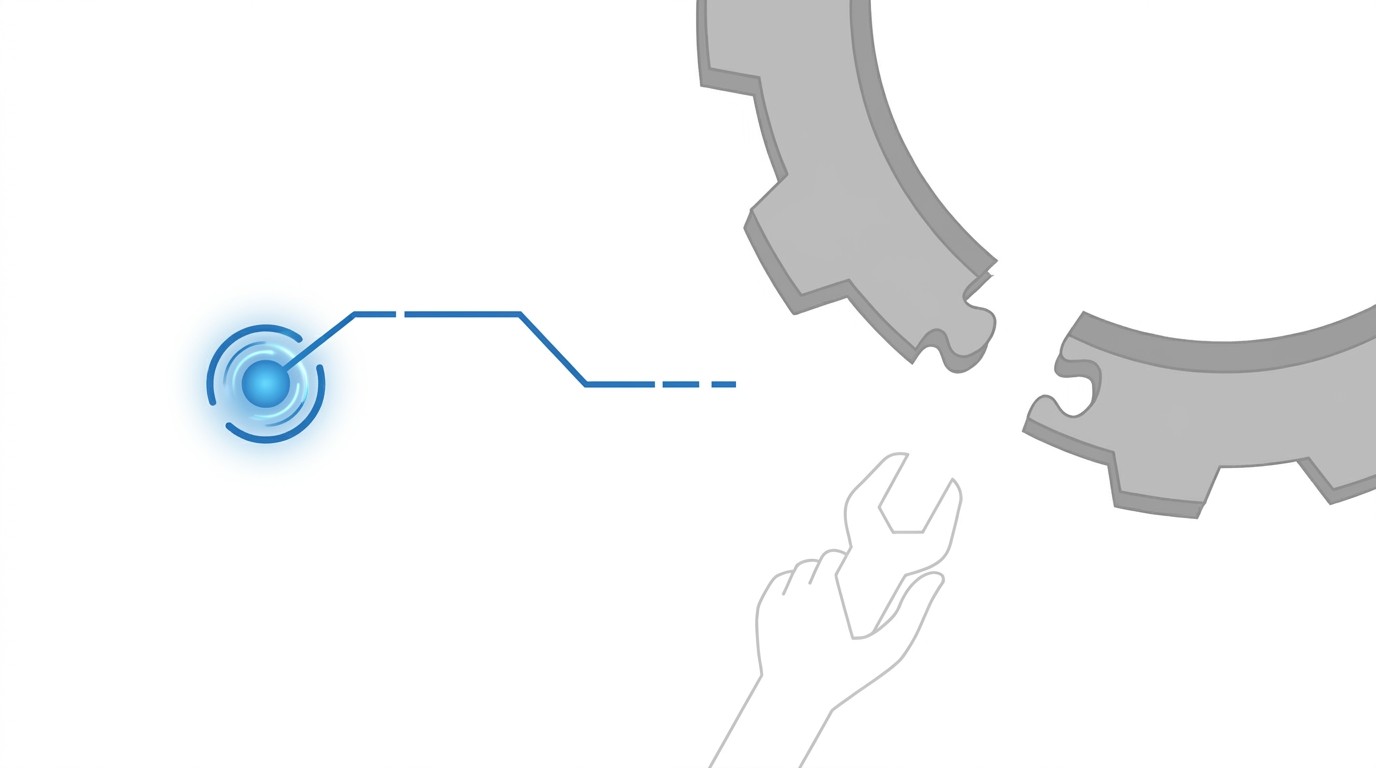
The Model Finds the Customer, Then the Queue Takes Over
A collections manager opens the Monday dashboard at 8:45 and sees a neat risk list from the latest prediction run. The model has done its job. It has grouped accounts by likelihood to pay, likelihood to dispute, and likelihood to respond to a nudge. Then the handoffs begin, and each one adds friction: the segment gets exported, the campaign loads, messages go out, and agents are asked to update records after the customer acts.
That sequence is why using AI to predict customer behaviour can feel productive while the operation still struggles. The work moves from guessing to chasing. Honestly, we think that's the part many teams underestimate, because the prediction layer is visible and impressive, while the operational layer is buried inside scripts, queues, and reconciliation tasks.
Better Targeting Can Still Create More Manual Work
Predictive scoring has a real place in financial services operations. It can reduce wasted outreach and help teams focus on customers who are more likely to act. That's a fair argument, and it's why so many leaders are investing in it. The limitation is simple: better targeting often increases response volume before the operation is ready to absorb it.
A major retail bank saw a version of this when a collections campaign scaled by 4x to 200,000 messages per month. Customers were trying to engage, but inbound lines created queue times of up to two minutes, and call abandonment moved from under 10% to over 50%. The outreach worked. The resolution path failed. Prediction would not have fixed that on its own.
Conversation Metrics Hide the Real Cost
Open rates and reply rates can make the automation story look strong. They tell you whether contact happened, but they don't tell you whether the balance actually changed or the compliance flag cleared. That distinction matters more than it looks.
A useful analogy is a teller line where every customer receives the right ticket number, but the counter can't process the transaction. The routing is better. The waiting room is still full. After a while, agents don't feel like automation has supported them. They feel like it's created a more organized backlog.
The real test is not whether the system predicted the next action. The real test is whether that action finished without manual clean-up.
How to Turn AI Predictions Into Completed Actions
Predictive workflows should be designed backwards from completion, not forwards from the model output. Start by defining the action that must be finished, then work back through the channel, policy rules, and writeback requirements needed to support it. That shift keeps AI tied to operational results.
Define the Action Before You Trust the Score
A score is only useful if it points to a specific action. Before approving any predictive workflow, ask four questions: what customer action do we want, where will they complete it, what evidence must we capture, and which system must be updated when it's done? If any answer is unclear, the workflow isn't ready for automation.
We've seen teams start with a broad prediction like "likely to default" and then struggle to turn it into a useful journey. A better version is narrower: "eligible customer likely to accept a compliant payment arrangement within seven days." That framing changes the build entirely, because it tells the team exactly what message to send and what outcome must be recorded.
The check is practical. First, name the customer action in plain language and confirm it's allowed under policy. Then identify the system field that proves completion, and decide what happens if the customer can't complete the action.
Separate Prediction From Eligibility
Using AI to predict likely behaviour doesn't mean every predicted action should be offered. Eligibility has to sit between the model and the customer experience. A customer may be likely to accept a plan, but if the account status or risk rule blocks that option, the system should not present it.
That sounds obvious, but it's where many no-code pilots stall. Drawing a path is easy. Encoding the rules behind that path is harder. We prefer a simple rule: if an agent would need to check a policy table before approving the action, the workflow needs that same rule before the customer sees the option.
There is a tradeoff here. More eligibility logic takes longer to model at the start, and some teams prefer to launch quickly with lighter rules. That's valid for low-risk notifications. For billing, collections, and compliance work, speed without policy control creates rework later, and rework is exactly what automation was meant to remove.
Put the Task Inside the Message
Predictive AI works better when the action happens where the customer already is. If the message tells the customer to log into a portal or call a centre, the model has only improved the invitation. The actual task still depends on the customer switching context at the moment of decision.
A private higher education institution we worked with faced a similar issue with overdue student accounts. Email statements were easy to ignore, and portal adoption was low, so payment cycles stayed slow. When the process shifted to mobile statements with identity verification and direct self-service options, students could view the amount owed and act immediately. The key change wasn't just a better message. It was removing the barrier between attention and action.
For financial services operations, the same principle applies to failed payments and document collection. If the prediction says a customer is likely to respond now, the message should carry the next step with it. Otherwise, the customer has to restart the journey somewhere else.
Build Exception Paths Into the Workflow
A predictive workflow without exception handling becomes another queue with nicer labels. Payment declines, missing data, and disputed amounts all need defined paths. If those cases fall out of the flow without context, agents end up doing discovery work again.
The practical threshold is simple: if more than 15% of cases are expected to need judgment, design the agent handoff before launch. That doesn't mean every exception needs a long process. Some need a call. Some need a document. Some need a different message after a time delay. What matters is that the system knows the difference.
We were surprised, early on, by how much agent time gets wasted after "successful" automation. The customer clicked, responded, or submitted something, but the case still arrived with missing context. A good exception path should pass the reason, the failed rule, and the next recommended step, not just the customer name.
Measure Resolution, Not Campaign Activity
Campaign reporting often stops too early. Delivered, opened, and replied are useful signals, but they don't prove that the work finished. For using AI to predict operational outcomes, measurement has to follow the case until the system of record reflects the change.
A better scorecard has four layers. First, did the customer receive the message? Second, did they open the in-message task? Third, did they complete the required action? Fourth, did the outcome write back correctly? If the fourth layer fails, the operation still carries the risk, even if the dashboard looks positive.
Track these measures by workflow:
Completion rate: The percentage of predicted cases that finish the intended action.
Time-to-resolution: The time between trigger and completed outcome.
Writeback success: The percentage of completed actions recorded in the system of record.
Agent deflection: The percentage of routine cases completed without agent touch.
Exception quality: The percentage of escalations that arrive with enough context for action.
The hidden advantage is that these measures expose where the workflow is broken. Low clicks suggest a message or channel issue. Low completion points to friction or eligibility problems. Low writeback success reveals integration reliability gaps that no single metric could surface on its own.
How RadMedia Closes the Prediction Loop
RadMedia connects predictive triggers to completed customer actions inside the message. The service links back-end events to secure in-message self-service and writes outcomes back to systems of record, with policy-aware workflow logic running in between. That means operations teams can measure resolution instead of stopping at campaign response.
From Predicted Need to In-Message Action
RadMedia is built for the point after prediction, where the customer needs to do something and the operation needs proof that it's done. Managed Back-End Integration connects billing and compliance systems so triggers can feed the right context into the workflow. In-Message Self-Service Mini-Apps then let customers complete eligible actions inside SMS, WhatsApp, or email after identity checks.
That matters when using AI to predict who needs outreach, because the next step can't be a generic message. It has to be a secure action path where the customer can, for example, update a card or sign an attestation without leaving the conversation. RadMedia presents only the actions that match the policy and context, then captures the structured input and evidence.
Writebacks Make the Outcome Real
RadMedia's Closed-Loop Resolution and Writeback capability handles the part that usually breaks after the customer acts. Outcomes write back to systems of record, updating things like balances, arrangements, and compliance flags in a single pass. The Autopilot Workflow Engine advances the case with policy-aware rules and exception routing, so routine work doesn't keep falling back to agents.
Operational visibility is part of the same loop. RadMedia emits telemetry across the entire journey, from delivery through writeback, so teams can see where completion is happening and where cases are falling out. For the retail bank scenario, that distinction would have mattered immediately: the campaign didn't need more calls, it needed a self-service path that could resolve overdue accounts without forcing customers into a broken queue.
When predictive workflows are ready to move from scoring to finished outcomes, Ready for customer communication workflows on autopilot? Get in touch.
Make Prediction Accountable to Resolution
Using AI to predict customer behaviour is valuable, but only when the prediction leads to a completed task. Financial services teams don't need more signals that create more follow-up. They need workflows that carry the customer from trigger to action to writeback with fewer handoffs.
Start with one high-volume, policy-bound use case. Define the finished outcome, map the eligibility rules, put the task inside the message, and measure whether the result updates the system of record. That's where prediction becomes operational value, not just another dashboard.