
Understanding Closed-Loop Resolution in Customer Service
Optimize customer service by focusing on closed-loop resolution, ensuring cases finish in the same message they start. Shift metrics from volume to completion to reduce costs and risks while improving customer satisfaction.
When operations teams optimize for volume, they overlook the thing that matters: outcomes. The most valuable metric in customer communications is closed-loop resolution. If a case starts in a message, it should finish there, with a safe writeback to your systems of record. Anything else adds cost, compounds risk, and leaves people doing reconciliation by hand.
We see the same pattern often. Teams scale messaging across SMS, email, and WhatsApp, then push customers to a portal or a phone queue at the moment of action. Completion drops, queues grow, and leaders wonder why deflection stalled despite big investments in tooling. Like this case study shows, the truth is simple: conversation without completion is operational debt.
Key Takeaways:
Shift your success metric from conversations to resolution that finishes inside the message
Define “done” for each workflow, then encode eligibility, rules, and exception paths
Connect triggers and data contracts before creative, so messages carry context that drives action
Use channel-native, secure self-service to remove the login and app-download detours
Sequence outreach for action, not volume, with consent, timing, and fatigue controls
Instrument completion rate, time-to-resolution, writeback success, and deflection as core KPIs
Start with one high-volume workflow to prove cost and queue reduction fast
Why Conversation Metrics Fail Without Closed-Loop Resolution In Customer Workflows
Conversation metrics alone fail because they don’t prove that work is finished. A closed-loop approach starts and ends inside the message, then writes outcomes back to core systems. When you anchor on completion, you stop counting activity and start measuring what reduces cost and risk.
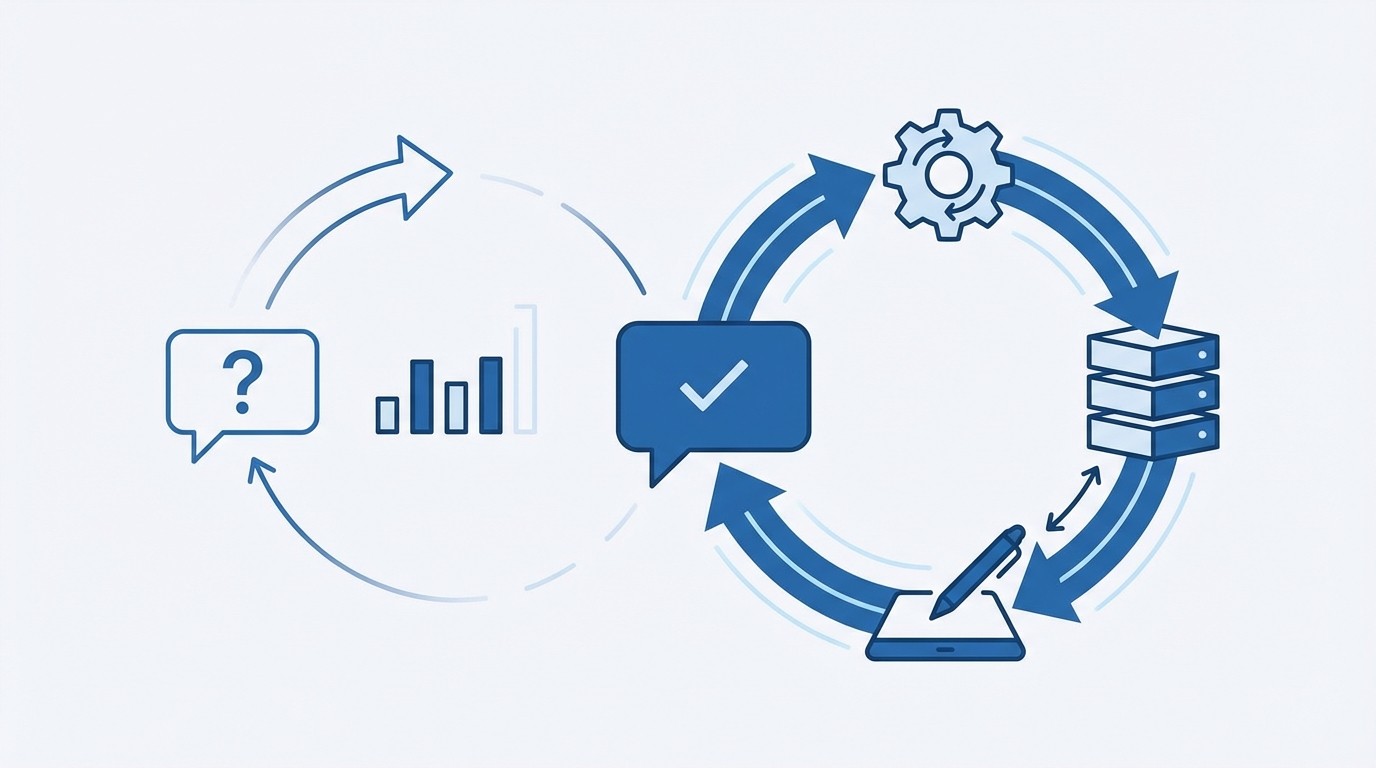
Symptom: High Contact Volume, Low Completion
High contact volume with low completion is a classic signal that action lives somewhere else. Messages push people to log in, wait in a queue, or repeat identity checks, and many drop. You see sends and opens, maybe even clicks, but not enough finished payments, plan setups, or attestations. Leaders feel the gap when escalations climb even as outreach increases.
The pattern is not random. It is a design problem that asks customers to switch channels at the moment of decision. That switch adds cognitive load, introduces password friction, and increases abandonment. In collections and billing, a single missed step can mean a lost payment or a compliance miss that shows up later in audit. It is frustrating for teams and customers. It feels like chasing your tail during month-end close.
Completion requires the action to live inside the conversation, not after it. When customers can confirm details, select a compliant plan, or update a card where they read the message, completion rises and queues shrink. Without that shift, you will keep paying twice: once for the contact and again for the agent time to clean it up.
Root Cause: Split Between Messaging And Action
Most stacks split messaging from action. Messaging tools broadcast. Portals and agents transact. That divide seems neat on a diagram, but it breaks under real-world pressure. Identity verification moves to another channel. Policy eligibility gets rechecked by a person. Writebacks happen at wrap-up, if someone remembers. The handoffs feel small, but they add up.
We have seen operations teams assume a chatbot will fill the gap. Bots detect intent, but they rarely hold the keys to your cores. When the flow needs to touch balances, flags, or documents, the case moves to a queue. That is not failure of AI. It is a system boundary. You can’t finish a policy-bound transaction without safe integration and guaranteed writebacks.
The fix is connecting triggers, policies, and transactions to the same flow that reaches the customer. That way, every step from message to outcome is one path, not three. When you remove the split, you remove the places where work leaks and agents must retype what customers already gave you.
Hidden Costs: Handoffs, Reconciliation, And Risk
Every handoff carries cost and risk. A customer explains a problem to a bot, gets routed to a portal, then lands with an agent who asks the same questions. It wastes time, increases error rates, and erodes trust. Research has shown that reducing customer effort is a strong driver of loyalty and cost reduction, because fewer steps mean fewer chances to fail. The classic case is well documented by Harvard Business Review. It’s the same reason we suggest teams Stop Celebrating Conversations and reframe metrics to resolution and cost-to-serve.
The costs are not just soft. Manual reconciliation consumes hours, delays writebacks, and creates audit gaps when evidence is scattered across tools. When identity checks repeat or break, you introduce risk. When writebacks are delayed, reports go stale and managers make the wrong capacity calls. You can measure these drags in unit cost and time-to-resolution.
Emotionally, this wears teams down. They know the work is routine and policy-bound, yet they still process it by hand. That disconnect breeds frustration. Fixing it is not about nicer messages. It is about finishing the job where it starts and proving it in your systems.
How To Design Closed-Loop Resolution In Customer Communications
Closed-loop resolution in customer communications means defining “done,” modeling rules and exceptions, connecting triggers, and letting customers act securely inside the conversation. The approach is teachable and repeatable. Start with one workflow, prove completion and deflection, then expand shape by shape.
Define Resolution For Each Workflow
Start by naming the outcome that matters for each high-volume workflow. For billing remediation, it could be a processed payment or a promise-to-pay captured with consent. For compliance refresh, it might be validated identity plus documents on file. You cannot measure what you have not defined, and this is where most teams go wrong.
Be specific about the evidence that proves completion. That includes the data you need to capture, the validations you must enforce, and the writebacks that signal “case closed” in your systems. In our experience, this clarity reduces scope creep and keeps everyone aligned when edge cases appear. It also shortens arguments about design because “done” is not a feeling.
A clear definition helps downstream teams too. Risk signs off faster when they see the exact validations. Finance trusts the numbers when writebacks are idempotent and auditable. Agents understand when to intervene, because exceptions are explicit, not just “when it feels stuck.”
You can capture resolution definitions in a simple template:
Outcome: the exact state change you expect
Evidence: what must be collected or validated This is particularly relevant for closed-loop resolution in customer.
Writebacks: which systems receive which updates
Exceptions: paths that require human review
Model Policies, Eligibility, And Exception Paths
Policies decide what is allowed. Eligibility gates decide who can take which path. Map both before you write a single message. Without this, you risk letting customers select plans they do not qualify for or submit incomplete data that stalls later. The result is rework, which looks like progress in a dashboard but feels like waste on the floor.
Write exception paths as first-class flows, not afterthoughts. When a rule blocks completion, define what happens next. Do you collect an alternate input? Do you escalate to an agent with full context? Do you pause and retry when a downstream system is unavailable? We have found that writing these branches early prevents a brittle happy-path design.
A good exception design keeps people focused on judgment, not discovery. When work does reach an agent, they should see what was attempted, what failed, and what is still needed. That cuts handle time and saves both the customer and agent from repeating steps that already happened.
Connect Triggers And Data Contracts First
Integration is where most no-code pilots stall, so connect your triggers and data contracts first. Triggers define when a workflow starts and what context it carries. A failed payment trigger, for example, should include amount, due date, contact preferences, and any policy flags. That context powers messaging that drives action, not just awareness.
Formalize your data contracts. Specify field names, types, and validation rules. Confirm how you will subscribe to events, whether by webhook, polling, or secure batch. Decide how you will post outcomes back, and which idempotency keys you will use to protect consistency. Doing this upfront prevents the classic mistake of designing great flows that cannot transact safely.
In practice, this step makes creative work easier, not harder. Writers and designers stop guessing about what the customer will see. Engineers stop reworking flows to match missing fields. Operations leaders stop worrying about whether a writeback will happen. Everyone benefits when the data shape is known and the connections are real.
When mapping triggers and contracts, cover these basics:
Event source and timing
Required context fields and validations
Consent status and channel preferences
Outcome payloads and writeback endpoints
Design Channel-Native, Friction-Right Self-Service
Self-service works when it is embedded where the customer already is. That means a secure, no-download mini-app inside SMS, email, or WhatsApp that exposes only policy-eligible actions. Identity has to be right-sized: one-time codes, known-fact checks, or signed links that balance risk and ease. Overdo it and people drop. Underdeliver and you invite fraud.
Keep forms short and focused on the decision. Pre-fill what you know from the trigger payload. Validate inputs inline, not five screens later. Capture explicit consent with a timestamp and retain the evidence. These are not nice-to-haves. They are the safeguards that keep risk teams comfortable while completion rises.
Designing for the channel matters too. SMS has different constraints than email. WhatsApp has a template system and strong user expectations. Teams that lean into each channel’s norms see higher response and fewer complaints. The official guidance on the WhatsApp Business Platform is a good starting point for template and policy basics.
Sequence Outreach For Action, Not Volume
Broadcasting more messages does not fix a broken flow. Sequence outreach for action, not noise. Respect quiet hours and consent. Personalize with the trigger data that matters, like due dates or eligibility. If the first message does not convert, consider a different channel at a better time, not three more pings in a row, especially when evaluating closed-loop resolution in customer.
Cadence is a lever, but so is content. Lead with the action and the secure link into the mini-app. Avoid sending people to a homepage or a generic portal. If you need an explanation, keep it tight and put it after the call to action. Most customers want to finish and move on. Give them the shortest safe path to do that.
Track which sequences actually drive completion for each workflow and segment. You will often find that fewer, better-timed touches outperform aggressive schedules. This reduces fatigue complaints and keeps regulators comfortable. It also reduces cost, because every send has a price even if your platform hides it.
A simple cadence test plan could include:
Two timing windows per channel, based on historical response
A cross-channel escalation only after a clear pause
Content variants that change the lead line, not the entire message
Instrument Completion Metrics And Audit Trails
If you do not measure completion, you will default back to vanity metrics. Establish a dashboard that shows completion rate, time-to-resolution, writeback success, and deflection. These are the numbers that move cost-to-serve and show whether the approach is working. Many teams already track pieces of this. Stitching them together is what unlocks continuous improvement.
Audit trails are not just a compliance checkbox. They are how you learn. When every step is logged, delivery, open, action, validation, writeback, you can pinpoint where drop-off happens and why. Then you can tune identity friction, adjust messaging, or refine eligibility without guessing. It is the difference between iteration and hope.
Finally, make the data portable. Export outcomes and logs to your data lake or SIEM so enterprise reporting does not become another handoff. Operations, risk, and finance should be looking at the same truth. That alignment reduces internal friction and speeds decision-making when something breaks.
Ready to turn design into outcomes without piling more work on your team? Let’s chat.
From Policy To Proof: Making Closed-Loop Resolution Real With RadMedia
RadMedia enables closed-loop resolution by connecting triggers, policies, and channels to the same flow that customers use to act. It manages back-end integrations, orchestrates omni-channel outreach, and executes rules so routine work finishes inside the message. The outcome writes back to your systems with audit evidence, which is what reduces cost and clears queues.
What RadMedia Connects And Orchestrates
RadMedia’s managed back-end integration removes the hardest part of automation. The team wires legacy cores and modern APIs, handles authentication and schema mapping, and subscribes to triggers that carry the right context. That foundation means messages point to real actions, not dead ends, and outcomes can be posted back safely without manual wrap-up.
On top of that, RadMedia sequences SMS, email, and WhatsApp for action. Outreach respects consent, timing, and fatigue, then drives customers into secure in-message mini-apps. The Autopilot Workflow Engine enforces eligibility, advances each case, and routes exceptions with full context when human judgment is required. In our field work, this is where unit cost drops, because routine work no longer spills into agent queues.
The platform connects capabilities that too often live apart:
Managed back-end integration that posts outcomes idempotently
Omni-channel orchestration tuned for completion, not volume
Autopilot rules that encode policy and move cases forward
Secure mini-apps inside the message for immediate action
How Outcomes Write Back And Prove Completion
RadMedia’s in-message self-service presents only policy-eligible actions after right-sized identity checks. Customers update cards, choose compliant plans, confirm details, upload documents, or sign an attestation without leaving the conversation. When they finish, RadMedia writes outcomes directly to systems of record, updating balances, flags, notes, and documents. Idempotent writebacks, retries with backoff, and circuit breakers protect consistency when downstream systems wobble.
Security and audit are built in. Transport is encrypted, access is role-based, and one-time codes or known-fact checks guard the front door. Every consent, input, validation, and writeback is timestamped. Telemetry shows deliveries, opens, actions, and completion so operations leaders can measure the numbers that actually matter. This closes the loop and addresses the rational costs we named earlier: less reconciliation, faster resolution, and fewer escalations.
If you want to see how this comes together in your environment, book a demo.
Start With One High-Volume Workflow And Measure Resolution for Closed-loop resolution in customer
Start small, prove resolution inside the message, then expand. Pick a workflow with clear “done,” meaningful volume, and policy paths you can encode. Connect triggers and writebacks first. Launch with channel-native self-service. Measure completion, time-to-resolution, writeback success, and deflection.
When the numbers move, roll the pattern to adjacent workflows. The shift from conversation volume to closed-loop outcomes pays back quickly.
Ready for customer communication workflows on autopilot? Get in touch.