
Reducing Bad Debt Through Early Automated Engagement and Follow-Ups
Reducing bad debt relies on effective customer actions rather than just increased conversations. Automation must facilitate seamless resolutions without extra steps, ensuring updates are efficiently recorded to lower manual follow-ups and enhance outcomes.
By the time an account reaches 30 days past due, the number of messages sent can start to feel like progress. Reducing bad debt through better communication only works when the customer can take the next action inside the same flow, and when that action updates the account record without manual clean-up.
A lot of collections automation still stops too early. It sends reminders and routes replies, but the results don't always match expectations. Customer engagement may improve while agent workloads stay high, and too many interactions still need manual follow-up. The system looks automated, but it isn't actually built to resolve things.
Key Takeaways:
Bad debt reduction depends less on conversation volume and more on completed customer actions.
Messaging only changes collections outcomes when it removes the portal login and call centre handoff.
The writeback should be defined before the message is designed, because completion has to land in the system of record.
A strong starting point is one high-volume, policy-bound workflow where customers are already willing to act.
Resolution metrics should track completion rate, time-to-resolution, and writeback success.
Why More Customer Conversations Still Leave Bad Debt Behind
More customer conversations don't automatically reduce bad debt because conversations are only a path to action. If the message asks the customer to switch channels or log into a portal, the workflow still carries friction. In collections, friction is where intent gets lost.
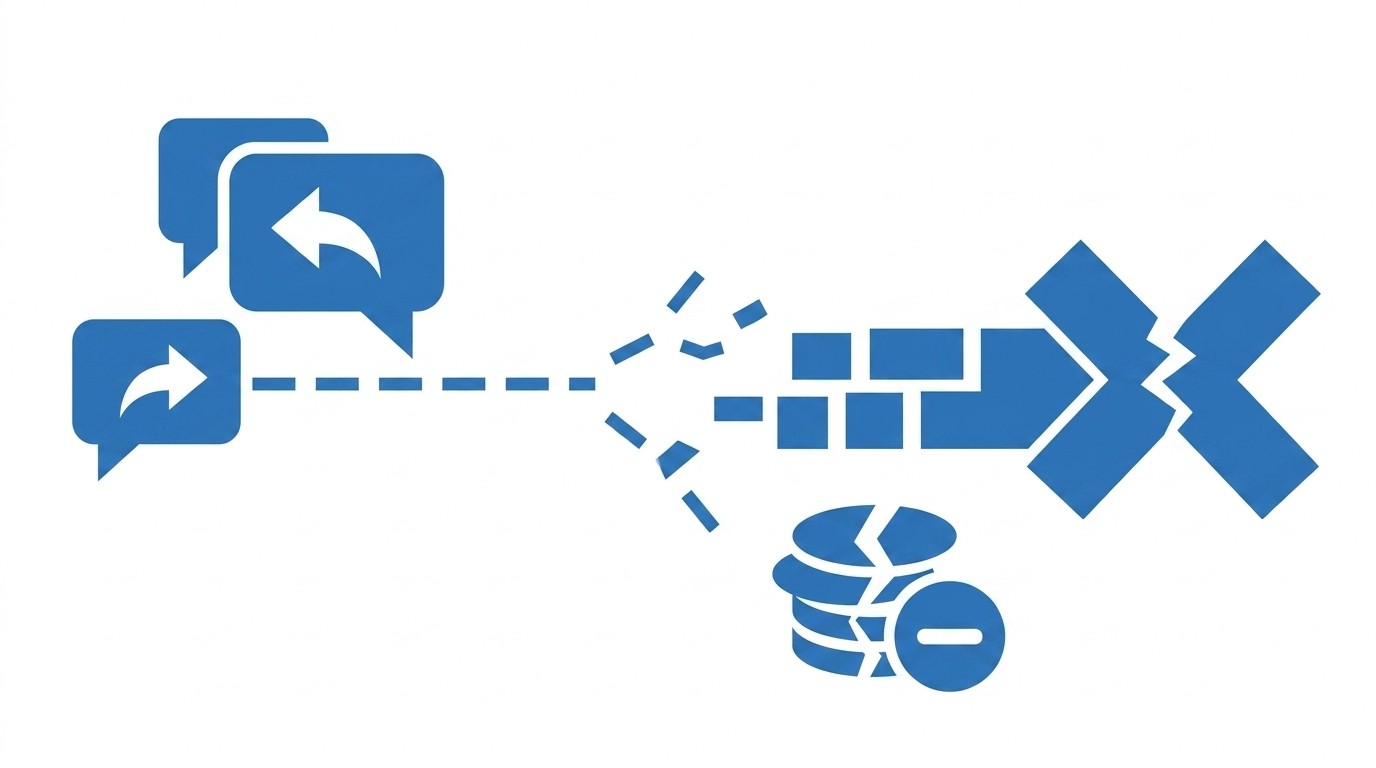
The Metric Looks Healthy Until the Account Stays Unresolved
Conversation metrics can be useful. We don't think operations leaders are wrong to track delivery, opens, or call deflection. Those numbers show whether your outreach is reaching people, and in a regulated environment, reach matters. The problem starts when those numbers become the headline metric while account outcomes sit in a separate report.
A customer can open a message, click a link, and still fail to make a payment arrangement. That sequence produces activity, but it doesn't reduce arrears. In our view, reducing bad debt through messaging needs a stricter test: did the customer complete a policy-approved action, and did the outcome write back to the account? If the answer is no, the workflow created evidence of effort rather than evidence of resolution.
A Day Inside the Broken Collections Loop
Picture a billing manager checking the morning dashboard after a large reminder run. Delivery rates look good. Click activity is better than last month, and the chatbot report shows a lift in handled interactions. By 10 a.m., the contact centre queue tells a different story. Customers clicked, got stuck at the portal login, and called for help. Agents are now verifying identity before rekeying details the system already requested.
That kind of loop is frustrating because everyone did their part. The campaign went out and the customer responded, and the agent was available. Still, the account didn't move until a person stepped in and completed the operational work manually. For teams measured on cash flow and cost-to-serve, that gap isn't a small inconvenience. It's the place where automation gives back the savings it promised.
Why Conversation Volume Hides Operational Debt
Conversation volume can hide bad debt risk because it rewards motion before completion. A messaging tool can start thousands of interactions, but if each successful action still needs manual reconciliation, the operating model hasn't changed much. The work has just moved from the front of the queue to the back office, where it becomes harder to see and easier to ignore.
A better analogy is statement processing. No one would celebrate a monthly statement run just because the files were generated. The real test is whether the right customer received the right message with a workable action, and whether the downstream record stayed correct. Collections messaging should be held to the same standard. The next question is practical: how do you design for completion before you design for contact?
How to Reduce Bad Debt by Designing for Completion
Reducing bad debt starts with designing workflows around the completed customer action, not the outbound message. The message should carry the customer to a secure action and produce a usable update in the system of record. Without that sequence, messaging remains a reminder system rather than a resolution system.
Start by Separating Intent From Resolution
A reply is not the same as a resolved case. That sounds obvious, but it gets missed surprisingly often when teams evaluate automation tools. A customer who says, "I want to pay Friday," has shown intent. The case is only resolved when the promise is captured against policy and attached to the account, so the next workflow can act on it.
Before changing channels or adding another bot, run a simple check on your current collections flow. Pick the last 100 digital engagements where the customer clicked or replied, then trace how many reached a completed account outcome without agent involvement. If fewer than half made it through without manual work, the problem isn't engagement. It's completion leakage, and reducing bad debt through extra outreach alone won't fix it.
Use these questions to diagnose where the leakage sits:
Did the customer have a clear action inside the message? If not, the workflow is still only a reminder.
Did the action enforce eligibility rules? If not, agents will keep correcting invalid choices.
Did the outcome update the account record? If not, back-office reconciliation remains the hidden cost.
Did exceptions carry context to agents? If not, escalations restart from discovery.
Choose One Workflow Where the Customer Is Ready to Act
The best first workflow is rarely the most complex one. We prefer starting with a high-volume, policy-bound action where customers already understand what needs to happen. Promise to Pay is a good example because the customer knows the account is overdue and the business can define acceptable dates and amounts. It doesn't need a long conversation. It needs a safe path to commitment.
One financial institution used a self-service Promise to Pay flow triggered by personalised mobile messages. Customers received account details and a link to choose an amount and future date, with SMS fallback when rich media delivery failed. The important number wasn't the click rate. It was that 50% of customer engagements resulted in a successful self-service Promise to Pay. That is the difference between reducing bad debt through contact and reducing bad debt through completed action.
Remove the Portal Step at the Moment of Decision
Portals have a valid place in financial services. They support broad account access and longer self-service journeys. We wouldn't argue that every customer workflow should leave the portal behind. The issue is timing. When a customer is responding to a specific collections message, asking them to remember a password can break momentum at exactly the wrong point.
A stronger flow keeps the action close to the message. The customer taps, verifies identity, and completes the task without searching for the right page. For reducing bad debt through digital communication, that matters because willingness to act is often brief. A reminder creates a window. Each extra step narrows it.
A practical rule works well here: if the customer came from a message about one account issue, show one account issue and one clear path to resolve it. For example, don't send them to a general portal dashboard, and don't make them hunt for the payment plan option. Keep the task small enough to finish, and the completion rate becomes a real operational lever.
Define the Writeback Before You Design the Message
The writeback is where many automation projects get exposed. Drawing the customer journey is the easy part. The hard part is deciding what the system of record must know after the customer acts, then making sure that update happens reliably. Without that, the message may feel modern, but the operations team still has to reconcile outcomes by hand.
Define completion in operational terms before the campaign is built. For a Promise to Pay flow, completion might mean amount, date, and consent evidence tied to the account reference, with agent visibility. For a card update flow, it might mean validation status alongside an updated payment token and account flag removal. We might be wrong about the exact sequence for every institution, but the principle holds: if the writeback isn't specified upfront, it becomes an exception later.
A useful decision rule is simple. If the outcome affects balance, eligibility, or next contact timing, it needs a system update, not just a campaign report. If the update can't be automated safely, reduce the scope of the workflow until it can. That may feel slower at the beginning, but it prevents a common mistake: launching a digital journey that increases back-office work because no one designed the final transaction.
Measure Deflection Only When the Case Actually Closes
Deflection is often counted too early. A customer who avoids an agent for five minutes and then calls because the payment link failed wasn't really deflected. The case took a longer route. In collections, that distinction matters because bad debt reduction depends on fewer unresolved accounts, not fewer initial calls.
A more useful scorecard separates communication activity from resolution outcomes. Track sends and opens, yes, but don't let them carry the business case. The core metrics should be completion rate and time-to-resolution, alongside writeback success and the percentage of routine cases closed without agent touch. When those improve together, you can say the workflow is reducing bad debt through resolution rather than shifting demand between channels.
The threshold we like is conservative: don't count a case as deflected until the customer action is complete and the account record reflects it. If an agent needs to verify or rekey the update, the case belongs in an assisted category. That honesty can be uncomfortable at first. It also gives operations leaders a cleaner view of where automation is actually working.
Build Exception Paths That Start With Context
Not every case should complete without a person. Some customers will dispute the amount or fail identity checks, and some will need support that policy can't automate. That doesn't weaken the case for self-service. It sharpens it, because the goal is not to remove agents from all work. The goal is to stop routing routine, policy-bound work through people who should be handling edge cases.
The exception path should carry the full story forward. If a customer tried to make an arrangement and failed because the selected date was outside policy, the agent shouldn't start by asking what happened. The workflow should show the attempted action and the reason for failure, along with the next valid option and customer details already verified. That makes the agent faster, but more importantly, it protects the customer from repeating themselves.
A good operating model sorts work into three buckets:
Straight-through resolution: The customer completes the action and the account updates automatically.
Guided exception: The customer tried to act, but a defined rule requires agent support.
True judgement case: The issue needs human review because policy, risk, or customer context is not straightforward.
That split is where reducing bad debt through automation becomes more credible. It doesn't pretend every case is simple. It gives simple cases a direct path and preserves human judgement where it actually adds value.
How RadMedia Closes the Message Loop
RadMedia supports completion-focused collections workflows by connecting customer messages and in-message actions to rules and writebacks in one managed service. Instead of treating SMS, WhatsApp, and email as separate outreach channels, it sequences them around the customer action. The aim is simple: resolve routine work inside the message.
Orchestration Tuned for Completion
RadMedia's omni-channel messaging orchestration sequences SMS, WhatsApp, and email so each touch points toward a secure action, not just a reply. Consent and channel preference shape the sequence, alongside timing, cadence, and customer context. That means a failed payment or due-date threshold can produce a message that leads directly to the right self-service step.
The in-message self-service mini-apps are where the workflow changes. Customers can verify identity and see policy-eligible actions, then authorize a payment or choose a compliant plan without being pushed into a general portal. They can also confirm details, upload documents, or sign an attestation in the same flow. For operations teams trying to reduce bad debt through completed action, that removes a major source of drop-off. The message doesn't just ask for action. It contains the action.
Writebacks That Make Resolution Measurable
RadMedia's managed back-end integration and closed-loop resolution writeback address the part that usually stalls automation. Outcomes can update systems of record with balances, flags, notes, documents, or arrangements, with idempotent handling and retries designed to protect consistency. The Autopilot Workflow Engine also applies policy-aware rules and routes exceptions with context, so agents handle cases that need judgement rather than routine capture.
Operational visibility matters here. RadMedia emits telemetry across deliveries, opens, actions, validations, writebacks, and completion, so the measurement moves beyond sends. That connects directly to the earlier scorecard: completion rate, time-to-resolution, writeback success, and deflection. If your next priority is turning high-volume collections workflows into measurable resolution paths, Ready for customer communication workflows on autopilot? Get in touch.
What Changes When Resolution Becomes the Metric
Resolution changes the collections conversation because it forces every channel, rule, and integration to prove its value against account outcomes. Messages still matter, but only as part of a workflow that customers can complete. For bad debt reduction, completion is the point where communication becomes operations.
The shift is not about adding more technology to an already crowded stack. It is about asking a stricter question of the tools already in play: did the customer finish the task, and did the record update? When the answer is yes, agent workloads fall, routine cases move faster, and reducing bad debt through customer communication becomes measurable rather than assumed.