
Reducing Call-Waiting Times by 85% Through Conversational AI Deployment
Deploying conversational AI can reduce call-waiting times by 85% by automating routine tasks directly within messaging, eliminating the need for customers to transition to agents. Focus on completing actions rather than just initiating conversations for true efficiency.
A 90-second queue is enough to expose the real gap in a billing or collections workflow: the customer was ready to act, but the system still sent them to a person. Reducing call-waiting times by adding agents only treats the visible pressure point, because the routine task still has to move from message to portal to call centre before anything gets updated. That delay is where cost builds and customers drop off, even though the workflow looked automated from the outside.
A collections team can add more agents, tune IVR menus, and send more reminders, but the queue still grows if every customer has to call to complete a simple action. We've seen this pattern often: the messaging layer looks active, customer intent is real, and the operational result still lands back in the contact centre.
Key Takeaways:
Reducing call-waiting times with more agents only makes sense if the query actually need human judgement.
Routine tasks should be designed to finish inside the message, not move from SMS to portal to agent.
Channel strategy matters less when SMS, WhatsApp, and email aren't tied to completion.
Safe integration and reliable writebacks are usually harder than drawing the customer journey.
The right metric is not conversation volume, it's completed actions that update the system of record.
Why Call Queues Persist After Messaging Automation
Call queues persist after messaging automation because the automation often starts conversations without completing the task. Customers still need to authenticate, choose an action, update a record, or confirm an arrangement somewhere else. When that final step falls back to an agent, call-waiting times remain high even though the system looks automated.
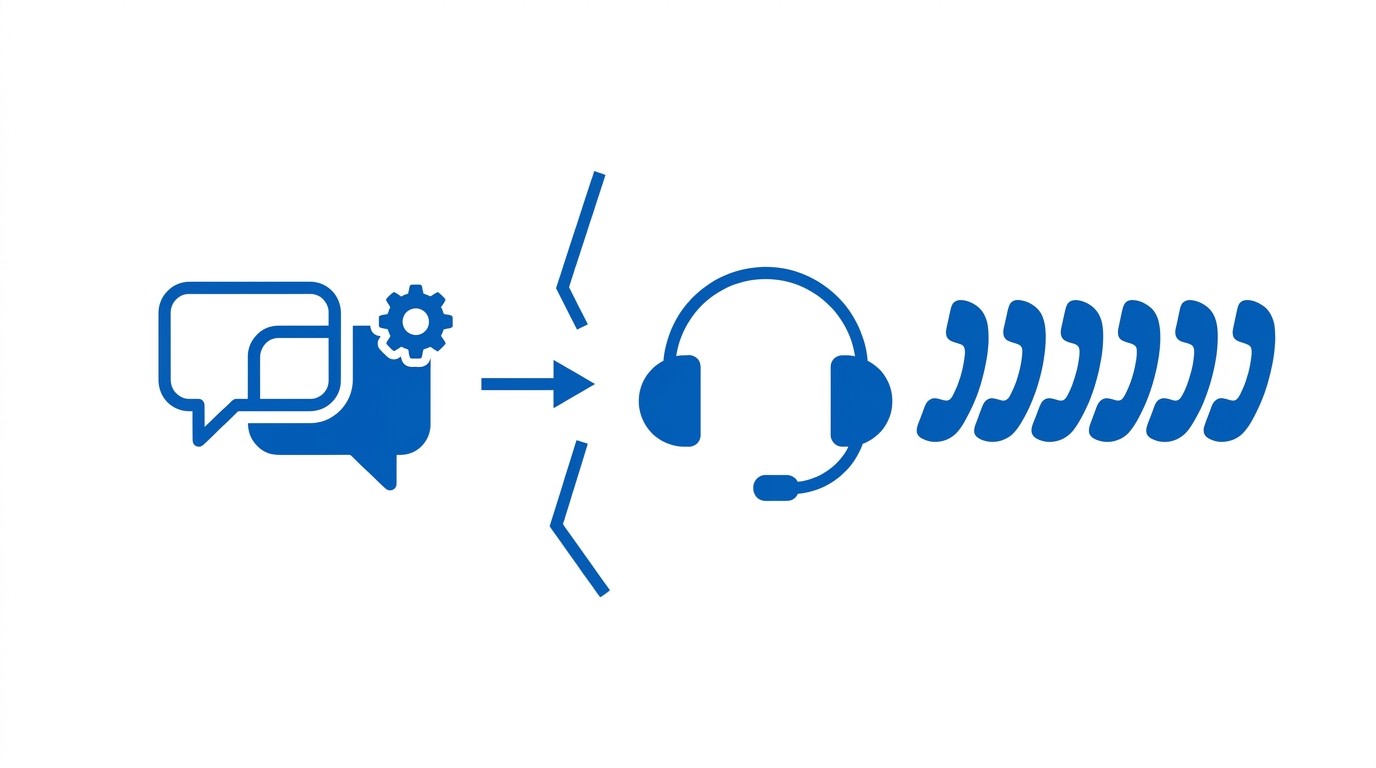
Messaging Creates Intent, but Queues Capture the Work
A major retail bank scaled a successful collections campaign by 4x and walked straight into the operational limit. Customers were responding, which should have been good news. Instead, the new inbound lines carried queue times of up to two minutes, and call abandonment moved from under 10% to over 50%. The campaign that looked strong on paper became difficult to justify. The customers weren't ignoring the bank — they were trying to resolve their accounts and getting lost at the handoff.
That's the overlooked issue with call reduction work. The message can create urgency, but if the next step is "call us," the contact centre inherits the volume. We don't think that's a messaging failure. It's a design failure. Increasing message reach will only reduce call-waiting times if the message gives customers a way to complete the action without joining the queue.
Portals Often Add Friction at the Worst Moment
Portals have their place, and it would be unfair to dismiss them entirely. For complex account management, document history, and account-wide service journeys, a portal can make sense. Where it breaks down is the routine action that depends on a login the customer doesn't remember, on a device they may not be using, at the exact moment they're ready to act.
A private higher education institution saw that pattern with overdue student accounts. Email statements were sent, the payment portal existed, and engagement stayed low because the path to action was too indirect. Once the workflow shifted to mobile statements with secure access and immediate payment or callback options, the payment cycle improved and overdue accounts fell. The rule that emerged: if the gap between message and action is more than two taps, expect a call.
The Root Cause Is Unfinished Resolution
Is the contact centre actually the problem? Usually not. Routine work keeps getting routed there because digital journeys stop before the operational record changes. A customer can click a reminder, start a chat, or open a link, and if the payment plan, document, dispute, or consent doesn't write back, someone still has to finish the job manually.
Picture the queue as a collections inbox with a phone attached to it. Every failed portal login, every unclear next step, every unposted customer action becomes another item that an agent has to interpret and resolve. Operations leaders focus on call-waiting times because the number is visible and painful. That's fair. The more useful question is what share of those calls should exist in the first place — and in most collections operations we've reviewed, 40-60% of routine call reasons are policy-bound tasks that never needed a human.
How to Reduce Call Waiting Through Resolution-First Messaging
Reducing call waiting through resolution-first messaging means removing routine cases from the queue before they become calls. The method is to identify high-volume, policy-bound tasks, move the action into the message, orchestrate channels around completion, and prove that outcomes write back correctly. Less glamorous than a new chatbot, but it works.
Diagnose the Calls That Should Never Reach an Agent
Are your top five call reasons scripted or judgement-based? That single question sorts the queue into work that belongs on the phone and work that shouldn't be there at all. If an agent asks the same verification questions and records the same outcome more than a few times a day, the workflow deserves a closer look. Not every call should disappear — disputes, hardship conversations, fraud concerns, and complaints still need people.
The diagnostic is practical. Pull a sample of recent call reasons and mark which ones are routine, policy-bound, and record-updating. A workflow is a good fit when the customer can complete it by confirming identity, choosing from approved options, and submitting structured information. If the agent needs judgement, negotiation, or empathy, keep the human path. If the agent is rekeying information from one system into another, the queue is carrying work that messaging could complete.
Use these questions before changing the workflow:
Can the customer take one of 2 to 5 approved actions?
Does the action require a system update, document, consent record, or payment instruction?
Can identity be checked without a full agent conversation?
Would a failed attempt need a clear exception path?
Can completion be measured without manual reconciliation?
If you answer yes to at least four of those five, the workflow is a strong deflection candidate. Three or fewer, and messaging will likely create noise without shrinking the queue.
Move the Action Into the First Message
More reminders rarely change the queue on their own. The message has to carry the next action, not just the instruction to take action somewhere else. A payment reminder that says "please log in" creates a detour. A secure message that lets the customer validate identity, choose a compliant payment option, and confirm the arrangement removes the reason to call.
The before-and-after contrast is stark. Before: the customer receives an SMS, opens a portal, fails a password step, and calls. After: the customer receives a secure message, verifies identity, sees only the actions allowed by policy, and completes the task in the same flow. We like this approach because it respects the customer's intent. When someone is ready to act, the system shouldn't ask them to become an administrator of your process.
A useful message-to-action flow looks like this:
Send a clear message tied to a specific trigger, such as a failed payment or document refresh.
Validate the customer with a one-time code, known detail, or signed access path.
Show only actions that match policy and account context.
Capture the customer's choice, consent, payment instruction, or document.
Route exceptions to an agent with the full context already attached.
Orchestrate Channels Around Completion, Not Preference Alone
Channel preference matters. Completion matters more. A customer may prefer WhatsApp for quick prompts, email for documents, and SMS for urgent reminders. Treating one channel as the answer creates blind spots because the channel that gets attention isn't always the channel that finishes the task. We've seen better results when SMS, WhatsApp, and email are sequenced around the workflow outcome rather than run as separate campaigns.
The practical rule is to build the channel plan backwards from the completed action. If the customer needs to make a Promise to Pay, upload a document, or confirm details, choose the channel sequence that gets them to that action with the fewest steps. A reminder without a secure action path is just pressure. A channel sequence that nudges, verifies, and completes has a different effect on call queues because fewer customers need help to finish.
For high-volume operations, the channel logic should define:
The first channel based on reach, consent, and urgency.
The follow-up channel if the first message is delivered but not acted on.
The fallback if the first delivery fails.
The time window that avoids fatigue and complaint risk.
The escalation point where an agent should intervene.
Protect the Writeback Before You Scale
Drawing the customer flow is easy. Safe integration and reliable writebacks are the hard part, and they're the part that decides whether the queue really shrinks. A no-code journey can look impressive in a workshop. If the outcome doesn't update balances, flags, notes, documents, or arrangement status, your team still has manual work at the end. That's where automation often looks finished, but isn't actually built to resolve things.
There's a fair counterpoint here. Some teams prefer to pilot without deep integration because it feels faster and lower risk. That can be valid for testing message copy, channel reach, or customer willingness to engage. Where the logic breaks down is mistaking a front-end pilot for an operational model. If the goal is reducing call-waiting times by moving routine work into messaging, the pilot has to prove writeback, not just clicks.
Before scaling, check the workflow against four operational tests:
What exact record changes when the customer completes the action?
What happens if the same customer submits twice?
What failure path applies if the system of record is unavailable?
What evidence is stored for audit, consent, and service recovery?
If any of those four don't have a documented answer, you're piloting a demo, not a workflow.
Prove Deflection With Completion Metrics
Call deflection is easy to overclaim if the measurement stops at engagement. Opens, clicks, replies, and bot interactions can all rise while agents remain overloaded. We prefer a stricter view: a case is deflected only when the customer completes the task and the outcome is recorded without manual wrap-up. Anything less is assisted demand, not resolved demand.
A financial services innovator used self-service messaging to capture Promise to Pay commitments, and 50% of customer engagements resulted in a successful self-service P2P. That matters because the metric wasn't just attention. It was a completed customer action that reduced the need for agent-driven dialer work. When operations teams measure that way, reducing call-waiting times by removing routine resolution from the phone becomes visible in the numbers that matter.
Track the metrics in layers:
Delivery and reach show whether the customer received the prompt.
Action rate shows whether the customer entered the self-service path.
Completion rate shows whether the task was finished.
Writeback success shows whether the system of record was updated.
Exception rate shows what still needs an agent and why.
Start With One Workflow Before Expanding
The safest way to reduce waiting time is to begin with one high-volume workflow where the policy rules are already clear. Failed payment recovery, card update prompts, document refreshes, address confirmation, and Promise to Pay capture are strong candidates because they repeat often and usually follow defined rules. Starting there gives the operations team a controlled way to prove completion, deflection, and writeback quality. It also avoids the mistake of trying to redesign the entire contact centre in one project.
A narrow start isn't a lack of ambition. It's how the model earns trust. Once one workflow proves that customers can act inside the message and that records update correctly, the next workflow becomes easier to justify. Your team learns which channels drive action, which exceptions need people, and which data fields have to be cleaned before automation expands. That learning is operationally useful, not theoretical.
A strong first workflow usually has:
High volume and predictable customer intent.
Clear eligibility rules.
A small set of approved outcomes.
A measurable system update.
A known exception path for agents.
How RadMedia Turns Messages Into Completed Workflows
RadMedia turns messages into completed workflows by connecting outreach, self-service, rules, and writebacks in one managed service. Instead of asking customers to leave the message and join a queue, RadMedia uses secure in-message mini-apps and omni-channel orchestration to drive completion across SMS, WhatsApp, and email.
Secure Mini-Apps Remove the Portal Detour
RadMedia's in-message self-service mini-apps are designed for routine financial services tasks that customers can complete without downloading an app or logging into a full portal. After identity validation through approved methods such as one-time codes, known-fact checks, or signed access paths, the customer sees actions that match policy and account context. That could include updating a card, authorising a payment, choosing an eligible plan, confirming details, uploading documents, or signing an attestation. The point is not to start another conversation. The point is to let the customer finish the work while they're already engaged.
RadMedia also handles the operational pieces that make the model safe to run at scale. Managed back-end integration connects triggers from billing, collections, policy, and compliance systems to the outreach and self-service path. Closed-loop resolution and writeback then update systems of record with outcomes such as balances, flags, notes, documents, or arrangements. For the retail bank scenario earlier, that's the difference between sending customers into a two-minute queue and giving them a secure path to complete eligible actions before an agent is needed.
Orchestration Keeps Agents Focused on Exceptions
RadMedia's omni-channel messaging orchestration sequences SMS, WhatsApp, and email around completion, not just message delivery. Consent, preferences, timing, cadence, and escalation rules are encoded so customers receive the right prompt through the right channel at the right stage of the workflow. The Autopilot Workflow Engine then advances cases using policy-aware rules, time-based logic, and exception routing. When a rule blocks completion, the case can move to an agent with context already captured.
That matters for reducing call-waiting times by lowering the number of routine cases that enter the queue at all. RadMedia's security, identity, and audit controls support regulated workflows with encryption in transit and at rest, role-based access controls, optional SSO, signed access paths, and logged evidence of customer actions. Its telemetry and data export also let operations teams measure deliveries, opens, actions, validations, writebacks, completion rate, time-to-resolution, and deflection. If your priority is to remove routine cases from the queue while keeping audit evidence intact, customer communication workflows on autopilot is the model worth discussing.
When Call Waiting Falls Because Routine Work Disappears
Call-waiting time falls sustainably when fewer customers need to call for routine, policy-bound work. Faster agents and better routing still matter. They can't fix a journey that sends customers into the queue to complete simple actions. The bigger gain comes from moving those actions into the message and proving the outcome wrote back.
We've seen the pattern across collections, billing, and compliance workflows: the system looks automated, but the work still lands with people. Reducing call-waiting times by removing that work from the phone changes the shape of the operation. Agents handle exceptions, customers complete routine tasks where they already are, and leaders finally measure what matters. Resolution, not conversation volume.