
How to Run a Low‑Risk, High‑Impact CCWaaS Pilot in 30 Days

Run a focused, low-risk CCWaaS pilot in 30 days by selecting one key workflow and defining success as a writeback to systems. This approach ensures clear metrics, efficient integration, and a sustainable path for scaling without overwhelming complexity.

Most pilots stall because they try to prove too much at once. A low risk, high impact CCWaaS pilot stays narrow, measures completion that writes back to source systems, and launches fast on one policy‑bound workflow. We’ll walk you through a 30‑day plan that proves resolution, not conversation, so you can scale with confidence.

If you lead operations, you already carry real constraints: compliance standards, integration backlog, and limited change windows. We respect that. The goal here isn’t a flashy demo. It’s a clean, auditable pilot that closes the loop in message, proves value with hard numbers, and sets a sustainable path to expand.

Key Takeaways:

  • Pick one high‑volume, low‑variance workflow and define “done” as a writeback to systems of record

  • Make the vendor own integration, authentication, mapping, retries, and audit logs from day one

  • Design for closed loop execution in message, with identity and consent captured in flow

  • Instrument the entire path, then measure completion rate, time to resolution, writeback success, and deflection

  • Run a 30‑day plan with weekly milestones, daily telemetry checks, and clear go or no‑go thresholds

  • Document exceptions and escalate with full context so agents handle only what truly needs judgment

Why Most CCWaaS Pilots Fail Before They Start

Most CCWaaS pilots fail early because they over‑scope, under‑define “done,” and skip writebacks. The pilot becomes a conversation test instead of a resolution test. A focused scope with objective outcomes is the difference between learning fast and burning weeks on noise.
A 30 Day CCWaaS Pilot Plan That Proves Resolution concept illustration - RadMedia

The wrong scope kills speed

When pilots attempt multiple channels, scripts, and journeys at once, timelines slip and results blur. You don’t learn which variable moved the needle, and you increase risk with every dependency you add. We’ve seen careful teams struggle here, not from haste, but from pressure to satisfy many stakeholders at once.

Scope for speed and certainty. Choose one repetitive, policy‑bound workflow that already produces volume and cost. Keep dependencies to the minimum needed to complete and write back. This isn’t playing small. It’s protecting the pilot from failure modes you can avoid, like brittle portal redirects or untested data paths that invite rework.

What single workflow should you pick?

Pick a workflow with high frequency, low variance, and clear rules. That combination limits surprises and accelerates your path to measurable outcomes. It also makes compliance review simpler because eligibility and actions are well defined upfront.

The best candidates share three traits: data is available to identify who qualifies, the action can be completed in message, and the result is easy to verify in systems of record. Examples that fit this pattern include failed payment updates, payment plan selection, KYC refresh, and address or contact changes.

  • High frequency: thousands of monthly events to reach significance

  • Low variance: limited branching, clear outcomes

  • Policy clarity: eligibility and rules are documented and testable

Define done with writebacks, not demos

A pilot succeeds only when the task completes and the outcome updates the source of truth automatically. Demos and conversation volume can mask failure. They feel active but don’t move unit cost, risk, or customer outcomes.

Define “done” with three primary metrics: writeback success, completion rate, and time to resolution. Require idempotent writes, retries with backoff, and audit logs. These guardrails expose reliability issues early and let you defend results with data, not anecdotes. If you need a single rule of thumb, use this one: if it doesn’t write back, it doesn’t count.

For standards that reinforce this discipline, see the federal guidance on information systems design and data integrity in Federal guidance for information systems.

The Real Bottleneck in a CCWaaS Pilot Is Integration and Writebacks

Integration and writebacks, not copy or channel choice, are the true bottlenecks. When vendors manage adapters, authentication, mapping, retries, and auditability, pilots launch faster and avoid hidden reconciliation work. Closed loop execution proves deflection and reduces risk from day one.

How RadMedia Accelerates Your CCWaaS Pilot concept illustration - RadMedia

Vendor managed integration avoids long IT timelines

Your team should focus on policy, compliance, and outcomes. The vendor should own connectivity to billing, collections, and policy systems across REST, SOAP, webhooks, message queues, or secure batch. That includes secrets management, schema mapping, and error handling so operations doesn’t wait on engineering cycles.

Ask for proof early: test event subscriptions, validate data contracts, and confirm writeback idempotency in a sandbox. Insist on visible telemetry for each step. A good partner will surface these signals without friction and will adapt to your security model without creating new operational debt.

Why closed loop execution matters

Completion drops when customers jump to a portal or wait for an agent at the moment of decision. In‑message self‑service, with secure identity and consent captured in flow, keeps customers engaged and reduces abandonment. When the engine processes payments, schedules plans, or stores documents, then writes the results back, you remove manual wrap‑up.

Closed loop execution isn’t a nice‑to‑have. It’s the only way to prove deflection and quantify cost reduction. Without it, you’ll see parallel queues, scattered audit trails, and increased reconciliation. With it, you get measurable resolution and fewer exceptions hitting your agents.

The Measurable Cost of a CCWaaS Pilot Without Closed Loop Execution

A pilot without closed loop execution hides waste in plain sight. You see more messages but not more completions, rising unit cost, and growing reconciliation work. The fix is disciplined measurement: track resolution, not chatter, and prove reliability with telemetry.

The metrics that expose waste

Resolution‑first pilots use a short list of metrics that map directly to cost and risk. These reveal delays, rework, and leakage faster than high‑level dashboards. They also make go or no‑go decisions transparent to sponsors.

Start with these five and set clear thresholds before launch. Then review them daily during the pilot window to catch problems early and prevent drift.

  • Completion rate: percentage of targeted cases that finish in message

  • Time to resolution: median minutes from trigger to writeback

  • Writeback success: confirmed, idempotent updates to systems of record

  • Deflection: share of routine cases resolved without agents

  • Exception rate: proportion that escalates, with minutes per exception

What telemetry is minimum viable?

Instrument the entire path from trigger to writeback. Log identity checks, payment attempts, document uploads, consent capture, and all outcome codes with timestamps and correlation IDs. Capture retries, failures, and escalation reasons so you can diagnose quickly and report reliability credibly.

Think of this as software assurance for your pilot, not extra polish. A basic, consistent signal set prevents misunderstanding and accelerates fixes when things go wrong. For teams that want a quality benchmark, the FDA’s approach to software assurance outlines useful verification principles in the FDA software assurance guidance.

What a Stalled CCWaaS Pilot Feels Like on the Ground

A stalled pilot feels busy but goes nowhere. Agents juggle screens while customers bounce between SMS, email, and portals. Dashboards show messages sent, yet completed tasks stay flat. Compliance grows uneasy when consent capture and audit logs are inconsistent.

The agent and customer experience drag

Every extra step in a journey adds time, creates error risk, and invites abandonment. When identity checks live in one place, payments in another, and wrap‑up in a third, agents become the glue. They rekey data and reconcile outcomes while queues grow.

Customers feel that friction. A failed card email leads to a portal login, a forgotten password, and a phone call. Even when they want to pay, obstacles pile up. Morale dips for both sides. You lose hours weekly across thousands of routine cases that should finish in message without help.

Leadership frustration and missed outcomes

Leaders see conversation metrics improving while core numbers don’t move. Unit cost per completed task stays high. Exceptions rise because the easy work never finishes cleanly and flows back to agents. Compliance asks valid questions about audit trails and consent artifacts that are scattered or missing.

We’ve watched careful, well‑run teams hit this wall. It isn’t a lack of effort. It’s a structural mismatch between tools built for messaging and the need to complete transactions with guaranteed writebacks. The path out is a measurable, closed loop pilot that proves resolution with the minimum set of moving parts.

For governance expectations that reinforce closed loop design and data stewardship, see the principles outlined in Federal guidance for information systems.

A 30 Day CCWaaS Pilot Plan That Proves Resolution

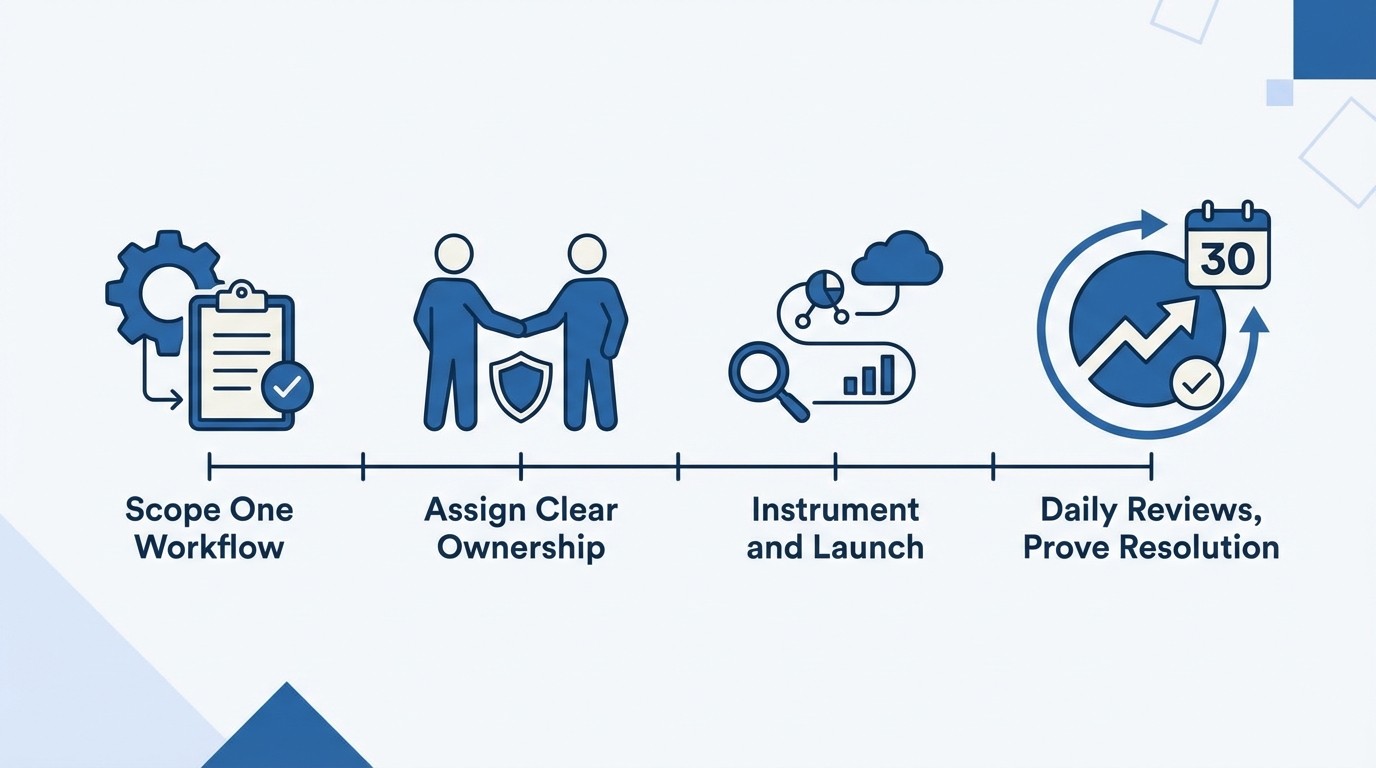
A 30‑day CCWaaS pilot is feasible when you scope one workflow, assign clear ownership, instrument the path, and launch to a narrow segment with daily reviews. You’ll learn fast, prove deflection, and decide on scale with confidence.

Week 1: Pick the workflow and lock responsibilities

Start with selection and structure. Choose one high‑volume, low‑variance workflow, document eligibility and outcome fields, and confirm data availability. Assign vendor ownership for integration, orchestration, identity, and writebacks. Assign internal owners for policy, compliance, and approvals, then agree on success metrics and thresholds.

Write a shared runbook. Include a simple RACI and a daily standup plan so issues never age. If something blocks completion, you want it visible that day, not at week’s end. This is where many pilots fail, not from technical problems but from unclear decisions about what counts as done.

  1. Define scope: workflow, segment, eligibility, outcome fields

  2. Confirm data: identity, eligibility, and writeback payloads

  3. Assign owners: vendor for plumbing, internal for policy and sign‑offs

  4. Set metrics: completion, time to resolution, writeback success, deflection

  5. Publish runbook: RACI, test cases, go or no‑go criteria, standup plan

Week 2: Build the in message flow and connect systems

Configure the in‑message experience. Stand up secure identity checks, consent capture, and the actions required to finish the task. Connect to systems of record and validate data contracts. Stub writebacks in a sandbox, then prove idempotency and error handling before you touch production data.

Plan exception paths carefully. Escalate to agents only when policy requires it, and always include full context so agents start at history, not discovery. This prevents long handle times and rework when exceptions do occur.

  1. Configure channels and templates with dynamic data

  2. Enable identity and consent in flow

  3. Connect to systems of record and validate contracts

  4. Prove idempotent writebacks with retries in sandbox

  5. Design exception routing with full case context

Weeks 3 to 4: Test, measure, soft launch, decide

Run end‑to‑end tests with telemetry verified. Launch to a small, well‑defined segment under a soft cap. Measure completion rate, time to resolution, writeback success, and deflection daily. Review exceptions and fix root causes quickly to avoid waste and drift.

Schedule compliance sign‑off after audit logs and consent records are reviewed and sampled. On day 30, compare results to go or no‑go thresholds and document the scale plan if targets are met. Keep it simple: expand the segment or add the next workflow using the same playbook.

  1. Validate telemetry and alerts end to end

  2. Soft launch to a narrow segment and watch daily

  3. Triage exceptions and ship fixes in hours, not days

  4. Complete compliance review of audit logs and consent artifacts

  5. Decide and scale: expand the cohort or add a second workflow

For teams in child welfare or similar programs, it can help to sanity‑check your design discipline against the [CCWIS design requirements self assessment].

How RadMedia Accelerates Your CCWaaS Pilot

RadMedia shortens your path to a successful pilot by operating the adapters, enforcing closed loop execution in message, and providing the telemetry and SLAs that matter. You get measurable resolution quickly, with fewer exceptions and a clean plan to scale.

Managed integration and writeback guarantees

With RadMedia, integration is handled for you. Our team connects to legacy cores and modern APIs, manages authentication and schema mapping, and guarantees idempotent writebacks with retries and audit logs. That removes the integration bottleneck that sinks many pilots.

This directly addresses earlier costs. Manual wrap‑up shrinks because outcomes write back reliably. Exceptions take fewer minutes because agents receive full context when escalation is required. You measure completion, time to resolution, and writeback success with confidence instead of guesswork.

In message self service and an autopilot engine

RadMedia delivers secure mini‑apps inside SMS, email, and WhatsApp so customers complete tasks without leaving the conversation. Identity and consent are captured in flow. The autopilot engine enforces policy, executes transactions, and routes only true exceptions to agents.

Teams see higher completion and shorter cycle times in the first week. Routine billing updates, payment plans, and compliance attestations finish in message, and you can verify the result in your systems of record. It’s resolution, not conversation, by design.

Proof, SLAs, and a clean scale path

RadMedia provides the minimum viable telemetry from day one: completion codes, writeback outcomes, and exception reasons with timestamps and correlation IDs. SLAs align to resolution, not just delivery, so you can hold the pilot to the right standards and defend decisions with data.

  • Evidence you can trust: writeback confirmations, consent artifacts, and audit logs

  • Resolution‑aligned SLAs: targets for completion, time to resolution, and reliability

  • Scale without rework: expand segments or add the next workflow using the same playbook

  • Exception insight: full case context so agents resolve faster when needed

When your go or no‑go criteria are met, RadMedia lets you scale without new tooling or reconfiguration. You extend what already works, instead of starting over.

Conclusion

A low risk, high impact CCWaaS pilot proves one thing clearly: can you complete the task in message and write the outcome back automatically. Keep the scope narrow, define “done” as a writeback, and instrument the path. Make integration and reliability the vendor’s job so your team can focus on policy, compliance, and outcomes. In 30 days, you’ll know if you have a repeatable, closed loop approach you can scale or a design that needs work. That clarity is the real win, and it is within reach.

Discover how to execute a low-risk, high-impact CCWaaS pilot in just 30 days. Get measurable results with a focused workflow and vendor-managed integration.

How to Run a Low‑Risk, High‑Impact CCWaaS Pilot in 30 Days - RadMedia professional guide illustration

[{"q":"How do I define success metrics for my CCWaaS pilot?","a":"To define success metrics for your CCWaaS pilot, start by identifying key outcomes that align with your business goals. Focus on metrics like completion rate, time to resolution, and writeback success. For instance, you can set a target for completion rates to ensure that tasks are being resolved effectively within the pilot. Additionally, consider measuring deflection rates to see how many cases are resolved without agent intervention. These metrics will help you gauge the effectiveness of your pilot and provide a clear path for future scaling."},{"q":"What if my integration fails during the pilot?","a":"If your integration fails during the pilot, first check the error logs for any specific issues that may have occurred. RadMedia's managed integration handles connectivity with legacy systems, so you can rely on their support to troubleshoot any problems. Ensure that your triggers are correctly mapped and that all necessary data is being sent to the right systems. If the issue persists, escalate it to RadMedia’s support team, who can assist in resolving the integration issues quickly to keep your pilot on track."},{"q":"Can I run multiple workflows in parallel during the pilot?","a":"It's generally advisable to focus on one high-volume, low-variance workflow during your pilot to avoid over-complication. Running multiple workflows can lead to confusion and dilute your ability to measure success effectively. RadMedia recommends starting with a single workflow that clearly defines 'done' as a writeback to your systems of record. Once you have validated this workflow and gathered insights, you can consider expanding to additional workflows in subsequent phases."},{"q":"When should I escalate issues to agents during the pilot?","a":"You should escalate issues to agents when exceptions occur that cannot be resolved automatically. RadMedia's system is designed to handle most routine cases without human intervention, but if a customer encounters issues like eligibility failures or missing data, those cases should be routed to an agent. Ensure that the workflow captures all necessary context so that agents can address these issues efficiently without needing to start from scratch."},{"q":"Why does my pilot need to focus on a single policy-bound workflow?","a":"Focusing on a single policy-bound workflow is crucial because it allows you to validate the effectiveness of your CCWaaS pilot without the noise of multiple variables. By narrowing your scope, you can clearly define what 'done' looks like and measure outcomes like completion rates and writeback success. This focused approach helps you learn quickly and ensures that you can scale with confidence once you have proven the value of the workflow."}]

10 Feb 2026

8cdf6ac7-4d1c-4188-bcdf-78633f30e23b

{"@graph":[{"@id":"https://radmedia.co.za/how-to-run-a-low-risk-high-impact-ccwaas-pilot-in-30-days#article","@type":"Article","image":"https://jdbrszggncetflrhtwcd.supabase.co/storage/v1/object/public/article-images/6dca98ae-107d-47b7-832f-ee543e4b5364/how-to-run-a-low-risk-high-impact-ccwaas-pilot-in-30-days-hero-1770707915423.png","author":{"name":"RadMedia","@type":"Organization"},"headline":"How to Run a Low‑Risk, High‑Impact CCWaaS Pilot in 30 Days","keywords":"CCWaaS pilot 30 days","publisher":{"name":"RadMedia","@type":"Organization"},"wordCount":2299,"description":"How to Run a Low‑Risk, High‑Impact CCWaaS Pilot in 30 Days","dateModified":"2026-02-10T07:18:14.93+00:00","datePublished":"2026-02-10T07:14:41.809865+00:00","mainEntityOfPage":{"@id":"https://radmedia.co.za/how-to-run-a-low-risk-high-impact-ccwaas-pilot-in-30-days","@type":"WebPage"}},{"@id":"https://radmedia.co.za/how-to-run-a-low-risk-high-impact-ccwaas-pilot-in-30-days#howto","name":"How to Run a Low‑Risk, High‑Impact CCWaaS Pilot in 30 Days","step":[{"name":"Why Most CCWaaS Pilots Fail Before They Start","text":"Most CCWaaS pilots fail early because they over‑scope, under‑define “done,” and skip writebacks. The pilot becomes a conversation test instead of a resolution test. A focused scope with objective outcomes is the difference between learning fast and burning weeks on noise. !A 30 Day CCWaaS Pilot Plan That Proves Resolution concept illustration - RadMedia","@type":"HowToStep","position":1},{"name":"The wrong scope kills speed","text":"When pilots attempt multiple channels, scripts, and journeys at once, timelines slip and results blur. You don’t learn which variable moved the needle, and you increase risk with every dependency you add. We’ve seen careful teams struggle here, not from haste, but from pressure to satisfy many stakeholders at once. Scope for speed and certainty. Choose one repetitive, policy‑bound workflow that already produces volume and cost. Keep dependencies to the minimum needed to complete and write back. ","@type":"HowToStep","position":2},{"name":"What single workflow should you pick?","text":"Pick a workflow with high frequency, low variance, and clear rules. That combination limits surprises and accelerates your path to measurable outcomes. It also makes compliance review simpler because eligibility and actions are well defined upfront. The best candidates share three traits: data is available to identify who qualifies, the action can be completed in message, and the result is easy to verify in systems of record. Examples that fit this pattern include failed payment updates, payment","@type":"HowToStep","position":3},{"name":"Define done with writebacks, not demos","text":"A pilot succeeds only when the task completes and the outcome updates the source of truth automatically. Demos and conversation volume can mask failure. They feel active but don’t move unit cost, risk, or customer outcomes. Define “done” with three primary metrics: writeback success, completion rate, and time to resolution. Require idempotent writes, retries with backoff, and audit logs. These guardrails expose reliability issues early and let you defend results with data, not anecdotes. If you ","@type":"HowToStep","position":4},{"name":"The Real Bottleneck in a CCWaaS Pilot Is Integration and Writebacks","text":"Integration and writebacks, not copy or channel choice, are the true bottlenecks. When vendors manage adapters, authentication, mapping, retries, and auditability, pilots launch faster and avoid hidden reconciliation work. Closed loop execution proves deflection and reduces risk from day one. !How RadMedia Accelerates Your CCWaaS Pilot concept illustration - RadMedia","@type":"HowToStep","position":5},{"name":"Vendor managed integration avoids long IT timelines","text":"Your team should focus on policy, compliance, and outcomes. The vendor should own connectivity to billing, collections, and policy systems across REST, SOAP, webhooks, message queues, or secure batch. That includes secrets management, schema mapping, and error handling so operations doesn’t wait on engineering cycles. Ask for proof early: test event subscriptions, validate data contracts, and confirm writeback idempotency in a sandbox. Insist on visible telemetry for each step. A good partner wi","@type":"HowToStep","position":6},{"name":"Why closed loop execution matters","text":"Completion drops when customers jump to a portal or wait for an agent at the moment of decision. In‑message self‑service, with secure identity and consent captured in flow, keeps customers engaged and reduces abandonment. When the engine processes payments, schedules plans, or stores documents, then writes the results back, you remove manual wrap‑up. Closed loop execution isn’t a nice‑to‑have. It’s the only way to prove deflection and quantify cost reduction. Without it, you’ll see parallel queu","@type":"HowToStep","position":7},{"name":"The Measurable Cost of a CCWaaS Pilot Without Closed Loop Execution","text":"A pilot without closed loop execution hides waste in plain sight. You see more messages but not more completions, rising unit cost, and growing reconciliation work. The fix is disciplined measurement: track resolution, not chatter, and prove reliability with telemetry.","@type":"HowToStep","position":8},{"name":"The metrics that expose waste","text":"Resolution‑first pilots use a short list of metrics that map directly to cost and risk. These reveal delays, rework, and leakage faster than high‑level dashboards. They also make go or no‑go decisions transparent to sponsors. Start with these five and set clear thresholds before launch. Then review them daily during the pilot window to catch problems early and prevent drift. Completion rate: percentage of targeted cases that finish in message Time to resolution: median minutes from trigger to wr","@type":"HowToStep","position":9},{"name":"What telemetry is minimum viable?","text":"Instrument the entire path from trigger to writeback. Log identity checks, payment attempts, document uploads, consent capture, and all outcome codes with timestamps and correlation IDs. Capture retries, failures, and escalation reasons so you can diagnose quickly and report reliability credibly. Think of this as software assurance for your pilot, not extra polish. A basic, consistent signal set prevents misunderstanding and accelerates fixes when things go wrong. For teams that want a quality b","@type":"HowToStep","position":10},{"name":"What a Stalled CCWaaS Pilot Feels Like on the Ground","text":"A stalled pilot feels busy but goes nowhere. Agents juggle screens while customers bounce between SMS, email, and portals. Dashboards show messages sent, yet completed tasks stay flat. Compliance grows uneasy when consent capture and audit logs are inconsistent.","@type":"HowToStep","position":11},{"name":"The agent and customer experience drag","text":"Every extra step in a journey adds time, creates error risk, and invites abandonment. When identity checks live in one place, payments in another, and wrap‑up in a third, agents become the glue. They rekey data and reconcile outcomes while queues grow. Customers feel that friction. A failed card email leads to a portal login, a forgotten password, and a phone call. Even when they want to pay, obstacles pile up. Morale dips for both sides. You lose hours weekly across thousands of routine cases t","@type":"HowToStep","position":12},{"name":"Leadership frustration and missed outcomes","text":"Leaders see conversation metrics improving while core numbers don’t move. Unit cost per completed task stays high. Exceptions rise because the easy work never finishes cleanly and flows back to agents. Compliance asks valid questions about audit trails and consent artifacts that are scattered or missing. We’ve watched careful, well‑run teams hit this wall. It isn’t a lack of effort. It’s a structural mismatch between tools built for messaging and the need to complete transactions with guaranteed","@type":"HowToStep","position":13},{"name":"A 30 Day CCWaaS Pilot Plan That Proves Resolution","text":"A 30‑day CCWaaS pilot is feasible when you scope one workflow, assign clear ownership, instrument the path, and launch to a narrow segment with daily reviews. You’ll learn fast, prove deflection, and decide on scale with confidence.","@type":"HowToStep","position":14},{"name":"Week 1: Pick the workflow and lock responsibilities","text":"Start with selection and structure. Choose one high‑volume, low‑variance workflow, document eligibility and outcome fields, and confirm data availability. Assign vendor ownership for integration, orchestration, identity, and writebacks. Assign internal owners for policy, compliance, and approvals, then agree on success metrics and thresholds. Write a shared runbook. Include a simple RACI and a daily standup plan so issues never age. If something blocks completion, you want it visible that day, n","@type":"HowToStep","position":15},{"name":"Week 2: Build the in message flow and connect systems","text":"Configure the in‑message experience. Stand up secure identity checks, consent capture, and the actions required to finish the task. Connect to systems of record and validate data contracts. Stub writebacks in a sandbox, then prove idempotency and error handling before you touch production data. Plan exception paths carefully. Escalate to agents only when policy requires it, and always include full context so agents start at history, not discovery. This prevents long handle times and rework when ","@type":"HowToStep","position":16},{"name":"Weeks 3 to 4: Test, measure, soft launch, decide","text":"Run end‑to‑end tests with telemetry verified. Launch to a small, well‑defined segment under a soft cap. Measure completion rate, time to resolution, writeback success, and deflection daily. Review exceptions and fix root causes quickly to avoid waste and drift. Schedule compliance sign‑off after audit logs and consent records are reviewed and sampled. On day 30, compare results to go or no‑go thresholds and document the scale plan if targets are met. Keep it simple: expand the segment or add the","@type":"HowToStep","position":17},{"name":"How RadMedia Accelerates Your CCWaaS Pilot","text":"RadMedia shortens your path to a successful pilot by operating the adapters, enforcing closed loop execution in message, and providing the telemetry and SLAs that matter. You get measurable resolution quickly, with fewer exceptions and a clean plan to scale.","@type":"HowToStep","position":18},{"name":"Managed integration and writeback guarantees","text":"With RadMedia, integration is handled for you. Our team connects to legacy cores and modern APIs, manages authentication and schema mapping, and guarantees idempotent writebacks with retries and audit logs. That removes the integration bottleneck that sinks many pilots. This directly addresses earlier costs. Manual wrap‑up shrinks because outcomes write back reliably. Exceptions take fewer minutes because agents receive full context when escalation is required. You measure completion, time to re","@type":"HowToStep","position":19},{"name":"In message self service and an autopilot engine","text":"RadMedia delivers secure mini‑apps inside SMS, email, and WhatsApp so customers complete tasks without leaving the conversation. Identity and consent are captured in flow. The autopilot engine enforces policy, executes transactions, and routes only true exceptions to agents. Teams see higher completion and shorter cycle times in the first week. Routine billing updates, payment plans, and compliance attestations finish in message, and you can verify the result in your systems of record. It’s reso","@type":"HowToStep","position":20},{"name":"Proof, SLAs, and a clean scale path","text":"RadMedia provides the minimum viable telemetry from day one: completion codes, writeback outcomes, and exception reasons with timestamps and correlation IDs. SLAs align to resolution, not just delivery, so you can hold the pilot to the right standards and defend decisions with data. Evidence you can trust: writeback confirmations, consent artifacts, and audit logs Resolution‑aligned SLAs: targets for completion, time to resolution, and reliability Scale without rework: expand segments or add the","@type":"HowToStep","position":21}],"@type":"HowTo","image":"https://jdbrszggncetflrhtwcd.supabase.co/storage/v1/object/public/article-images/6dca98ae-107d-47b7-832f-ee543e4b5364/how-to-run-a-low-risk-high-impact-ccwaas-pilot-in-30-days-hero-1770707915423.png","totalTime":"PT16M","description":"How to Run a Low‑Risk, High‑Impact CCWaaS Pilot in 30 Days"},{"@id":"https://radmedia.co.za/how-to-run-a-low-risk-high-impact-ccwaas-pilot-in-30-days#breadcrumb","@type":"BreadcrumbList","itemListElement":[{"item":"https://radmedia.co.za","name":"Home","@type":"ListItem","position":1},{"item":"https://radmedia.co.za/how-to-run-a-low-risk-high-impact-ccwaas-pilot-in-30-days","name":"How to Run a Low‑Risk, High‑Impact CCWaaS Pilot in 30 Days","@type":"ListItem","position":2}]}],"@context":"https://schema.org"}

[{"url":"https://jdbrszggncetflrhtwcd.supabase.co/storage/v1/object/public/article-images/6dca98ae-107d-47b7-832f-ee543e4b5364/how-to-run-a-low-risk-high-impact-ccwaas-pilot-in-30-days-inline-0-1770707931602.png","alt":"A 30 Day CCWaaS Pilot Plan That Proves Resolution concept illustration - RadMedia","filename":"how-to-run-a-low-risk-high-impact-ccwaas-pilot-in-30-days-inline-0-1770707931602.png","position":"after_h2_1","asset_id":null,"type":"ai_generated","dimensions":{"width":1024,"height":1024}},{"url":"https://jdbrszggncetflrhtwcd.supabase.co/storage/v1/object/public/article-images/6dca98ae-107d-47b7-832f-ee543e4b5364/how-to-run-a-low-risk-high-impact-ccwaas-pilot-in-30-days-inline-1-1770707951206.png","alt":"How RadMedia Accelerates Your CCWaaS Pilot concept illustration - RadMedia","filename":"how-to-run-a-low-risk-high-impact-ccwaas-pilot-in-30-days-inline-1-1770707951206.png","position":"after_h2_2","asset_id":null,"type":"ai_generated","dimensions":{"width":1024,"height":1024}}]

82

2299

Most pilots stall because they try to prove too much at once. A low risk, high impact CCWaaS pilot stays narrow, measures completion that writes back to source systems, and launches fast on one policy‑bound workflow. We’ll walk you through a 30‑day plan that proves resolution, not conversation, so you can scale with confidence.

If you lead operations, you already carry real constraints: compliance standards, integration backlog, and limited change windows. We respect that. The goal here isn’t a flashy demo. It’s a clean, auditable pilot that closes the loop in message, proves value with hard numbers, and sets a sustainable path to expand.

Key Takeaways:

  • Pick one high‑volume, low‑variance workflow and define “done” as a writeback to systems of record

  • Make the vendor own integration, authentication, mapping, retries, and audit logs from day one

  • Design for closed loop execution in message, with identity and consent captured in flow

  • Instrument the entire path, then measure completion rate, time to resolution, writeback success, and deflection

  • Run a 30‑day plan with weekly milestones, daily telemetry checks, and clear go or no‑go thresholds

  • Document exceptions and escalate with full context so agents handle only what truly needs judgment

Why Most CCWaaS Pilots Fail Before They Start

Most CCWaaS pilots fail early because they over‑scope, under‑define “done,” and skip writebacks. The pilot becomes a conversation test instead of a resolution test. A focused scope with objective outcomes is the difference between learning fast and burning weeks on noise.

A 30 Day CCWaaS Pilot Plan That Proves Resolution concept illustration - RadMedia

The wrong scope kills speed

When pilots attempt multiple channels, scripts, and journeys at once, timelines slip and results blur. You don’t learn which variable moved the needle, and you increase risk with every dependency you add. We’ve seen careful teams struggle here, not from haste, but from pressure to satisfy many stakeholders at once.

Scope for speed and certainty. Choose one repetitive, policy‑bound workflow that already produces volume and cost. Keep dependencies to the minimum needed to complete and write back. This isn’t playing small. It’s protecting the pilot from failure modes you can avoid, like brittle portal redirects or untested data paths that invite rework.

What single workflow should you pick?

Pick a workflow with high frequency, low variance, and clear rules. That combination limits surprises and accelerates your path to measurable outcomes. It also makes compliance review simpler because eligibility and actions are well defined upfront.

The best candidates share three traits: data is available to identify who qualifies, the action can be completed in message, and the result is easy to verify in systems of record. Examples that fit this pattern include failed payment updates, payment plan selection, KYC refresh, and address or contact changes.

  • High frequency: thousands of monthly events to reach significance

  • Low variance: limited branching, clear outcomes

  • Policy clarity: eligibility and rules are documented and testable

Define done with writebacks, not demos

A pilot succeeds only when the task completes and the outcome updates the source of truth automatically. Demos and conversation volume can mask failure. They feel active but don’t move unit cost, risk, or customer outcomes.

Define “done” with three primary metrics: writeback success, completion rate, and time to resolution. Require idempotent writes, retries with backoff, and audit logs. These guardrails expose reliability issues early and let you defend results with data, not anecdotes. If you need a single rule of thumb, use this one: if it doesn’t write back, it doesn’t count.

For standards that reinforce this discipline, see the federal guidance on information systems design and data integrity in Federal guidance for information systems.

The Real Bottleneck in a CCWaaS Pilot Is Integration and Writebacks

Integration and writebacks, not copy or channel choice, are the true bottlenecks. When vendors manage adapters, authentication, mapping, retries, and auditability, pilots launch faster and avoid hidden reconciliation work. Closed loop execution proves deflection and reduces risk from day one.

How RadMedia Accelerates Your CCWaaS Pilot concept illustration - RadMedia

Vendor managed integration avoids long IT timelines

Your team should focus on policy, compliance, and outcomes. The vendor should own connectivity to billing, collections, and policy systems across REST, SOAP, webhooks, message queues, or secure batch. That includes secrets management, schema mapping, and error handling so operations doesn’t wait on engineering cycles.

Ask for proof early: test event subscriptions, validate data contracts, and confirm writeback idempotency in a sandbox. Insist on visible telemetry for each step. A good partner will surface these signals without friction and will adapt to your security model without creating new operational debt.

Why closed loop execution matters

Completion drops when customers jump to a portal or wait for an agent at the moment of decision. In‑message self‑service, with secure identity and consent captured in flow, keeps customers engaged and reduces abandonment. When the engine processes payments, schedules plans, or stores documents, then writes the results back, you remove manual wrap‑up.

Closed loop execution isn’t a nice‑to‑have. It’s the only way to prove deflection and quantify cost reduction. Without it, you’ll see parallel queues, scattered audit trails, and increased reconciliation. With it, you get measurable resolution and fewer exceptions hitting your agents.

The Measurable Cost of a CCWaaS Pilot Without Closed Loop Execution

A pilot without closed loop execution hides waste in plain sight. You see more messages but not more completions, rising unit cost, and growing reconciliation work. The fix is disciplined measurement: track resolution, not chatter, and prove reliability with telemetry.

The metrics that expose waste

Resolution‑first pilots use a short list of metrics that map directly to cost and risk. These reveal delays, rework, and leakage faster than high‑level dashboards. They also make go or no‑go decisions transparent to sponsors.

Start with these five and set clear thresholds before launch. Then review them daily during the pilot window to catch problems early and prevent drift.

  • Completion rate: percentage of targeted cases that finish in message

  • Time to resolution: median minutes from trigger to writeback

  • Writeback success: confirmed, idempotent updates to systems of record

  • Deflection: share of routine cases resolved without agents

  • Exception rate: proportion that escalates, with minutes per exception

What telemetry is minimum viable?

Instrument the entire path from trigger to writeback. Log identity checks, payment attempts, document uploads, consent capture, and all outcome codes with timestamps and correlation IDs. Capture retries, failures, and escalation reasons so you can diagnose quickly and report reliability credibly.

Think of this as software assurance for your pilot, not extra polish. A basic, consistent signal set prevents misunderstanding and accelerates fixes when things go wrong. For teams that want a quality benchmark, the FDA’s approach to software assurance outlines useful verification principles in the FDA software assurance guidance.

What a Stalled CCWaaS Pilot Feels Like on the Ground

A stalled pilot feels busy but goes nowhere. Agents juggle screens while customers bounce between SMS, email, and portals. Dashboards show messages sent, yet completed tasks stay flat. Compliance grows uneasy when consent capture and audit logs are inconsistent.

The agent and customer experience drag

Every extra step in a journey adds time, creates error risk, and invites abandonment. When identity checks live in one place, payments in another, and wrap‑up in a third, agents become the glue. They rekey data and reconcile outcomes while queues grow.

Customers feel that friction. A failed card email leads to a portal login, a forgotten password, and a phone call. Even when they want to pay, obstacles pile up. Morale dips for both sides. You lose hours weekly across thousands of routine cases that should finish in message without help.

Leadership frustration and missed outcomes

Leaders see conversation metrics improving while core numbers don’t move. Unit cost per completed task stays high. Exceptions rise because the easy work never finishes cleanly and flows back to agents. Compliance asks valid questions about audit trails and consent artifacts that are scattered or missing.

We’ve watched careful, well‑run teams hit this wall. It isn’t a lack of effort. It’s a structural mismatch between tools built for messaging and the need to complete transactions with guaranteed writebacks. The path out is a measurable, closed loop pilot that proves resolution with the minimum set of moving parts.

For governance expectations that reinforce closed loop design and data stewardship, see the principles outlined in Federal guidance for information systems.

A 30 Day CCWaaS Pilot Plan That Proves Resolution

A 30‑day CCWaaS pilot is feasible when you scope one workflow, assign clear ownership, instrument the path, and launch to a narrow segment with daily reviews. You’ll learn fast, prove deflection, and decide on scale with confidence.

Week 1: Pick the workflow and lock responsibilities

Start with selection and structure. Choose one high‑volume, low‑variance workflow, document eligibility and outcome fields, and confirm data availability. Assign vendor ownership for integration, orchestration, identity, and writebacks. Assign internal owners for policy, compliance, and approvals, then agree on success metrics and thresholds.

Write a shared runbook. Include a simple RACI and a daily standup plan so issues never age. If something blocks completion, you want it visible that day, not at week’s end. This is where many pilots fail, not from technical problems but from unclear decisions about what counts as done.

  1. Define scope: workflow, segment, eligibility, outcome fields

  2. Confirm data: identity, eligibility, and writeback payloads

  3. Assign owners: vendor for plumbing, internal for policy and sign‑offs

  4. Set metrics: completion, time to resolution, writeback success, deflection

  5. Publish runbook: RACI, test cases, go or no‑go criteria, standup plan

Week 2: Build the in message flow and connect systems

Configure the in‑message experience. Stand up secure identity checks, consent capture, and the actions required to finish the task. Connect to systems of record and validate data contracts. Stub writebacks in a sandbox, then prove idempotency and error handling before you touch production data.

Plan exception paths carefully. Escalate to agents only when policy requires it, and always include full context so agents start at history, not discovery. This prevents long handle times and rework when exceptions do occur.

  1. Configure channels and templates with dynamic data

  2. Enable identity and consent in flow

  3. Connect to systems of record and validate contracts

  4. Prove idempotent writebacks with retries in sandbox

  5. Design exception routing with full case context

Weeks 3 to 4: Test, measure, soft launch, decide

Run end‑to‑end tests with telemetry verified. Launch to a small, well‑defined segment under a soft cap. Measure completion rate, time to resolution, writeback success, and deflection daily. Review exceptions and fix root causes quickly to avoid waste and drift.

Schedule compliance sign‑off after audit logs and consent records are reviewed and sampled. On day 30, compare results to go or no‑go thresholds and document the scale plan if targets are met. Keep it simple: expand the segment or add the next workflow using the same playbook.

  1. Validate telemetry and alerts end to end

  2. Soft launch to a narrow segment and watch daily

  3. Triage exceptions and ship fixes in hours, not days

  4. Complete compliance review of audit logs and consent artifacts

  5. Decide and scale: expand the cohort or add a second workflow

For teams in child welfare or similar programs, it can help to sanity‑check your design discipline against the [CCWIS design requirements self assessment].

How RadMedia Accelerates Your CCWaaS Pilot

RadMedia shortens your path to a successful pilot by operating the adapters, enforcing closed loop execution in message, and providing the telemetry and SLAs that matter. You get measurable resolution quickly, with fewer exceptions and a clean plan to scale.

Managed integration and writeback guarantees

With RadMedia, integration is handled for you. Our team connects to legacy cores and modern APIs, manages authentication and schema mapping, and guarantees idempotent writebacks with retries and audit logs. That removes the integration bottleneck that sinks many pilots.

This directly addresses earlier costs. Manual wrap‑up shrinks because outcomes write back reliably. Exceptions take fewer minutes because agents receive full context when escalation is required. You measure completion, time to resolution, and writeback success with confidence instead of guesswork.

In message self service and an autopilot engine

RadMedia delivers secure mini‑apps inside SMS, email, and WhatsApp so customers complete tasks without leaving the conversation. Identity and consent are captured in flow. The autopilot engine enforces policy, executes transactions, and routes only true exceptions to agents.

Teams see higher completion and shorter cycle times in the first week. Routine billing updates, payment plans, and compliance attestations finish in message, and you can verify the result in your systems of record. It’s resolution, not conversation, by design.

Proof, SLAs, and a clean scale path

RadMedia provides the minimum viable telemetry from day one: completion codes, writeback outcomes, and exception reasons with timestamps and correlation IDs. SLAs align to resolution, not just delivery, so you can hold the pilot to the right standards and defend decisions with data.

  • Evidence you can trust: writeback confirmations, consent artifacts, and audit logs

  • Resolution‑aligned SLAs: targets for completion, time to resolution, and reliability

  • Scale without rework: expand segments or add the next workflow using the same playbook

  • Exception insight: full case context so agents resolve faster when needed

When your go or no‑go criteria are met, RadMedia lets you scale without new tooling or reconfiguration. You extend what already works, instead of starting over.

Conclusion

A low risk, high impact CCWaaS pilot proves one thing clearly: can you complete the task in message and write the outcome back automatically. Keep the scope narrow, define “done” as a writeback, and instrument the path. Make integration and reliability the vendor’s job so your team can focus on policy, compliance, and outcomes. In 30 days, you’ll know if you have a repeatable, closed loop approach you can scale or a design that needs work. That clarity is the real win, and it is within reach.