
How to Build Closed‑Loop Resolution Workflows for Financial Services Ops
Closed-loop resolution workflows in financial services streamline operations by automating task completion within messages, reducing costs and errors. Focus on measurable outcomes like resolution times and writeback success to enhance efficiency and customer satisfaction.
Most operations leaders are judged on outcomes, not message counts. Closed-loop resolution workflows give you that grip. You start from a system trigger, let customers complete the task inside the message, and write the result back to the source of truth automatically. We’ll walk you through how to build this, step by step, with real-world constraints in mind.
We’ll discuss the specific ways to choose a pilot, encode policy, design in-message mini-apps, and guarantee idempotent writebacks across legacy cores and modern APIs. The goal is simple and measurable, fewer conversations, more completed tasks, and a clear drop in unit cost, error rates, and cycle time.
Key Takeaways:
Measure completion, time to resolution, writeback success, and deflection, not message volume or bot containment
Design from the outcome back, define evidence and writeback fields before any UI or copy
Make the message the app, reduce logins and channel switches to raise completion and lower cost
Guarantee idempotent writebacks with keys, retries, circuit breakers, and reconciliation dashboards
Start with one high-volume, policy-bound use case, then expand once the loop is closed
Build for audit, capture identity, consent, documents, and timestamps inside the flow
Expect a 30-day pilot to prove resolution gains if scope is tight and rules are encoded
Why Closed-Loop Resolution Workflows Beat Conversation Metrics in Financial Services
Closed-loop resolution workflows win because they finish the task inside the message and write the outcome back automatically. That reduces handoffs, removes logins, and eliminates manual wrap-up that inflates unit cost. The result is faster cycle time, fewer errors, and higher completion across billing, collections, and compliance.

Conversations Without Completion Create Operational Debt
High contact volume can look like progress, but it often hides failure to complete the task. Each context switch, portal login, and handoff adds time and creates room for mistakes. You feel it in reconciliation queues and in audit findings when evidence is missing or scattered across tools.
A conversation that ends in a detour to a portal or a long call often stalls. Password resets, channel changes, and identity checks slow people down. Agents then spend minutes toggling between systems, rekeying data, and adding notes that still need verification. That is cost, not service.
In a resolution-first model, the message becomes the app. Customers update card details, choose a compliant plan, or submit a document inside the thread. When they act, systems update deterministically. That closes tickets without manual wrap-up and cuts the hidden waste that drains budgets.
Metrics That Truly Move Cost to Serve
Contact volume, handle time, and bot containment are easy to track, yet they rarely correlate with completed tasks. The metrics that matter are concrete and auditable, completion rate, time to resolution, writeback success, and deflection of routine cases from agents.
Set baselines before you start. Track pre and post results on one pilot cohort. If completion happens inside the message and outcomes post to the system of record, you will see the drop in unit cost. If those numbers do not move, you still have a closure problem, not a channel problem.
Here is a simple metrics set to standardize:
Completion rate, the percentage of cases that finish inside the message
Time to resolution, median minutes from trigger to closed case
Writeback success, percentage of outcomes posted without manual repair
Deflection, percentage of routine cases handled without an agent
The Hidden Bottleneck in Closed-Loop Resolution Workflows: Deterministic Writebacks
Writebacks fail when integration is brittle and state transitions are unclear. Deterministic writebacks require clear outcome records, idempotency keys, retries, and circuit breakers that prevent duplicates or partial updates. Test negative paths first, then confirm each posted result against the source of truth.
Why Writebacks Fail in Legacy Cores
Legacy cores and mixed integration patterns create predictable failure modes. Batch-only posting, flaky authentication, mismatched schemas, and fragile SOAP endpoints lead to partial updates and orphaned cases. You see it as duplicate flags, missing notes, and agents cleaning up after the system.
Without idempotency, retries can post extra charges or flip flags twice. Without circuit breaking, downstream slowdowns cascade into timeouts. Without a consistent payload schema, fields map wrong under pressure. That is how “automation” turns into more rework for operations.
Teams can avoid these traps with a few strict rules. Define the data contract, version it, and enforce it. Apply a unique idempotency key per case or per state transition. Log every attempt with a clear status, then reconcile posted results against the source system on a schedule.
How Do You Guarantee Idempotent Writebacks?
Start with the outcome record. List the required fields that prove the task is complete, and the exact state change expected in each system. Assign an idempotency key per case or per transaction. Map state transitions so the same message can be retried safely until success.
Plan for failure. Define a retry budget with exponential backoff. Add a circuit breaker so downstream instability does not multiply errors. Keep a reconciliation dashboard that compares posted outcomes to the system of record and raises exceptions automatically.
For context on closed-loop action and why it depends on verified writebacks, see What Is Closed Loop Action. It reinforces a hard truth, you cannot close the loop until the system of record reflects the outcome deterministically.
The Cost of Not Building Closed-Loop Resolution Workflows
Fragmented journeys waste time and money, increase risk, and erode customer trust. Each handoff adds minutes, each login step shrinks conversion, and each manual wrap-up invites error. Over thousands of cases, this compounds into real headcount and rising unit cost.
Quantify Time, Money, Risk, and CX Erosion
You can estimate the waste with simple math. If a single handoff adds three minutes and your team handles 30,000 routine cases a month, you lose 1,500 hours. That is almost nine FTE weeks every month tied up in movement, not outcomes.
Manual wrap-up increases error rates. Documents go missing, consent is not captured consistently, and audit trails scatter across tools. Customers notice the friction. Every extra step is a chance to drop off or to complain, which creates repeat contacts and more backlog.
Leaders who close the loop see the opposite pattern. Completion rises because action happens where the customer already is. Cycle times shrink from days to hours. Agents focus on complex exceptions. You pay for resolution, not reconciliation. For an executive view of why closure beats conversation, see Closing The Loop.
Integration Hurdles You Can Predict
Integration always takes longer when you discover issues late. Authentication sprawl, schema drift, batch-lag windows, partial success across multi-system updates, and orphaned cases after timeouts are common. None of this is a surprise. Plan for it up front.
Run pre-production soak tests that simulate high volume across all endpoints. Add contract tests for payloads and idempotency behavior. Validate negative paths, expired links, revoked tokens, and downstream slowness. If you only test the happy path, you will pay for it later.
A short checklist helps during planning:
Authentication and token refresh patterns across every endpoint
Schema versioning and drift detection for all payloads
Retry and backoff policies with explicit budgets
Circuit breakers and fallback behaviors
Reconciliation jobs that confirm posted results match the source of truth
Which Metrics Prove You Closed the Loop?
You only “closed the loop” if systems show the outcome without manual repair. That requires a minimum metric set. Start small, prove it, then scale. Avoid vanity indicators like sends and clicks that hide silent failure to complete tasks.
Set these as your non-negotiables, completion rate, time to resolution, writeback success, exception rate, and deflection. Measure a single pilot cohort pre and post. Tie gains to unit cost and FTE hours returned to the business. For additional framing on closed-loop analytics, see What Are Closed Loop Analytics.
What Manual Reconciliation Really Feels Like for Ops
Manual reconciliation feels like carrying water with a cracked bucket. Agents toggle between systems, rekey details, chase documents, and write notes that no one can verify later. Burnout grows as SLA breaches and audit gaps pile up, even when people do everything right.
The Nightly Grind No Dashboard Shows
Dashboards show contacts handled and emails sent. They rarely show the late-night scramble to fix orphaned cases or track down a missing consent. People copy data from one system to another, hoping they did not miss a field. It is exhausting and it is risky.
You can hear the frustration in stand-ups. “I updated the record, but the flag never cleared.” “The file posted, but the status did not change.” These are not edge cases. They are symptoms of a loop that never closed. The team pays the cost in time and morale.
A calm system looks different. Routine cases finish in-message. Evidence, identity, and consent are captured once and attached to the case. Outcomes post back automatically. Agents handle true exceptions with full context and predictable handoffs. Trust starts to return.
Why Do Portals and Chatbots Miss the Last Mile?
Portals force logins and context shifts. Chatbots detect intent but escalate the moment a transaction touches a core system. That is where outcomes stall. The last mile is not copy or routing. It is safe, deterministic writes to the system of record without making the user jump.
It is not that teams ignore this. They often inherit tools that were never built to transact across legacy systems. Even well-planned efforts can fail at integration seams. Closing the loop inside the message is the change that removes these seams and prevents silent failure.
For a broader view of how organizations restore trust by acting on feedback quickly and visibly, see Closing The Loop: Innovative Approaches To Acting On Customer Feedback. The same principle applies in operations, action beats acknowledgment.
How to Design Closed-Loop Resolution Workflows That Finish Inside Messages
To design for closure, define the outcome and evidence first, then craft the smallest in-message experience that can collect it. Next, guarantee writebacks with keys, retries, and circuit breakers. Finally, prove it on a narrow pilot before you scale to more use cases.
Pick a Pilot You Can Win in 30 Days
Start where policy is clear and volume is high. Failed payments, compliant payment plans, KYC refresh, and address updates are often ideal. Limit scope to one outcome and one or two systems of record. This reduces risk and makes results easy to measure.
Score candidate pilots before you commit. Consider volume, policy clarity, integration scope, and the number of fields needed to prove completion. If the pilot needs four departments to agree on rules, pick another. You want a fast, fair test, not a political project.
A practical way to select a pilot:
Rank top use cases by monthly volume and current completion rates
Filter to policy-bound tasks with clear eligibility and evidence rules
Map systems touched and estimate integration complexity
Choose the case with the best mix of high impact and low integration risk
Model Outcomes and Policy Rules First
Define “done” in data, not prose. List the writeback fields required to prove the outcome, balances updated, flags cleared, notes posted, documents attached, and consent captured. Assign idempotency keys and state transitions. Agree on exception paths with risk and legal.
This blueprint is your guardrail. It stops scope creep and prevents UI-first designs that look good but cannot pass an audit. When rules live in the engine, exceptions route with context and are resolved the same way every time. That cuts error rates and speeds reviews.
Turn your blueprint into a checklist before you build:
Outcome fields and schema, with versions
Eligibility and policy rules, encoded in the engine
Exception paths with escalation criteria and data passed to agents
Idempotency keys per state transition
Evidence pack items, identity, consent, documents, timestamps
Why Do In-Message Mini-Apps Outperform Portals?
Mini-apps inside messages remove logins and channel switches. They present only the actions that match the user’s context and policy rules, update a card, choose a plan, confirm identity, upload a document, or sign an attestation. Fewer steps lead to higher completion.
Secure identity checks happen in flow. One-time codes or known-fact validation confirm who is acting. Consent is captured with timestamps and stored with the case. When the customer completes a step, systems update without a detour. That is closure, not conversation.
Integration and Reliability Checklist for Guaranteed Writebacks
Writebacks need a defense-in-depth approach. You must plan for network blips, downstream slowness, schema changes, and duplicate messages. Reliability patterns are not optional. They are the difference between straight-through processing and nightly cleanup.
Bake these patterns into your design:
Idempotency keys tied to case or transaction state
Retries with exponential backoff and an explicit budget
Circuit breakers that stop cascades during downstream incidents
Structured logging and telemetry at each step for audit
Reconciliation jobs that compare posted outcomes to the source of truth
For customer experience leaders aligning around closure as the goal, see Closed Loop CX. The same lesson applies in operations, define the end state and prove it with data.
How RadMedia Delivers Closed-Loop Resolution Workflows at Scale
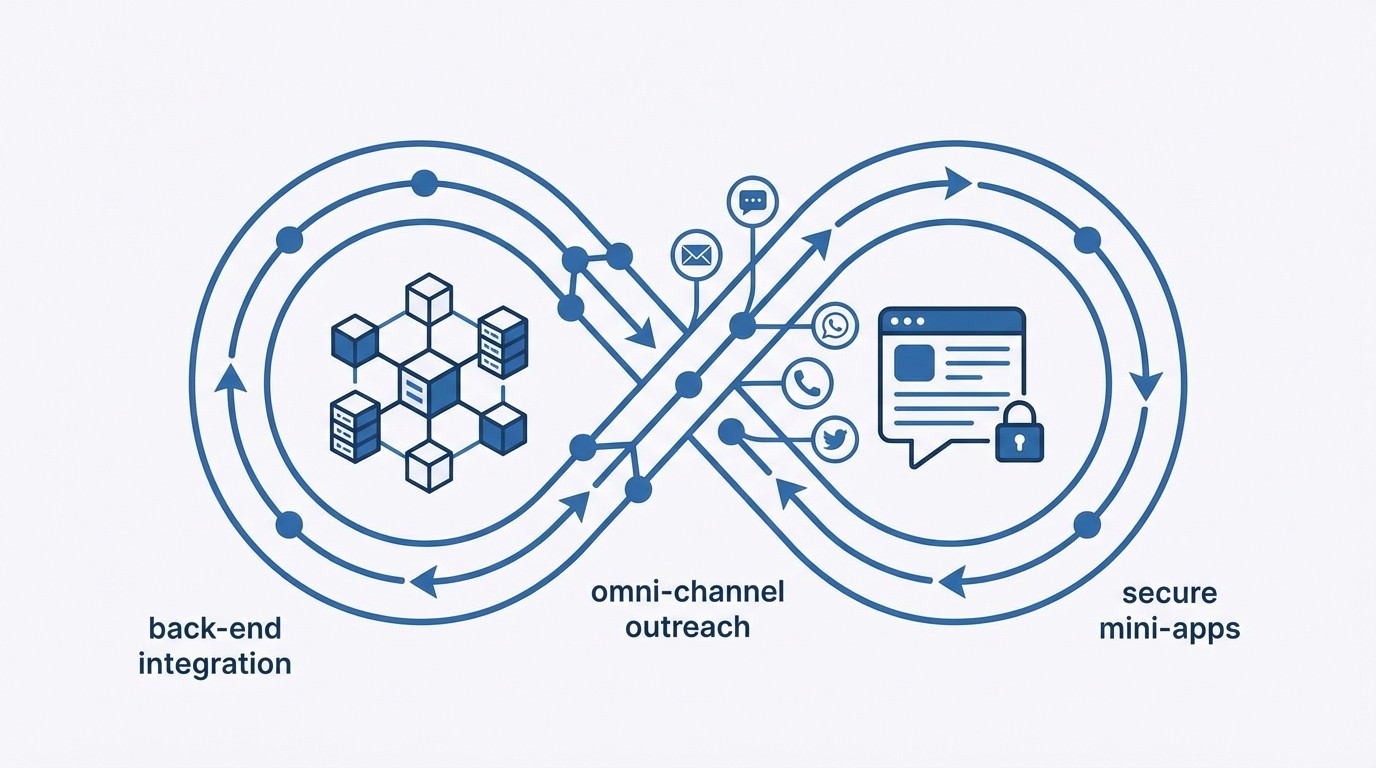
RadMedia delivers closed-loop resolution by managing back-end integration, orchestrating omni-channel outreach, and embedding secure, no-download mini-apps inside messages. The platform executes rules, completes transactions, and writes outcomes back with idempotent guarantees. That turns routine cases into straight-through processing while exceptions go to agents with context.
Managed Back-End Integration That Handles Legacy Complexities
RadMedia connects to legacy cores and modern APIs without asking your team to write glue code. Adapters handle REST, SOAP, message queues, and SFTP. Authentication, schema mapping, retries, and idempotency keys are built in. That removes months of custom engineering and the risk of partial updates.
When a workflow completes, RadMedia posts the result to the system of record and confirms the new state. If a downstream service is slow, retries and circuit breakers protect consistency. Telemetry and audit logs make verification straightforward. You get closure you can prove, not a to-do for someone after hours.
In-Message Self-Service Apps With Secure Identity and Consent
RadMedia’s mini-apps live inside SMS, email, and WhatsApp. Customers update payment details, choose plans, verify identity, upload documents, and capture consent without a portal detour. One-time codes and known-fact checks secure the flow. Evidence and timestamps attach to the case automatically.
Completion rates improve because there are fewer chances to drop off. Time to resolution falls because action happens where the user already is. Agents see cleaner queues because routine cases never arrive. That is the practical impact of message-as-app design done with audit in mind.
Autopilot Workflow Engine With Policy Rules and Exceptions
Triggers from your systems start the journey. RadMedia personalizes outreach, sequences channels based on consent and responsiveness, and advances the flow based on user actions and rules. When an exception occurs, the case escalates with full history so agents start at context.
This engine prevents the common risks you modeled earlier. It encodes eligibility, applies retries with backoff, and uses idempotency keys so writes are safe even when networks wobble. The result is fewer partial updates and less manual reconciliation. For a broader industry view on closed-loop processes and customer loyalty, see Unlocking Customer Loyalty: The Power Of Closed Loop Processes In Financial Services.
RadMedia at a glance, capabilities that enable resolution-first operations:
Managed integration, adapters for REST, SOAP, queues, and SFTP, with writeback guarantees
Omni-channel orchestration, SMS, email, and WhatsApp sequences tuned for reach and action
In-message mini-apps, secure self-service for payments, plans, identity, and documents
Rules and exceptions, a policy engine that routes edge cases to agents with context
Telemetry and audit, logs, evidence capture, and exports to your data lake or SIEM
Conclusion
If your teams count conversations but still reconcile outcomes by hand, you have a resolution gap. Closed-loop resolution workflows fix that by finishing the task inside the message and writing the result back automatically. Start with one high-volume, policy-bound use case, define the outcome and evidence, and guarantee writebacks with idempotency and retries.
We covered how to pick a 30-day pilot, model rules, design in-message mini-apps, and build a reliability layer that prevents duplicates and partial updates. Measure completion, time to resolution, writeback success, and deflection. When those move, unit cost falls and trust returns. That is how you scale service without scaling headcount.
Discover how to create closed-loop resolution workflows that improve task completion and reduce costs. Follow our practical step-by-step guide today!
How to Build Closed‑Loop Resolution Workflows for Financial Services Ops - RadMedia professional guide illustration
[{"q":"How do I set up a closed-loop resolution workflow?","a":"To set up a closed-loop resolution workflow with RadMedia, start by identifying a high-volume use case, such as failed payments or KYC refreshes. Next, define the completion criteria and writeback fields to ensure the workflow meets your operational goals. Then, use RadMedia’s managed back-end integration to connect your existing systems, allowing for seamless data flow. Finally, implement in-message self-service apps to enable customers to complete tasks directly within their preferred messaging channels like SMS or email, ensuring the outcomes write back automatically to your system of record."},{"q":"What if my workflow needs to handle exceptions?","a":"If your workflow encounters exceptions, RadMedia has built-in escalation paths. When a customer’s action triggers an exception, the workflow can automatically escalate to an agent with full context of the interaction, including messages and inputs collected. This way, agents can start from a place of understanding rather than having to gather information from scratch. Ensure that your workflows are designed with these exception paths in mind to maintain efficiency and customer satisfaction."},{"q":"Can I track completion rates in my workflows?","a":"While RadMedia doesn’t provide traditional analytics dashboards, you can measure completion rates by tracking the outcomes of your workflows. Focus on the metrics that matter, such as time-to-resolution and writeback success. These metrics will help you understand how effectively your workflows are operating and where improvements might be needed. By prioritizing resolution over conversation volume, you can ensure that your operations are streamlined and efficient."},{"q":"When should I expand my workflow pilot?","a":"You should consider expanding your workflow pilot after successfully closing the loop on your initial high-volume use case. Typically, a 30-day pilot is recommended to measure resolution gains and ensure that the workflow is functioning as intended. Once you’ve validated the process and seen improvements in completion rates and reduced cycle times, you can scale by introducing additional use cases or channels, leveraging RadMedia’s capabilities to automate more customer interactions."},{"q":"Why does my messaging need to be channel-native?","a":"Making your messaging channel-native is crucial because it allows customers to complete tasks without switching contexts or logging into different portals. RadMedia’s in-message self-service apps enable this by embedding secure mini-apps directly within the messaging interface, whether it’s SMS, email, or WhatsApp. This approach reduces friction, increases task completion rates, and ultimately enhances the customer experience by allowing customers to act where they already are."}]
14 Feb 2026
45ef3228-603c-4670-bb3a-d514aa6b7e32
{"@graph":[{"@id":"https://radmedia.co.za/how-to-build-closed-loop-resolution-workflows-for-financial-services-ops#article","@type":"Article","image":"https://jdbrszggncetflrhtwcd.supabase.co/storage/v1/object/public/article-images/6dca98ae-107d-47b7-832f-ee543e4b5364/how-to-build-closed-loop-resolution-workflows-for-financial-services-ops-hero-1771027554310.png","author":{"name":"RadMedia","@type":"Organization"},"headline":"How to Build Closed‑Loop Resolution Workflows for Financial Services Ops","keywords":"closed-loop resolution workflows","publisher":{"name":"RadMedia","@type":"Organization"},"wordCount":2722,"description":"How to Build Closed‑Loop Resolution Workflows for Financial Services Ops","dateModified":"2026-02-14T00:05:38.053+00:00","datePublished":"2026-02-14T00:02:15.257859+00:00","mainEntityOfPage":{"@id":"https://radmedia.co.za/how-to-build-closed-loop-resolution-workflows-for-financial-services-ops","@type":"WebPage"}},{"@id":"https://radmedia.co.za/how-to-build-closed-loop-resolution-workflows-for-financial-services-ops#howto","name":"How to Build Closed‑Loop Resolution Workflows for Financial Services Ops","step":[{"name":"Why Closed-Loop Resolution Workflows Beat Conversation Metrics in Financial Services","text":"Closed-loop resolution workflows win because they finish the task inside the message and write the outcome back automatically. That reduces handoffs, removes logins, and eliminates manual wrap-up that inflates unit cost. The result is faster cycle time, fewer errors, and higher completion across billing, collections, and compliance. !How to Design Closed-Loop Resolution Workflows That Finish Inside Messages concept illustration - RadMedia","@type":"HowToStep","position":1},{"name":"Conversations Without Completion Create Operational Debt","text":"High contact volume can look like progress, but it often hides failure to complete the task. Each context switch, portal login, and handoff adds time and creates room for mistakes. You feel it in reconciliation queues and in audit findings when evidence is missing or scattered across tools. A conversation that ends in a detour to a portal or a long call often stalls. Password resets, channel changes, and identity checks slow people down. Agents then spend minutes toggling between systems, rekeyi","@type":"HowToStep","position":2},{"name":"Metrics That Truly Move Cost to Serve","text":"Contact volume, handle time, and bot containment are easy to track, yet they rarely correlate with completed tasks. The metrics that matter are concrete and auditable, completion rate, time to resolution, writeback success, and deflection of routine cases from agents. Set baselines before you start. Track pre and post results on one pilot cohort. If completion happens inside the message and outcomes post to the system of record, you will see the drop in unit cost. If those numbers do not move, y","@type":"HowToStep","position":3},{"name":"The Hidden Bottleneck in Closed-Loop Resolution Workflows: Deterministic Writebacks","text":"Writebacks fail when integration is brittle and state transitions are unclear. Deterministic writebacks require clear outcome records, idempotency keys, retries, and circuit breakers that prevent duplicates or partial updates. Test negative paths first, then confirm each posted result against the source of truth. !How RadMedia Delivers Closed-Loop Resolution Workflows at Scale concept illustration - RadMedia","@type":"HowToStep","position":4},{"name":"Why Writebacks Fail in Legacy Cores","text":"Legacy cores and mixed integration patterns create predictable failure modes. Batch-only posting, flaky authentication, mismatched schemas, and fragile SOAP endpoints lead to partial updates and orphaned cases. You see it as duplicate flags, missing notes, and agents cleaning up after the system. Without idempotency, retries can post extra charges or flip flags twice. Without circuit breaking, downstream slowdowns cascade into timeouts. Without a consistent payload schema, fields map wrong under","@type":"HowToStep","position":5},{"name":"How Do You Guarantee Idempotent Writebacks?","text":"Start with the outcome record. List the required fields that prove the task is complete, and the exact state change expected in each system. Assign an idempotency key per case or per transaction. Map state transitions so the same message can be retried safely until success. Plan for failure. Define a retry budget with exponential backoff. Add a circuit breaker so downstream instability does not multiply errors. Keep a reconciliation dashboard that compares posted outcomes to the system of record","@type":"HowToStep","position":6},{"name":"The Cost of Not Building Closed-Loop Resolution Workflows","text":"Fragmented journeys waste time and money, increase risk, and erode customer trust. Each handoff adds minutes, each login step shrinks conversion, and each manual wrap-up invites error. Over thousands of cases, this compounds into real headcount and rising unit cost.","@type":"HowToStep","position":7},{"name":"Quantify Time, Money, Risk, and CX Erosion","text":"You can estimate the waste with simple math. If a single handoff adds three minutes and your team handles 30,000 routine cases a month, you lose 1,500 hours. That is almost nine FTE weeks every month tied up in movement, not outcomes. Manual wrap-up increases error rates. Documents go missing, consent is not captured consistently, and audit trails scatter across tools. Customers notice the friction. Every extra step is a chance to drop off or to complain, which creates repeat contacts and more b","@type":"HowToStep","position":8},{"name":"Integration Hurdles You Can Predict","text":"Integration always takes longer when you discover issues late. Authentication sprawl, schema drift, batch-lag windows, partial success across multi-system updates, and orphaned cases after timeouts are common. None of this is a surprise. Plan for it up front. Run pre-production soak tests that simulate high volume across all endpoints. Add contract tests for payloads and idempotency behavior. Validate negative paths, expired links, revoked tokens, and downstream slowness. If you only test the ha","@type":"HowToStep","position":9},{"name":"Which Metrics Prove You Closed the Loop?","text":"You only “closed the loop” if systems show the outcome without manual repair. That requires a minimum metric set. Start small, prove it, then scale. Avoid vanity indicators like sends and clicks that hide silent failure to complete tasks. Set these as your non-negotiables, completion rate, time to resolution, writeback success, exception rate, and deflection. Measure a single pilot cohort pre and post. Tie gains to unit cost and FTE hours returned to the business. For additional framing on close","@type":"HowToStep","position":10},{"name":"What Manual Reconciliation Really Feels Like for Ops","text":"Manual reconciliation feels like carrying water with a cracked bucket. Agents toggle between systems, rekey details, chase documents, and write notes that no one can verify later. Burnout grows as SLA breaches and audit gaps pile up, even when people do everything right.","@type":"HowToStep","position":11},{"name":"The Nightly Grind No Dashboard Shows","text":"Dashboards show contacts handled and emails sent. They rarely show the late-night scramble to fix orphaned cases or track down a missing consent. People copy data from one system to another, hoping they did not miss a field. It is exhausting and it is risky. You can hear the frustration in stand-ups. “I updated the record, but the flag never cleared.” “The file posted, but the status did not change.” These are not edge cases. They are symptoms of a loop that never closed. The team pays the cost ","@type":"HowToStep","position":12},{"name":"Why Do Portals and Chatbots Miss the Last Mile?","text":"Portals force logins and context shifts. Chatbots detect intent but escalate the moment a transaction touches a core system. That is where outcomes stall. The last mile is not copy or routing. It is safe, deterministic writes to the system of record without making the user jump. It is not that teams ignore this. They often inherit tools that were never built to transact across legacy systems. Even well-planned efforts can fail at integration seams. Closing the loop inside the message is the chan","@type":"HowToStep","position":13},{"name":"How to Design Closed-Loop Resolution Workflows That Finish Inside Messages","text":"To design for closure, define the outcome and evidence first, then craft the smallest in-message experience that can collect it. Next, guarantee writebacks with keys, retries, and circuit breakers. Finally, prove it on a narrow pilot before you scale to more use cases.","@type":"HowToStep","position":14},{"name":"Pick a Pilot You Can Win in 30 Days","text":"Start where policy is clear and volume is high. Failed payments, compliant payment plans, KYC refresh, and address updates are often ideal. Limit scope to one outcome and one or two systems of record. This reduces risk and makes results easy to measure. Score candidate pilots before you commit. Consider volume, policy clarity, integration scope, and the number of fields needed to prove completion. If the pilot needs four departments to agree on rules, pick another. You want a fast, fair test, no","@type":"HowToStep","position":15},{"name":"Model Outcomes and Policy Rules First","text":"Define “done” in data, not prose. List the writeback fields required to prove the outcome, balances updated, flags cleared, notes posted, documents attached, and consent captured. Assign idempotency keys and state transitions. Agree on exception paths with risk and legal. This blueprint is your guardrail. It stops scope creep and prevents UI-first designs that look good but cannot pass an audit. When rules live in the engine, exceptions route with context and are resolved the same way every time","@type":"HowToStep","position":16},{"name":"Why Do In-Message Mini-Apps Outperform Portals?","text":"Mini-apps inside messages remove logins and channel switches. They present only the actions that match the user’s context and policy rules, update a card, choose a plan, confirm identity, upload a document, or sign an attestation. Fewer steps lead to higher completion. Secure identity checks happen in flow. One-time codes or known-fact validation confirm who is acting. Consent is captured with timestamps and stored with the case. When the customer completes a step, systems update without a detou","@type":"HowToStep","position":17},{"name":"Integration and Reliability Checklist for Guaranteed Writebacks","text":"Writebacks need a defense-in-depth approach. You must plan for network blips, downstream slowness, schema changes, and duplicate messages. Reliability patterns are not optional. They are the difference between straight-through processing and nightly cleanup. Bake these patterns into your design: 1. Idempotency keys tied to case or transaction state 2. Retries with exponential backoff and an explicit budget 3. Circuit breakers that stop cascades during downstream incidents 4. Structured logging a","@type":"HowToStep","position":18},{"name":"How RadMedia Delivers Closed-Loop Resolution Workflows at Scale","text":"RadMedia delivers closed-loop resolution by managing back-end integration, orchestrating omni-channel outreach, and embedding secure, no-download mini-apps inside messages. The platform executes rules, completes transactions, and writes outcomes back with idempotent guarantees. That turns routine cases into straight-through processing while exceptions go to agents with context.","@type":"HowToStep","position":19},{"name":"Managed Back-End Integration That Handles Legacy Complexities","text":"RadMedia connects to legacy cores and modern APIs without asking your team to write glue code. Adapters handle REST, SOAP, message queues, and SFTP. Authentication, schema mapping, retries, and idempotency keys are built in. That removes months of custom engineering and the risk of partial updates. When a workflow completes, RadMedia posts the result to the system of record and confirms the new state. If a downstream service is slow, retries and circuit breakers protect consistency. Telemetry an","@type":"HowToStep","position":20},{"name":"In-Message Self-Service Apps With Secure Identity and Consent","text":"RadMedia’s mini-apps live inside SMS, email, and WhatsApp. Customers update payment details, choose plans, verify identity, upload documents, and capture consent without a portal detour. One-time codes and known-fact checks secure the flow. Evidence and timestamps attach to the case automatically. Completion rates improve because there are fewer chances to drop off. Time to resolution falls because action happens where the user already is. Agents see cleaner queues because routine cases never ar","@type":"HowToStep","position":21},{"name":"Autopilot Workflow Engine With Policy Rules and Exceptions","text":"Triggers from your systems start the journey. RadMedia personalizes outreach, sequences channels based on consent and responsiveness, and advances the flow based on user actions and rules. When an exception occurs, the case escalates with full history so agents start at context. This engine prevents the common risks you modeled earlier. It encodes eligibility, applies retries with backoff, and uses idempotency keys so writes are safe even when networks wobble. The result is fewer partial updates","@type":"HowToStep","position":22}],"@type":"HowTo","image":"https://jdbrszggncetflrhtwcd.supabase.co/storage/v1/object/public/article-images/6dca98ae-107d-47b7-832f-ee543e4b5364/how-to-build-closed-loop-resolution-workflows-for-financial-services-ops-hero-1771027554310.png","totalTime":"PT19M","description":"How to Build Closed‑Loop Resolution Workflows for Financial Services Ops"},{"@id":"https://radmedia.co.za/how-to-build-closed-loop-resolution-workflows-for-financial-services-ops#breadcrumb","@type":"BreadcrumbList","itemListElement":[{"item":"https://radmedia.co.za","name":"Home","@type":"ListItem","position":1},{"item":"https://radmedia.co.za/how-to-build-closed-loop-resolution-workflows-for-financial-services-ops","name":"How to Build Closed‑Loop Resolution Workflows for Financial ","@type":"ListItem","position":2}]}],"@context":"https://schema.org"}
[{"url":"https://jdbrszggncetflrhtwcd.supabase.co/storage/v1/object/public/article-images/6dca98ae-107d-47b7-832f-ee543e4b5364/how-to-build-closed-loop-resolution-workflows-for-financial-services-ops-inline-0-1771027571621.png","alt":"How to Design Closed-Loop Resolution Workflows That Finish Inside Messages concept illustration - RadMedia","filename":"how-to-build-closed-loop-resolution-workflows-for-financial-services-ops-inline-0-1771027571621.png","position":"after_h2_1","asset_id":null,"type":"ai_generated","dimensions":{"width":1024,"height":1024}},{"url":"https://jdbrszggncetflrhtwcd.supabase.co/storage/v1/object/public/article-images/6dca98ae-107d-47b7-832f-ee543e4b5364/how-to-build-closed-loop-resolution-workflows-for-financial-services-ops-inline-1-1771027588277.png","alt":"How RadMedia Delivers Closed-Loop Resolution Workflows at Scale concept illustration - RadMedia","filename":"how-to-build-closed-loop-resolution-workflows-for-financial-services-ops-inline-1-1771027588277.png","position":"after_h2_2","asset_id":null,"type":"ai_generated","dimensions":{"width":1024,"height":1024}}]
88
2722
Most operations leaders are judged on outcomes, not message counts. Closed-loop resolution workflows give you that grip. You start from a system trigger, let customers complete the task inside the message, and write the result back to the source of truth automatically. We’ll walk you through how to build this, step by step, with real-world constraints in mind.
We’ll discuss the specific ways to choose a pilot, encode policy, design in-message mini-apps, and guarantee idempotent writebacks across legacy cores and modern APIs. The goal is simple and measurable, fewer conversations, more completed tasks, and a clear drop in unit cost, error rates, and cycle time.
Key Takeaways:
Measure completion, time to resolution, writeback success, and deflection, not message volume or bot containment
Design from the outcome back, define evidence and writeback fields before any UI or copy
Make the message the app, reduce logins and channel switches to raise completion and lower cost
Guarantee idempotent writebacks with keys, retries, circuit breakers, and reconciliation dashboards
Start with one high-volume, policy-bound use case, then expand once the loop is closed
Build for audit, capture identity, consent, documents, and timestamps inside the flow
Expect a 30-day pilot to prove resolution gains if scope is tight and rules are encoded
Why Closed-Loop Resolution Workflows Beat Conversation Metrics in Financial Services
Closed-loop resolution workflows win because they finish the task inside the message and write the outcome back automatically. That reduces handoffs, removes logins, and eliminates manual wrap-up that inflates unit cost. The result is faster cycle time, fewer errors, and higher completion across billing, collections, and compliance.

Conversations Without Completion Create Operational Debt
High contact volume can look like progress, but it often hides failure to complete the task. Each context switch, portal login, and handoff adds time and creates room for mistakes. You feel it in reconciliation queues and in audit findings when evidence is missing or scattered across tools.
A conversation that ends in a detour to a portal or a long call often stalls. Password resets, channel changes, and identity checks slow people down. Agents then spend minutes toggling between systems, rekeying data, and adding notes that still need verification. That is cost, not service.
In a resolution-first model, the message becomes the app. Customers update card details, choose a compliant plan, or submit a document inside the thread. When they act, systems update deterministically. That closes tickets without manual wrap-up and cuts the hidden waste that drains budgets.
Metrics That Truly Move Cost to Serve
Contact volume, handle time, and bot containment are easy to track, yet they rarely correlate with completed tasks. The metrics that matter are concrete and auditable, completion rate, time to resolution, writeback success, and deflection of routine cases from agents.
Set baselines before you start. Track pre and post results on one pilot cohort. If completion happens inside the message and outcomes post to the system of record, you will see the drop in unit cost. If those numbers do not move, you still have a closure problem, not a channel problem.
Here is a simple metrics set to standardize:
Completion rate, the percentage of cases that finish inside the message
Time to resolution, median minutes from trigger to closed case
Writeback success, percentage of outcomes posted without manual repair
Deflection, percentage of routine cases handled without an agent
The Hidden Bottleneck in Closed-Loop Resolution Workflows: Deterministic Writebacks
Writebacks fail when integration is brittle and state transitions are unclear. Deterministic writebacks require clear outcome records, idempotency keys, retries, and circuit breakers that prevent duplicates or partial updates. Test negative paths first, then confirm each posted result against the source of truth.

Why Writebacks Fail in Legacy Cores
Legacy cores and mixed integration patterns create predictable failure modes. Batch-only posting, flaky authentication, mismatched schemas, and fragile SOAP endpoints lead to partial updates and orphaned cases. You see it as duplicate flags, missing notes, and agents cleaning up after the system.
Without idempotency, retries can post extra charges or flip flags twice. Without circuit breaking, downstream slowdowns cascade into timeouts. Without a consistent payload schema, fields map wrong under pressure. That is how “automation” turns into more rework for operations.
Teams can avoid these traps with a few strict rules. Define the data contract, version it, and enforce it. Apply a unique idempotency key per case or per state transition. Log every attempt with a clear status, then reconcile posted results against the source system on a schedule.
How Do You Guarantee Idempotent Writebacks?
Start with the outcome record. List the required fields that prove the task is complete, and the exact state change expected in each system. Assign an idempotency key per case or per transaction. Map state transitions so the same message can be retried safely until success.
Plan for failure. Define a retry budget with exponential backoff. Add a circuit breaker so downstream instability does not multiply errors. Keep a reconciliation dashboard that compares posted outcomes to the system of record and raises exceptions automatically.
For context on closed-loop action and why it depends on verified writebacks, see What Is Closed Loop Action. It reinforces a hard truth, you cannot close the loop until the system of record reflects the outcome deterministically.
The Cost of Not Building Closed-Loop Resolution Workflows
Fragmented journeys waste time and money, increase risk, and erode customer trust. Each handoff adds minutes, each login step shrinks conversion, and each manual wrap-up invites error. Over thousands of cases, this compounds into real headcount and rising unit cost.
Quantify Time, Money, Risk, and CX Erosion
You can estimate the waste with simple math. If a single handoff adds three minutes and your team handles 30,000 routine cases a month, you lose 1,500 hours. That is almost nine FTE weeks every month tied up in movement, not outcomes.
Manual wrap-up increases error rates. Documents go missing, consent is not captured consistently, and audit trails scatter across tools. Customers notice the friction. Every extra step is a chance to drop off or to complain, which creates repeat contacts and more backlog.
Leaders who close the loop see the opposite pattern. Completion rises because action happens where the customer already is. Cycle times shrink from days to hours. Agents focus on complex exceptions. You pay for resolution, not reconciliation. For an executive view of why closure beats conversation, see Closing The Loop.
Integration Hurdles You Can Predict
Integration always takes longer when you discover issues late. Authentication sprawl, schema drift, batch-lag windows, partial success across multi-system updates, and orphaned cases after timeouts are common. None of this is a surprise. Plan for it up front.
Run pre-production soak tests that simulate high volume across all endpoints. Add contract tests for payloads and idempotency behavior. Validate negative paths, expired links, revoked tokens, and downstream slowness. If you only test the happy path, you will pay for it later.
A short checklist helps during planning:
Authentication and token refresh patterns across every endpoint
Schema versioning and drift detection for all payloads
Retry and backoff policies with explicit budgets
Circuit breakers and fallback behaviors
Reconciliation jobs that confirm posted results match the source of truth
Which Metrics Prove You Closed the Loop?
You only “closed the loop” if systems show the outcome without manual repair. That requires a minimum metric set. Start small, prove it, then scale. Avoid vanity indicators like sends and clicks that hide silent failure to complete tasks.
Set these as your non-negotiables, completion rate, time to resolution, writeback success, exception rate, and deflection. Measure a single pilot cohort pre and post. Tie gains to unit cost and FTE hours returned to the business. For additional framing on closed-loop analytics, see What Are Closed Loop Analytics.
What Manual Reconciliation Really Feels Like for Ops
Manual reconciliation feels like carrying water with a cracked bucket. Agents toggle between systems, rekey details, chase documents, and write notes that no one can verify later. Burnout grows as SLA breaches and audit gaps pile up, even when people do everything right.
The Nightly Grind No Dashboard Shows
Dashboards show contacts handled and emails sent. They rarely show the late-night scramble to fix orphaned cases or track down a missing consent. People copy data from one system to another, hoping they did not miss a field. It is exhausting and it is risky.
You can hear the frustration in stand-ups. “I updated the record, but the flag never cleared.” “The file posted, but the status did not change.” These are not edge cases. They are symptoms of a loop that never closed. The team pays the cost in time and morale.
A calm system looks different. Routine cases finish in-message. Evidence, identity, and consent are captured once and attached to the case. Outcomes post back automatically. Agents handle true exceptions with full context and predictable handoffs. Trust starts to return.
Why Do Portals and Chatbots Miss the Last Mile?
Portals force logins and context shifts. Chatbots detect intent but escalate the moment a transaction touches a core system. That is where outcomes stall. The last mile is not copy or routing. It is safe, deterministic writes to the system of record without making the user jump.
It is not that teams ignore this. They often inherit tools that were never built to transact across legacy systems. Even well-planned efforts can fail at integration seams. Closing the loop inside the message is the change that removes these seams and prevents silent failure.
For a broader view of how organizations restore trust by acting on feedback quickly and visibly, see Closing The Loop: Innovative Approaches To Acting On Customer Feedback. The same principle applies in operations, action beats acknowledgment.
How to Design Closed-Loop Resolution Workflows That Finish Inside Messages
To design for closure, define the outcome and evidence first, then craft the smallest in-message experience that can collect it. Next, guarantee writebacks with keys, retries, and circuit breakers. Finally, prove it on a narrow pilot before you scale to more use cases.
Pick a Pilot You Can Win in 30 Days
Start where policy is clear and volume is high. Failed payments, compliant payment plans, KYC refresh, and address updates are often ideal. Limit scope to one outcome and one or two systems of record. This reduces risk and makes results easy to measure.
Score candidate pilots before you commit. Consider volume, policy clarity, integration scope, and the number of fields needed to prove completion. If the pilot needs four departments to agree on rules, pick another. You want a fast, fair test, not a political project.
A practical way to select a pilot:
Rank top use cases by monthly volume and current completion rates
Filter to policy-bound tasks with clear eligibility and evidence rules
Map systems touched and estimate integration complexity
Choose the case with the best mix of high impact and low integration risk
Model Outcomes and Policy Rules First
Define “done” in data, not prose. List the writeback fields required to prove the outcome, balances updated, flags cleared, notes posted, documents attached, and consent captured. Assign idempotency keys and state transitions. Agree on exception paths with risk and legal.
This blueprint is your guardrail. It stops scope creep and prevents UI-first designs that look good but cannot pass an audit. When rules live in the engine, exceptions route with context and are resolved the same way every time. That cuts error rates and speeds reviews.
Turn your blueprint into a checklist before you build:
Outcome fields and schema, with versions
Eligibility and policy rules, encoded in the engine
Exception paths with escalation criteria and data passed to agents
Idempotency keys per state transition
Evidence pack items, identity, consent, documents, timestamps
Why Do In-Message Mini-Apps Outperform Portals?
Mini-apps inside messages remove logins and channel switches. They present only the actions that match the user’s context and policy rules, update a card, choose a plan, confirm identity, upload a document, or sign an attestation. Fewer steps lead to higher completion.
Secure identity checks happen in flow. One-time codes or known-fact validation confirm who is acting. Consent is captured with timestamps and stored with the case. When the customer completes a step, systems update without a detour. That is closure, not conversation.
Integration and Reliability Checklist for Guaranteed Writebacks
Writebacks need a defense-in-depth approach. You must plan for network blips, downstream slowness, schema changes, and duplicate messages. Reliability patterns are not optional. They are the difference between straight-through processing and nightly cleanup.
Bake these patterns into your design:
Idempotency keys tied to case or transaction state
Retries with exponential backoff and an explicit budget
Circuit breakers that stop cascades during downstream incidents
Structured logging and telemetry at each step for audit
Reconciliation jobs that compare posted outcomes to the source of truth
For customer experience leaders aligning around closure as the goal, see Closed Loop CX. The same lesson applies in operations, define the end state and prove it with data.
How RadMedia Delivers Closed-Loop Resolution Workflows at Scale
RadMedia delivers closed-loop resolution by managing back-end integration, orchestrating omni-channel outreach, and embedding secure, no-download mini-apps inside messages. The platform executes rules, completes transactions, and writes outcomes back with idempotent guarantees. That turns routine cases into straight-through processing while exceptions go to agents with context.
Managed Back-End Integration That Handles Legacy Complexities
RadMedia connects to legacy cores and modern APIs without asking your team to write glue code. Adapters handle REST, SOAP, message queues, and SFTP. Authentication, schema mapping, retries, and idempotency keys are built in. That removes months of custom engineering and the risk of partial updates.
When a workflow completes, RadMedia posts the result to the system of record and confirms the new state. If a downstream service is slow, retries and circuit breakers protect consistency. Telemetry and audit logs make verification straightforward. You get closure you can prove, not a to-do for someone after hours.
In-Message Self-Service Apps With Secure Identity and Consent
RadMedia’s mini-apps live inside SMS, email, and WhatsApp. Customers update payment details, choose plans, verify identity, upload documents, and capture consent without a portal detour. One-time codes and known-fact checks secure the flow. Evidence and timestamps attach to the case automatically.
Completion rates improve because there are fewer chances to drop off. Time to resolution falls because action happens where the user already is. Agents see cleaner queues because routine cases never arrive. That is the practical impact of message-as-app design done with audit in mind.
Autopilot Workflow Engine With Policy Rules and Exceptions
Triggers from your systems start the journey. RadMedia personalizes outreach, sequences channels based on consent and responsiveness, and advances the flow based on user actions and rules. When an exception occurs, the case escalates with full history so agents start at context.
This engine prevents the common risks you modeled earlier. It encodes eligibility, applies retries with backoff, and uses idempotency keys so writes are safe even when networks wobble. The result is fewer partial updates and less manual reconciliation. For a broader industry view on closed-loop processes and customer loyalty, see Unlocking Customer Loyalty: The Power Of Closed Loop Processes In Financial Services.
RadMedia at a glance, capabilities that enable resolution-first operations:
Managed integration, adapters for REST, SOAP, queues, and SFTP, with writeback guarantees
Omni-channel orchestration, SMS, email, and WhatsApp sequences tuned for reach and action
In-message mini-apps, secure self-service for payments, plans, identity, and documents
Rules and exceptions, a policy engine that routes edge cases to agents with context
Telemetry and audit, logs, evidence capture, and exports to your data lake or SIEM
Conclusion
If your teams count conversations but still reconcile outcomes by hand, you have a resolution gap. Closed-loop resolution workflows fix that by finishing the task inside the message and writing the result back automatically. Start with one high-volume, policy-bound use case, define the outcome and evidence, and guarantee writebacks with idempotency and retries.
We covered how to pick a 30-day pilot, model rules, design in-message mini-apps, and build a reliability layer that prevents duplicates and partial updates. Measure completion, time to resolution, writeback success, and deflection. When those move, unit cost falls and trust returns. That is how you scale service without scaling headcount.
