
How Banks Close the Gap Between Customer Intent and Account Resolution
Bank communication automation stalls when messages start tasks that portals and agents still have to finish. Define completion before choosing channels, keep routine actions inside the message, and confirm every outcome in the system of record before scaling.
Your bank can add WhatsApp, SMS, and email to a customer journey while leaving the underlying work untouched. A payment reminder reaches the customer, but completing the task still means opening a portal, recovering a password, or calling an agent. Banks are transforming customer communication only when the message carries the customer through to resolution and records the outcome in the core system. Anything less adds another conversation without removing the manual follow-up.
The question, “How are banks transforming customer communication?”, has a practical answer. Banks are replacing channel-led outreach with workflows that let customers act inside the message and confirm the outcome in core systems. That distinction matters because a conversation can look successful while creating more work behind the scenes.
Key Takeaways:
Measure completed tasks, not messages sent, opened, or answered.
Define the system-of-record update before designing customer communication.
Keep routine actions inside SMS, WhatsApp, or email wherever policy permits.
Sequence channels around consent and completion, then stop outreach when the task finishes.
Start with one high-volume workflow that can prove resolution, deflection, and lower cost-to-serve.
Why Bank Communication Automation Stalls Before Resolution
Bank communication automation stalls when messaging, customer action, and system updates are treated as separate projects. A campaign may reach the customer, yet the task still passes through a portal, agent queue, or reconciliation team. Until the outcome reaches the system of record, operations still owns unfinished work.
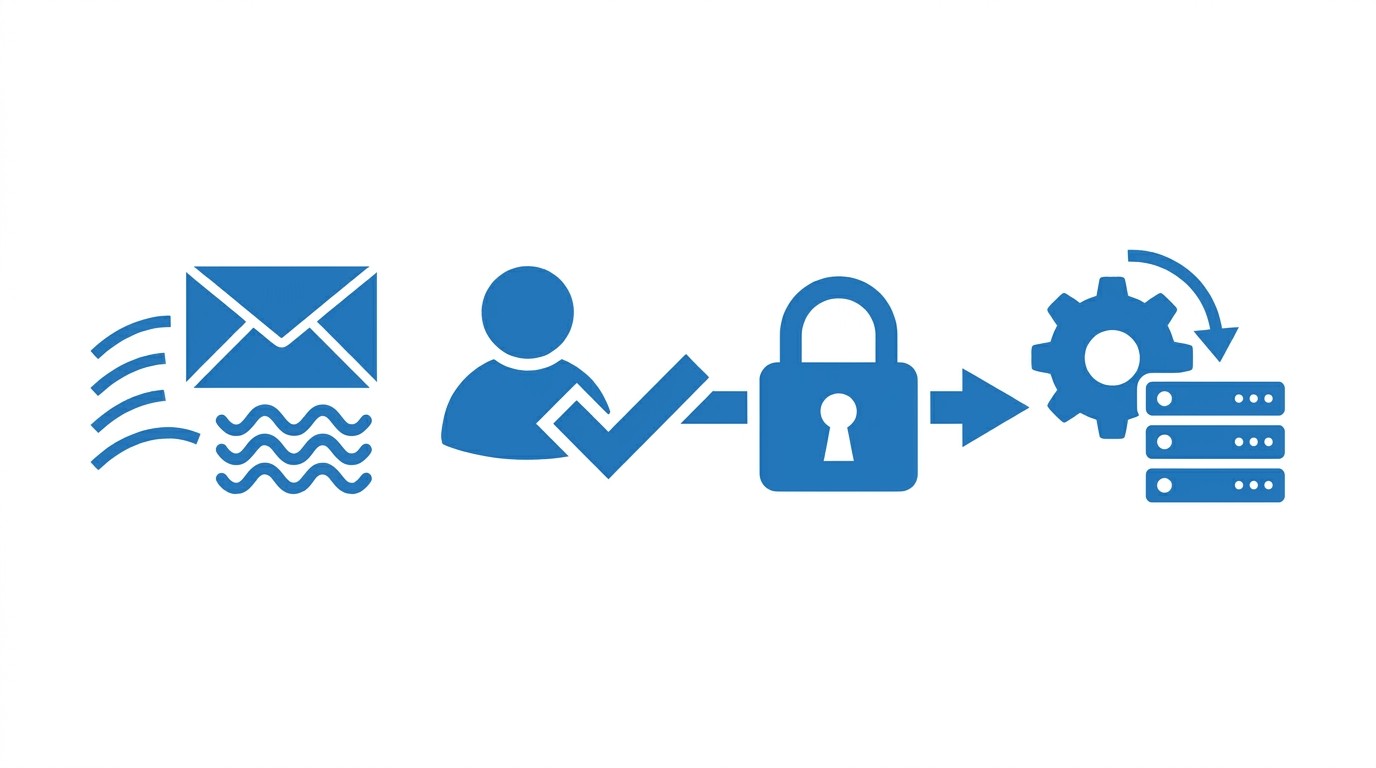
More Messages Can Create a Larger Manual Queue
A collections supervisor approves a campaign that sends 200,000 messages each month. Customers respond, which initially looks encouraging, but the responses route them into inbound call queues that stretch to two minutes. Call abandonment rises from under 10% to over 50%, and agents spend their shifts recovering cases the campaign was meant to resolve.
That scenario came from a major retail bank after it increased an SMS-to-call campaign by four times. The bank’s decision to scale wasn’t careless. The earlier campaign worked, and adding inbound capacity appeared sensible. What failed was the handoff between customer intent and actual completion.
A bank wouldn’t treat an authorised payment as settled before posting and reconciliation are complete. Customer communication needs the same discipline. A click, reply, or chatbot exchange is only an initiation event; confirmed action and reliable writeback are the operational equivalent of settlement.
Flow Design Is Easier Than Safe Completion
Drawing a customer journey is useful, and no-code tools make that work faster. They can model reminders, branches, timing rules, and channel changes without a long development cycle. There’s a valid case for using them to test language or early journey logic.
The harder work begins when the workflow must validate identity, enforce policy, update a balance, or record consent. Legacy cores and modern APIs may use different data structures, failure rules, and authentication methods. If an update times out, the workflow needs to know whether to retry, stop, or route the case for review without creating duplicates.
Operations teams feel the gap immediately. They’re left comparing campaign files, agent notes, and core records to work out what actually happened. The communication looked automated, but it wasn’t built to finish the task.
Banks need a different design sequence, one that begins with completion and works backwards to the message.
How Banks Turn Customer Communication Into Resolution
Banks transform customer communication by defining the completed outcome first, keeping eligible actions inside the message, and designing writebacks before outreach begins. Channels then become delivery routes rather than separate journeys. The approach reduces handoffs because each workflow has one trigger, one completion state, and a controlled exception path.
Diagnose Where the Workflow Stops Being Automated
Where does your current workflow hand responsibility back to the customer or an agent? The answer is often buried after the message has performed well. A strong delivery rate can hide a weak operational process if the next step requires another application, another login, or another person.
Start with one live workflow and follow a single case from trigger to final record update. Use production evidence rather than the process map because real cases expose password resets, delayed files, payment declines, and missing data. We’ve found that the written journey usually ends too early. It describes contact, not completion.
Ask five questions while tracing the case:
Does the customer leave the message to act?
Must an agent verify information already held elsewhere?
Does anyone rekey the customer’s response?
Can operations prove that the core update succeeded?
Does outreach stop automatically after completion?
Three or more “yes” answers indicate that the workflow is still partly manual. Even one “no” on writeback confirmation is enough to block closed-loop resolution because the bank can’t prove that the task finished.
Define Completion Before Choosing a Channel
A message should be designed around a specific operational state change. “Customer engaged” is too vague because it doesn’t say what changed. “Payment arrangement posted with the agreed amount and date” gives operations, risk, and technology something they can test.
Defining completion also exposes policy questions early. Which customers qualify? What evidence must be captured? Which system owns the final state? Without those answers, the team can build an attractive interaction that reaches a dead end when it touches the bank’s operating rules.
For each workflow, document completion in this order:
Trigger: Name the event that starts the case, such as a failed payment or expiring compliance record.
Eligible action: State what the customer may do under the relevant policy.
Evidence: Specify the identity checks, consent, documents, or payment data required.
Writeback: List the balances, flags, notes, or documents that must update.
Exception: Define where the case goes when data is missing or the action fails.
A workflow isn’t complete if the final step says “notify an agent.” Agent routing may be the correct exception, but it shouldn’t remain the default ending for routine, policy-bound work.
Keep Eligible Actions Inside the Message
A portal gives banks control over account access, document storage, and authenticated actions. That value is real, especially for complex servicing tasks that require several screens or broad account access. The limitation appears when a simple action forces the customer through a much larger experience.
Consider a customer who receives a payment reminder on a mobile phone. The message creates intent, but the portal then asks for credentials the customer may not remember, followed by navigation to the right account and action. Each switch separates the decision from the task. If the customer must call after failing to log in, the digital journey has created an assisted case.
For narrow, policy-bound actions, the better pattern is a secure mini-app reached from the message. After identity validation, it should show only the action allowed for that customer, such as paying, setting a date, confirming details, or uploading a document. No broad menu. No unrelated account features.
A financial institution used this approach for Promise to Pay collections. Customers received personalised mobile messages, entered an amount and future date through self-service, and had their commitments captured without agent involvement. Half of all customer engagements produced a successful Promise to Pay, showing how much completion can change when action sits next to intent.
Orchestrate Channels Around the Task, Not the Campaign
SMS, WhatsApp, and email shouldn’t operate as three competing customer journeys. Each channel should move the same case toward one defined outcome while respecting consent and customer preference. The case state, not the campaign calendar, should decide what happens next.
Email may provide useful detail, while SMS can create immediate visibility and WhatsApp can support an interactive exchange where consent allows it. Some banks will still prefer a channel-led model for general notices, and that’s reasonable. Transactional workflows are different because repeated messages after completion create confusion and unnecessary contact.
A practical sequence looks like this:
Send the first message through the eligible preferred channel.
Check delivery and action events before triggering a fallback.
Carry the same case context into the next channel.
Stop every remaining message when completion is confirmed.
Route only defined exceptions to an agent with the case history attached.
If separate channels can produce conflicting case states, they aren’t orchestrated. They’re simply sending messages from the same customer list.
Design Writebacks and Exceptions Before Launch
Reliable writeback is the line between communication software and operational automation. The workflow must know which system to update, what data to send, and how to confirm success. It also needs a safe response when the receiving system is unavailable.
Having designed the customer flow first, teams often discover these questions late in testing. A payment can succeed while the account flag remains unchanged. A repeated request can post the same arrangement twice. Neither problem is visible in open rates, yet both create risk and manual reconciliation.
Before launch, test at least four writeback conditions:
A normal completion updates the correct record.
A repeated request doesn’t create a duplicate outcome.
A temporary system failure retries under controlled rules.
A permanent failure routes to a named exception path with context.
The same care applies to agent handoffs. Missing data, an ineligible plan, or a declined payment may require human judgement, and automation shouldn’t hide that. It should give the agent the trigger, customer action, validation status, and failure reason so work starts with context rather than discovery.
Prove One High-Volume Workflow Before Expanding
A bank doesn’t need to transform every customer journey at once. Starting with one high-volume workflow gives operations a controlled way to test completion, deflection, writeback reliability, and customer behaviour. It also limits integration scope while the team learns where real exceptions occur.
Choose a workflow with frequent cases, clear policy rules, a defined system owner, and a measurable completion state. Failed-payment remediation, Promise to Pay capture, address updates, and compliance refreshes can fit those conditions. A broad service enquiry usually won’t because the intent and outcome vary too widely.
Run the pilot across the full operating path:
Capture the trigger from the source system.
Send eligible outreach through the selected channels.
Let the customer complete the action inside the message.
Confirm the system-of-record update.
Measure completion, time-to-resolution, deflection, and writeback success.
One retail bank moved its scaled collections campaign from overloaded calls to secure self-service in under 30 days. Customers could pay, make a Promise to Pay, or dispute the amount, while specialised agents focused on dispute cases. The lesson wasn’t that every bank should copy the journey. It was that a narrow workflow can prove the operating model before wider transformation begins.
Once that model is proven, the next question is who will manage the integration, policy logic, channel sequence, and writeback controls as volume grows.
How RadMedia Completes Customer Workflows Inside Messages
RadMedia connects bank triggers to secure in-message actions, coordinates outreach across SMS, WhatsApp, and email, and writes completed outcomes back to systems of record. Its role is practical: keep routine cases moving from trigger to resolution while giving agents the context needed for genuine exceptions.
Secure Mini-Apps Turn Customer Intent Into Action
RadMedia’s in-message self-service mini-apps let customers complete policy-eligible tasks without downloading an application or navigating a general portal. Identity can be validated through signed links, one-time codes, or known-fact checks before any action appears. Forms, payment actions, document capture, and timestamped consent then collect the evidence required for completion.
Omni-channel messaging orchestration carries the same workflow across SMS, email, and WhatsApp. Consent, preferences, timing, and cadence shape the sequence, while completion stops further outreach. RadMedia isn’t designed as a cheap bulk email pipe, and it won’t fit a programme that only wants more sends. It’s built for operations teams that need customer communication to finish work.
Managed Integration Closes the Operational Loop
RadMedia manages back-end adapters, authentication, schema mapping, and error handling across legacy cores and modern APIs. The Autopilot Workflow Engine applies policy-aware rules, advances valid cases, and sends blocked cases through defined exception routes. Agents receive the case context when judgement is required instead of repeating the customer’s journey from the beginning.
Closed-loop writeback then updates the relevant balances, arrangements, flags, notes, or documents. Idempotent operations, controlled retries, circuit breaking, and audit logs protect consistency when systems or networks fail. Telemetry records delivery, action, validation, completion, and writeback events, allowing the pilot to be judged on resolution rather than conversation volume.
RadMedia can apply that model to one high-volume workflow first, giving operations a contained way to prove customer completion and agent deflection before expanding. If that first workflow needs secure action, managed integration, and confirmed system updates, get in touch about customer communication workflows on autopilot.
What Banks Should Prove Before They Scale
Banks are transforming customer communication by removing the break between outreach and action. The strongest programmes define completion first, keep routine tasks inside the message, and confirm every valid outcome in the system of record. Channel reach still matters, but it can’t substitute for resolution.
Start with one workflow where the rules are clear and the manual load is visible. Prove that customers can complete the task, exceptions reach the right people, and writebacks remain reliable. Then scale what works.
Frequently asked questions
How do I handle edge cases effectively?
To manage edge cases effectively, start by defining clear exception paths for scenarios where customer actions may fail. For instance, if a payment declines, ensure the workflow routes the case to an agent with full context. You can use RadMedia's Autopilot Workflow Engine to set up these rules, ensuring that every potential issue is accounted for. This way, agents receive the necessary information to assist customers without repeating their journey, which streamlines resolution.
What if my customer doesn't respond to outreach?
If a customer doesn't respond, consider adjusting your outreach strategy. Start by analyzing the timing and channel preferences. RadMedia's Omni-Channel Messaging Orchestration can help you sequence messages across SMS, email, and WhatsApp based on customer behavior. If a message goes unanswered, you can set up automatic follow-ups through a different channel to increase engagement. Always ensure that the message includes a clear call to action to encourage a response.
Can I track the success of my customer communication?
While RadMedia does not provide traditional analytics, you can measure success through completion rates and time-to-resolution. Focus on how many customers complete the actions embedded in your messages. By leveraging RadMedia's Closed-Loop Resolution feature, you can ensure that outcomes write back to your systems, allowing you to track effectiveness based on actual task completion rather than just message delivery.
How do I ensure compliance in customer communications?
To ensure compliance, start by defining the necessary policies and eligibility rules for each workflow. RadMedia's Managed Back-End Integration can help you connect to your core systems and enforce these rules effectively. Additionally, use in-message self-service mini-apps to capture necessary consents and document submissions securely. This approach not only streamlines the process but also maintains a clear audit trail for compliance purposes.
When should I scale my customer communication efforts?
You should consider scaling your efforts once you have successfully proven one high-volume workflow. Start by focusing on a specific task that has clear rules and measurable outcomes. Use RadMedia's capabilities to automate this process and ensure that it consistently delivers results before expanding to other workflows. This way, you can refine your approach and build confidence in your customer communication strategy.