
Channel Comparison for Automated Resolutions in Finance
Choosing the right channel for automated resolutions in financial services is crucial. Focus on secure identity and consent within messages to ensure task completion, rather than popularity. A blended strategy minimizes friction and enhances compliance.
Channel choice shouldn’t be a guessing game or a popularity contest. If your goal is automated resolution, the deciding factor is whether a customer can complete the task inside the message—securely—without detours, logins, or agent handoffs. We’ll walk you through how to make that call without sacrificing compliance or conversion.
We’ll discuss the specific ways channel decisions succeed or fail in regulated journeys. You’ll see how identity, consent, auditability, and writebacks shape what’s possible on SMS, WhatsApp, email, and voice. The aim is simple: design for completion and evidence, not conversation volume.
Key Takeaways:
Choose channels by task type and identity requirements, not popularity or convenience
Design for completion in the message with secure authentication and guaranteed writebacks
Quantify hidden costs from handoffs, manual wrap-up, and missing consent evidence
Use a blended channel strategy that meets the strongest regulatory requirement
Build identity and consent into flows; avoid portal detours for policy-bound tasks
Reserve agents for true exceptions; let autopilot workflows handle the rest
Why Popular Channels Do Not Guarantee Resolution
Popular channels don’t guarantee resolution because completion requires secure identity, consent capture, and automatic writebacks to core systems. A channel that can’t do these in-message adds friction and manual work. For example, an SMS that pushes to a portal increases drop-off if users don’t remember credentials.

The task type, not the trend, should drive channel choice
Resolution depends on the task’s requirements: identity assurance, data capture, payments, documents, and evidence. Pick the channel that safely supports those steps in-message. Trend-first decisions inflate conversations but not completions, especially when customers have to switch context to finish. This mistake costs time, adds risk, and leaves teams reconciling outcomes after the fact.
Start by defining the outcome and evidence: what “done” means, what must be written back, and what proof regulators expect. Then match channel capabilities to those needs. WhatsApp can support richer, authenticated flows; SMS delivers reach and OTPs; email carries disclosures and attachments; voice handles nuance but scales poorly for routine tasks. Vendors like RadMedia design outcome-first flows that finish in-message and close the loop automatically.
When should financial services avoid portal detours?
Avoid detours whenever the task is repeatable, policy-bound, or identity-sensitive. Each extra click invites abandonment and forces agents to reconcile partial outcomes. Customers who intended to pay or submit documents lose momentum when asked to download apps or log in elsewhere, and your team pays the reconciliation tax later.
You’ll get better results by embedding secure identity inside the message. Use signed deep links and one-time codes to authenticate. Present a focused mini-app that captures payments, plan selection, or documents in a single flow. When outcomes write back with idempotency, the system of record updates immediately and the case closes—no manual wrap-up, no parallel queues.
The Decision Inputs That Matter in Regulated Journeys
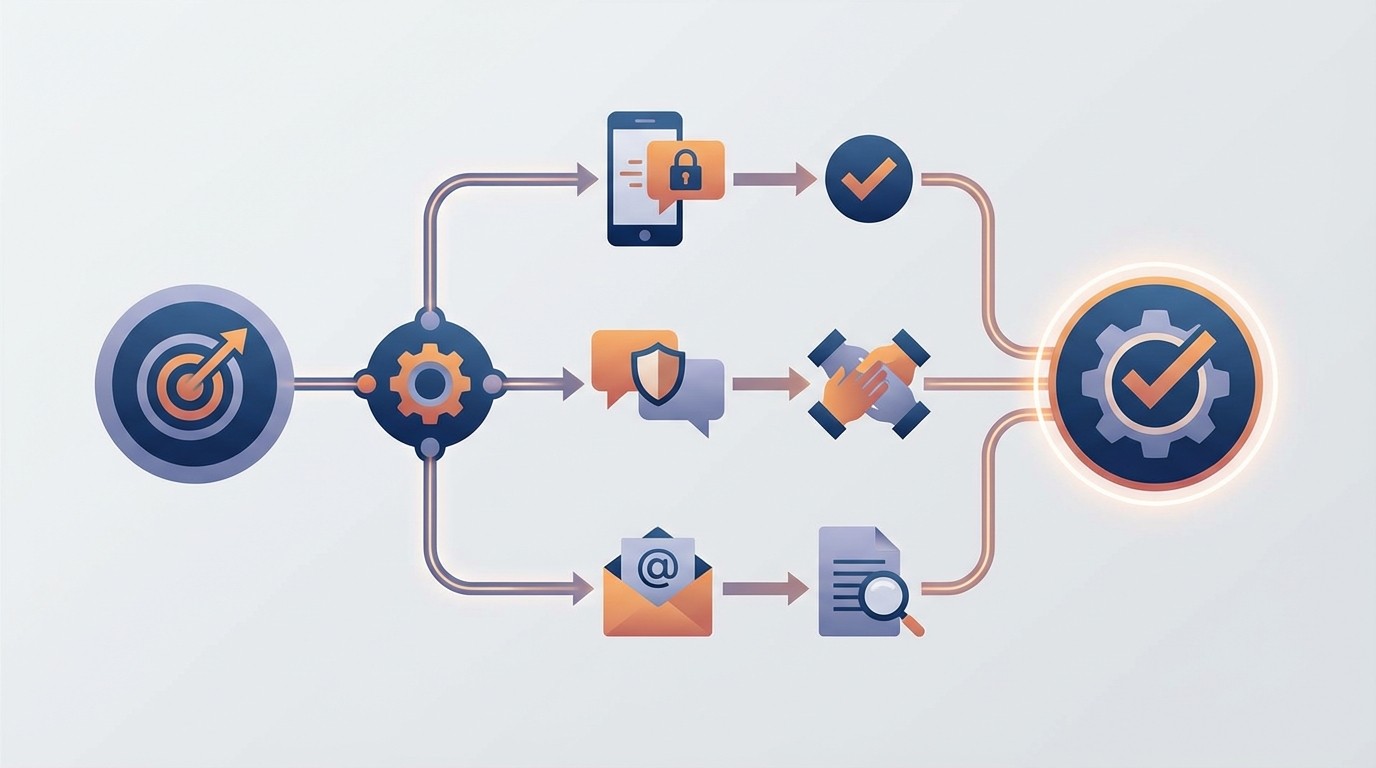
In regulated journeys, define the outcome and controls first, then pick channels that satisfy the strongest requirement with the least friction. WhatsApp supports encrypted, two-way flows; SMS excels at reach and OTPs; email provides durable evidence; voice serves nuanced exceptions. Blending channels with clear roles reduces risk and improves completion.
How do you balance reach, security, and auditability?
Balancing reach, security, and auditability starts with the control that cannot be compromised. If identity proof is paramount, prioritize channels that support secure links and verified sender profiles. If auditability leads, ensure disclosures and consents are captured with timestamps and are retrievable later. Meanwhile, reach determines how reliably you can prompt action at scale.
In practice, use SMS for alerts and OTPs when seconds matter; consider WhatsApp for encrypted, multi-step exchanges that need richer UI; rely on email for detailed notices, attachments, and archival evidence. Reference points like Twilio’s comparison of SMS and WhatsApp for business and FICO’s view on omnichannel communications can help frame the trade-offs. Your policy, not preference, should drive the final mix.
The authentication options that change what is possible
Your identity toolbox determines whether a task can finish in-channel. Signed deep links with short-lived tokens, one-time codes, and known-fact checks allow secure actions without forcing a portal login. WhatsApp verified business profiles strengthen trust; SMS OTPs remain a reliable stepping stone; email can carry signed links for downstream steps.
Think in layers. A signed deep link authenticates the session; a one-time code binds the user; known-fact validation (last digits, DOB, recent transaction) adds assurance for sensitive tasks. When identity fails, the workflow should escalate with context, not restart in discovery mode. For a practical look at choosing channels with identity in mind, see DanaConnect’s channel strategy guidance.
Deliverability and evidence, what differs by channel?
Deliverability and evidence vary meaningfully. SMS offers near-universal reach and speed for OTPs and critical alerts, but limited UI. WhatsApp provides high engagement and richer interactions with verified profiles, strong for policy-bound, two-way flows. Email excels at formal disclosures and attachments, with a durable audit trail that legal teams trust.
Voice can be effective for exceptions or low-connectivity scenarios but carries queue and abandonment risk at scale. Treat RCS as an SMS enhancement where available—useful, but not a substitute for identity and writeback design. Whatever the channel, plan for message templates, rate limits, and retries so operational hiccups don’t undermine completion and evidence capture.
The Hidden Costs of Mismatched Channels
Mismatched channels create parallel queues, scattered evidence, and manual wrap-up. Each handoff adds minutes and error risk; each portal hop invites abandonment. Over time, you see longer cycle times, higher unit cost, and uncomfortable audit gaps when consent, identity, or documents can’t be traced cleanly.
Fragmentation drives manual wrap up and compliance risk
When tasks move from SMS to portal to call centre, the handoffs fragment data. Agents rekey details. Documents go missing. Consents live in one tool while outcomes sit in another. Without guaranteed writebacks, someone must reconcile the record. That’s expensive and brittle, especially across legacy systems.
The operational signal is clear: extended resolution times, higher escalations, and audit anxiety. Consolidating the flow inside the message changes the math. You reduce hops, standardize steps, and capture evidence by design. Industry discussions, including Infobip’s analysis of conversational banking’s rise, reinforce that chat volume alone isn’t the win—completion with proof is.
Why failed identity checks sink completion
Identity friction derails intent. Customers who were ready to pay (or submit KYC documents) stall when they face password resets, multi-step logins, or unclear verification prompts. The result is abandonment and a manual escalation that adds cost without improving the outcome. The fix is embedding identity where action happens.
Build identity into the message flow with signed links and one-time codes, then gate sensitive steps behind known-fact checks. When policy blocks completion, route the exception with full context—data collected, validations done, and attempted writebacks—so agents start at resolution, not discovery. This protects conversion and creates the audit trail compliance teams expect.
When Automation Backfires, Everyone Feels It
Automation backfires when infrastructure and design can’t support resolution in the channel. Bottlenecks, missing consent, and identity gaps force manual work. Customers experience delays; agents absorb exceptions that should have resolved automatically; leaders see rising costs with little movement on completion metrics.
When a high volume voice campaign collapses under load
Voice is persuasive, but it doesn’t scale routine work. At volume, line capacity, IVR friction, and queues drive abandonment. We’ve seen programs crater after expansion because wait times doubled and customers dropped. Intent was there, but the path to completion failed under load. The campaign looked active; results fell flat.
Shift routine, policy-bound steps into in-message self-service. Payments, plan selection, and document submission don’t need a call if identity and writebacks are handled in-flow. Reserve agents for nuanced conversations where empathy and judgment matter. This reduces abandonment and keeps your contact centre focused on work only people can do.
Who pays the price when consent is missing?
Missing or stale consent blocks outreach and limits channel options. Teams either pause communication (and lose time) or push ahead and accept regulatory risk. Both are costly. Worse, consent scattered across tools creates audit gaps just when you need clarity most.
Bake consent into your workflows. Capture it in-message alongside the action, store timestamps and policy versions, and adjust channel sequencing when consent changes. With clear evidence, you can run proactive programs confidently, expand to richer channels, and remove the hesitation that slows resolution.
A Practical Channel Decision Framework for Automated Resolution
A practical framework starts with outcome definition, then aligns channels to identity, consent, and evidence requirements. Use SMS for reach and OTPs, WhatsApp for secure two-way resolution, email for formal notices and records, and voice for complex exceptions. We’ll walk you through concrete patterns you can apply immediately.
Deliverability and reach, SMS, WhatsApp, email, voice
Deliverability is your safety net for time-sensitive prompts; reach determines how many customers can realistically act. SMS remains the most reliable for OTPs and urgent alerts. WhatsApp, with verified senders, combines strong engagement with richer UI for guided flows. Email carries long-form content and attachments, providing durable records for compliance. Voice supports nuance but struggles at scale.
Before picking a channel, define the action you want taken and the evidence you must retain. Then pressure-test deliverability: template approvals, throttling, sender reputation, and fallback options. Plan for rate limits and retries so spikes don’t stall critical flows. When you know how many customers will get the message—and how fast—you can set realistic completion targets.
SMS: near universal reach; strong for OTPs and critical alerts; limited UI
WhatsApp: verified senders; encrypted, rich two-way flows; template governance needed
Email: detailed notices, attachments, and archivable evidence; reputation management required
Voice: useful for nuanced exceptions and low-connectivity cases; queue risk at scale
Authentication and consent design by channel
Identity and consent design determine whether you can complete the task in-channel. For SMS, pair OTPs with signed links and known-fact checks for sensitive steps. In WhatsApp, use a verified business profile and signed deep links; the channel’s encryption supports higher-trust interactions. In email, include signed links and clear disclosures, then capture digital consent inside the mini-app. In voice, rely on KBA and escalate only when policy requires human review.
Treat consent as part of the task, not a separate process. Capture it alongside the action, store timestamps and policy references, and adapt sequences when consent is limited, revoked, or expired. Designing these controls up front reduces the chance of last-minute channel changes that delay resolution.
SMS: OTP + signed link for session binding; known-fact validation for sensitive actions
WhatsApp: verified profile + signed deep link; supports encrypted, multi-step flows
Email: signed links with explicit disclosures; supports documents and long-form content
Voice: KBA for exceptions; best for non-routine cases
Recommended use cases by segment
Segment-specific patterns make selection faster. For new-to-bank customers, use SMS OTPs to verify identity, email for welcome materials and disclosures, and WhatsApp for guided onboarding actions. For high-value, fraud-sensitive accounts, pair SMS OTP for step-up with WhatsApp for secure confirmation and email for post-event notices. In collections, start with SMS nudges, offer plan selection in WhatsApp, and send terms via email. In late-stage or low-connectivity contexts, combine SMS and voice with in-message plan options where feasible.
The common thread is ending the task inside the message and writing outcomes back automatically. When each segment’s flow is designed this way, you reduce drop-off, capture evidence by default, and avoid the manual reconciliation that inflates cost-to-serve.
New to bank: SMS for OTPs; email for disclosures; WhatsApp for guided steps
High value/fraud sensitive: SMS step-up; WhatsApp confirmation; email for documentation
Collections early stage: SMS nudges; WhatsApp plan selection; email for terms
Late stage/low connectivity: SMS + voice tandem; in-message plan options where possible
How RadMedia Orchestrates the Right Channel for Resolution
RadMedia enables resolution-first journeys by matching each task to the right channel, embedding identity and consent in-message, and writing outcomes back automatically. The platform handles sequencing, authentication, and integration so routine cases close on autopilot while exceptions escalate with full context. That combination cuts cycle time, lowers unit cost, and improves audit readiness.
Omni channel sequencing that adapts to consent and responsiveness
RadMedia learns customer responsiveness and respects consent, then sequences SMS, WhatsApp, email, and voice to move each case forward. Quiet hours, jurisdictional templates, and send windows are enforced so outreach is compliant by design. If a nudge misses, cadence adjusts; if consent changes, the channel plan updates automatically.
This approach directly addresses the hidden costs of fragmentation. Instead of parallel queues across tools, you get a single orchestrated flow that prioritizes reach when timing matters and depth when the task requires it. Telemetry at each step provides visibility into completion and deflection, so you can tune the mix without guesswork.
In message mini apps with secure identity and digital evidence
RadMedia delivers secure, branded mini-apps inside messages so customers finish tasks without logins or downloads. Identity is validated with one-time codes, signed deep links, or known-fact checks. Payments, plan selection, KYC, and document capture all happen in a guided interface that minimizes errors and captures consent with timestamps.
Each interaction creates digital evidence: the actions taken, the policy version shown, the identity checks passed, and the consents given. That evidence travels with the case. When an exception occurs, it escalates to an agent with full context—messages sent, inputs collected, validations attempted—so resolution continues, not restarts.
Managed integration and idempotent writebacks that close the loop
RadMedia connects to legacy cores and modern APIs, then guarantees outcomes write back to systems of record reliably. Idempotency keys, retries with backoff, and circuit breaking protect data consistency when downstream services wobble. Schema mapping, authentication management, and error handling are managed for you, which removes a major source of operational risk and delay.
Closing the loop where the conversation happens eliminates manual wrap-up. Balances update, flags clear, notes and documents attach, and audit logs store automatically. That’s how RadMedia turns intent into completion and reconciled records, not more conversations about doing the thing. The results are concrete: shorter time-to-resolution, higher deflection for routine cases, and cleaner audits with less effort.
Conclusion
Channel strategy isn’t about where customers like to chat—it’s about where they can finish securely, with evidence, and without handoffs. When you define the outcome first, embed identity and consent in-message, and guarantee writebacks, completion becomes the default. Build your mix around those non-negotiables, and you’ll reduce cost, protect compliance, and improve customer outcomes at the same time.
Discover effective channel comparison strategies for automated resolutions in financial services. Improve compliance and conversion rates today!
Comparison: SMS, WhatsApp, Email and Voice for Automated Resolutions in Financial Services - RadMedia professional guide illustration
[{"q":"How do I choose the right channel for customer communication?","a":"Choosing the right channel starts with understanding the task type and identity requirements. For instance, if you need secure identity verification and consent capture, SMS or WhatsApp might be better than email. You can use RadMedia to automate outreach across these channels, ensuring that the message includes an in-message self-service app. This way, customers can complete their tasks without switching contexts or dealing with logins, which often leads to drop-offs. Always consider the customer's preferences and the nature of the task to maximize completion rates."},{"q":"What if my customers prefer different communication channels?","a":"It's common for customers to have varying channel preferences. To address this, you can implement a blended channel strategy using RadMedia. This approach allows you to adapt your outreach based on customer consent status and responsiveness. By sequencing SMS, email, and WhatsApp messages, you can ensure that each customer receives communication through their preferred channel, enhancing engagement and completion rates. Make sure to monitor the effectiveness of each channel to optimize your strategy over time."},{"q":"Can I automate compliance tasks with RadMedia?","a":"Yes, RadMedia is designed to handle compliance tasks effectively. You can set up workflows that automatically trigger outreach for KYC or AML attestations. When customers receive these requests, they can confirm their identity and upload necessary documents directly within the message using secure, no-download mini-apps. This eliminates the need for portal logins and ensures that all actions are captured with timestamps for audit purposes. By automating these processes, you can improve efficiency and reduce the risk of non-compliance."},{"q":"When should I escalate a case to an agent?","a":"You should consider escalating a case to an agent when there are exceptions that prevent automated resolution, such as eligibility failures or missing data. RadMedia's autopilot workflow engine is designed to handle most routine cases automatically, but if a rule blocks completion, it will route the case to an agent with full context. This way, agents can focus on more complex issues while routine tasks are resolved seamlessly. Make sure to define clear business rules to guide when escalation is necessary."},{"q":"Why does my current system struggle with automated resolutions?","a":"Many systems struggle with automated resolutions due to fragmented workflows that require customers to switch channels or log into portals. RadMedia addresses this by integrating back-end systems and enabling in-message self-service apps. This means that customers can complete their tasks directly within the communication channel, whether it's SMS, email, or WhatsApp, without unnecessary detours. By ensuring that outcomes write back to the system of record automatically, you can reduce operational overhead and improve customer satisfaction."}]
24 Jan 2026
cc062b79-9100-4ac9-8884-5a8199b8c34b
{"@graph":[{"@id":"https://radmedia.co.za/comparison-sms-whatsapp-email-and-voice-for-automated-resolutions-in-financial-services#article","@type":"Article","image":"https://jdbrszggncetflrhtwcd.supabase.co/storage/v1/object/public/article-images/6dca98ae-107d-47b7-832f-ee543e4b5364/comparison-sms-whatsapp-email-and-voice-for-automated-resolutions-in-financial-services-hero-1769213245610.png","author":{"name":"RadMedia","@type":"Organization"},"headline":"Comparison: SMS, WhatsApp, Email and Voice for Automated Resolutions in Financial Services","keywords":"channel comparison automated resolutions","publisher":{"name":"RadMedia","@type":"Organization"},"wordCount":2382,"description":"Comparison: SMS, WhatsApp, Email and Voice for Automated Resolutions in Financial Services","dateModified":"2026-01-24T00:03:57.876+00:00","datePublished":"2026-01-24T00:02:06.264139+00:00","mainEntityOfPage":{"@id":"https://radmedia.co.za/comparison-sms-whatsapp-email-and-voice-for-automated-resolutions-in-financial-services","@type":"WebPage"}},{"@id":"https://radmedia.co.za/comparison-sms-whatsapp-email-and-voice-for-automated-resolutions-in-financial-services#breadcrumb","@type":"BreadcrumbList","itemListElement":[{"item":"https://radmedia.co.za","name":"Home","@type":"ListItem","position":1},{"item":"https://radmedia.co.za/comparison-sms-whatsapp-email-and-voice-for-automated-resolutions-in-financial-services","name":"Comparison: SMS, WhatsApp, Email and Voice for Automated Res","@type":"ListItem","position":2}]}],"@context":"https://schema.org"}
[{"url":"https://jdbrszggncetflrhtwcd.supabase.co/storage/v1/object/public/article-images/6dca98ae-107d-47b7-832f-ee543e4b5364/comparison-sms-whatsapp-email-and-voice-for-automated-resolutions-in-financial-services-inline-0-1769213260685.png","alt":"How RadMedia Orchestrates the Right Channel for Resolution concept illustration - RadMedia","filename":"comparison-sms-whatsapp-email-and-voice-for-automated-resolutions-in-financial-services-inline-0-1769213260685.png","position":"after_h2_1","asset_id":null,"type":"ai_generated","dimensions":{"width":1024,"height":1024}},{"url":"https://jdbrszggncetflrhtwcd.supabase.co/storage/v1/object/public/article-images/6dca98ae-107d-47b7-832f-ee543e4b5364/comparison-sms-whatsapp-email-and-voice-for-automated-resolutions-in-financial-services-inline-1-1769213275303.png","alt":"A Practical Channel Decision Framework for Automated Resolution concept illustration - RadMedia","filename":"comparison-sms-whatsapp-email-and-voice-for-automated-resolutions-in-financial-services-inline-1-1769213275303.png","position":"after_h2_2","asset_id":null,"type":"ai_generated","dimensions":{"width":1024,"height":1024}}]
97
2382
Channel choice shouldn’t be a guessing game or a popularity contest. If your goal is automated resolution, the deciding factor is whether a customer can complete the task inside the message—securely—without detours, logins, or agent handoffs. We’ll walk you through how to make that call without sacrificing compliance or conversion.
We’ll discuss the specific ways channel decisions succeed or fail in regulated journeys. You’ll see how identity, consent, auditability, and writebacks shape what’s possible on SMS, WhatsApp, email, and voice. The aim is simple: design for completion and evidence, not conversation volume.
Key Takeaways:
Choose channels by task type and identity requirements, not popularity or convenience
Design for completion in the message with secure authentication and guaranteed writebacks
Quantify hidden costs from handoffs, manual wrap-up, and missing consent evidence
Use a blended channel strategy that meets the strongest regulatory requirement
Build identity and consent into flows; avoid portal detours for policy-bound tasks
Reserve agents for true exceptions; let autopilot workflows handle the rest
Why Popular Channels Do Not Guarantee Resolution
Popular channels don’t guarantee resolution because completion requires secure identity, consent capture, and automatic writebacks to core systems. A channel that can’t do these in-message adds friction and manual work. For example, an SMS that pushes to a portal increases drop-off if users don’t remember credentials.

The task type, not the trend, should drive channel choice
Resolution depends on the task’s requirements: identity assurance, data capture, payments, documents, and evidence. Pick the channel that safely supports those steps in-message. Trend-first decisions inflate conversations but not completions, especially when customers have to switch context to finish. This mistake costs time, adds risk, and leaves teams reconciling outcomes after the fact.
Start by defining the outcome and evidence: what “done” means, what must be written back, and what proof regulators expect. Then match channel capabilities to those needs. WhatsApp can support richer, authenticated flows; SMS delivers reach and OTPs; email carries disclosures and attachments; voice handles nuance but scales poorly for routine tasks. Vendors like RadMedia design outcome-first flows that finish in-message and close the loop automatically.
When should financial services avoid portal detours?
Avoid detours whenever the task is repeatable, policy-bound, or identity-sensitive. Each extra click invites abandonment and forces agents to reconcile partial outcomes. Customers who intended to pay or submit documents lose momentum when asked to download apps or log in elsewhere, and your team pays the reconciliation tax later.
You’ll get better results by embedding secure identity inside the message. Use signed deep links and one-time codes to authenticate. Present a focused mini-app that captures payments, plan selection, or documents in a single flow. When outcomes write back with idempotency, the system of record updates immediately and the case closes—no manual wrap-up, no parallel queues.
The Decision Inputs That Matter in Regulated Journeys
In regulated journeys, define the outcome and controls first, then pick channels that satisfy the strongest requirement with the least friction. WhatsApp supports encrypted, two-way flows; SMS excels at reach and OTPs; email provides durable evidence; voice serves nuanced exceptions. Blending channels with clear roles reduces risk and improves completion.

How do you balance reach, security, and auditability?
Balancing reach, security, and auditability starts with the control that cannot be compromised. If identity proof is paramount, prioritize channels that support secure links and verified sender profiles. If auditability leads, ensure disclosures and consents are captured with timestamps and are retrievable later. Meanwhile, reach determines how reliably you can prompt action at scale.
In practice, use SMS for alerts and OTPs when seconds matter; consider WhatsApp for encrypted, multi-step exchanges that need richer UI; rely on email for detailed notices, attachments, and archival evidence. Reference points like Twilio’s comparison of SMS and WhatsApp for business and FICO’s view on omnichannel communications can help frame the trade-offs. Your policy, not preference, should drive the final mix.
The authentication options that change what is possible
Your identity toolbox determines whether a task can finish in-channel. Signed deep links with short-lived tokens, one-time codes, and known-fact checks allow secure actions without forcing a portal login. WhatsApp verified business profiles strengthen trust; SMS OTPs remain a reliable stepping stone; email can carry signed links for downstream steps.
Think in layers. A signed deep link authenticates the session; a one-time code binds the user; known-fact validation (last digits, DOB, recent transaction) adds assurance for sensitive tasks. When identity fails, the workflow should escalate with context, not restart in discovery mode. For a practical look at choosing channels with identity in mind, see DanaConnect’s channel strategy guidance.
Deliverability and evidence, what differs by channel?
Deliverability and evidence vary meaningfully. SMS offers near-universal reach and speed for OTPs and critical alerts, but limited UI. WhatsApp provides high engagement and richer interactions with verified profiles, strong for policy-bound, two-way flows. Email excels at formal disclosures and attachments, with a durable audit trail that legal teams trust.
Voice can be effective for exceptions or low-connectivity scenarios but carries queue and abandonment risk at scale. Treat RCS as an SMS enhancement where available—useful, but not a substitute for identity and writeback design. Whatever the channel, plan for message templates, rate limits, and retries so operational hiccups don’t undermine completion and evidence capture.
The Hidden Costs of Mismatched Channels
Mismatched channels create parallel queues, scattered evidence, and manual wrap-up. Each handoff adds minutes and error risk; each portal hop invites abandonment. Over time, you see longer cycle times, higher unit cost, and uncomfortable audit gaps when consent, identity, or documents can’t be traced cleanly.
Fragmentation drives manual wrap up and compliance risk
When tasks move from SMS to portal to call centre, the handoffs fragment data. Agents rekey details. Documents go missing. Consents live in one tool while outcomes sit in another. Without guaranteed writebacks, someone must reconcile the record. That’s expensive and brittle, especially across legacy systems.
The operational signal is clear: extended resolution times, higher escalations, and audit anxiety. Consolidating the flow inside the message changes the math. You reduce hops, standardize steps, and capture evidence by design. Industry discussions, including Infobip’s analysis of conversational banking’s rise, reinforce that chat volume alone isn’t the win—completion with proof is.
Why failed identity checks sink completion
Identity friction derails intent. Customers who were ready to pay (or submit KYC documents) stall when they face password resets, multi-step logins, or unclear verification prompts. The result is abandonment and a manual escalation that adds cost without improving the outcome. The fix is embedding identity where action happens.
Build identity into the message flow with signed links and one-time codes, then gate sensitive steps behind known-fact checks. When policy blocks completion, route the exception with full context—data collected, validations done, and attempted writebacks—so agents start at resolution, not discovery. This protects conversion and creates the audit trail compliance teams expect.
When Automation Backfires, Everyone Feels It
Automation backfires when infrastructure and design can’t support resolution in the channel. Bottlenecks, missing consent, and identity gaps force manual work. Customers experience delays; agents absorb exceptions that should have resolved automatically; leaders see rising costs with little movement on completion metrics.
When a high volume voice campaign collapses under load
Voice is persuasive, but it doesn’t scale routine work. At volume, line capacity, IVR friction, and queues drive abandonment. We’ve seen programs crater after expansion because wait times doubled and customers dropped. Intent was there, but the path to completion failed under load. The campaign looked active; results fell flat.
Shift routine, policy-bound steps into in-message self-service. Payments, plan selection, and document submission don’t need a call if identity and writebacks are handled in-flow. Reserve agents for nuanced conversations where empathy and judgment matter. This reduces abandonment and keeps your contact centre focused on work only people can do.
Who pays the price when consent is missing?
Missing or stale consent blocks outreach and limits channel options. Teams either pause communication (and lose time) or push ahead and accept regulatory risk. Both are costly. Worse, consent scattered across tools creates audit gaps just when you need clarity most.
Bake consent into your workflows. Capture it in-message alongside the action, store timestamps and policy versions, and adjust channel sequencing when consent changes. With clear evidence, you can run proactive programs confidently, expand to richer channels, and remove the hesitation that slows resolution.
A Practical Channel Decision Framework for Automated Resolution
A practical framework starts with outcome definition, then aligns channels to identity, consent, and evidence requirements. Use SMS for reach and OTPs, WhatsApp for secure two-way resolution, email for formal notices and records, and voice for complex exceptions. We’ll walk you through concrete patterns you can apply immediately.
Deliverability and reach, SMS, WhatsApp, email, voice
Deliverability is your safety net for time-sensitive prompts; reach determines how many customers can realistically act. SMS remains the most reliable for OTPs and urgent alerts. WhatsApp, with verified senders, combines strong engagement with richer UI for guided flows. Email carries long-form content and attachments, providing durable records for compliance. Voice supports nuance but struggles at scale.
Before picking a channel, define the action you want taken and the evidence you must retain. Then pressure-test deliverability: template approvals, throttling, sender reputation, and fallback options. Plan for rate limits and retries so spikes don’t stall critical flows. When you know how many customers will get the message—and how fast—you can set realistic completion targets.
SMS: near universal reach; strong for OTPs and critical alerts; limited UI
WhatsApp: verified senders; encrypted, rich two-way flows; template governance needed
Email: detailed notices, attachments, and archivable evidence; reputation management required
Voice: useful for nuanced exceptions and low-connectivity cases; queue risk at scale
Authentication and consent design by channel
Identity and consent design determine whether you can complete the task in-channel. For SMS, pair OTPs with signed links and known-fact checks for sensitive steps. In WhatsApp, use a verified business profile and signed deep links; the channel’s encryption supports higher-trust interactions. In email, include signed links and clear disclosures, then capture digital consent inside the mini-app. In voice, rely on KBA and escalate only when policy requires human review.
Treat consent as part of the task, not a separate process. Capture it alongside the action, store timestamps and policy references, and adapt sequences when consent is limited, revoked, or expired. Designing these controls up front reduces the chance of last-minute channel changes that delay resolution.
SMS: OTP + signed link for session binding; known-fact validation for sensitive actions
WhatsApp: verified profile + signed deep link; supports encrypted, multi-step flows
Email: signed links with explicit disclosures; supports documents and long-form content
Voice: KBA for exceptions; best for non-routine cases
Recommended use cases by segment
Segment-specific patterns make selection faster. For new-to-bank customers, use SMS OTPs to verify identity, email for welcome materials and disclosures, and WhatsApp for guided onboarding actions. For high-value, fraud-sensitive accounts, pair SMS OTP for step-up with WhatsApp for secure confirmation and email for post-event notices. In collections, start with SMS nudges, offer plan selection in WhatsApp, and send terms via email. In late-stage or low-connectivity contexts, combine SMS and voice with in-message plan options where feasible.
The common thread is ending the task inside the message and writing outcomes back automatically. When each segment’s flow is designed this way, you reduce drop-off, capture evidence by default, and avoid the manual reconciliation that inflates cost-to-serve.
New to bank: SMS for OTPs; email for disclosures; WhatsApp for guided steps
High value/fraud sensitive: SMS step-up; WhatsApp confirmation; email for documentation
Collections early stage: SMS nudges; WhatsApp plan selection; email for terms
Late stage/low connectivity: SMS + voice tandem; in-message plan options where possible
How RadMedia Orchestrates the Right Channel for Resolution
RadMedia enables resolution-first journeys by matching each task to the right channel, embedding identity and consent in-message, and writing outcomes back automatically. The platform handles sequencing, authentication, and integration so routine cases close on autopilot while exceptions escalate with full context. That combination cuts cycle time, lowers unit cost, and improves audit readiness.
Omni channel sequencing that adapts to consent and responsiveness
RadMedia learns customer responsiveness and respects consent, then sequences SMS, WhatsApp, email, and voice to move each case forward. Quiet hours, jurisdictional templates, and send windows are enforced so outreach is compliant by design. If a nudge misses, cadence adjusts; if consent changes, the channel plan updates automatically.
This approach directly addresses the hidden costs of fragmentation. Instead of parallel queues across tools, you get a single orchestrated flow that prioritizes reach when timing matters and depth when the task requires it. Telemetry at each step provides visibility into completion and deflection, so you can tune the mix without guesswork.
In message mini apps with secure identity and digital evidence
RadMedia delivers secure, branded mini-apps inside messages so customers finish tasks without logins or downloads. Identity is validated with one-time codes, signed deep links, or known-fact checks. Payments, plan selection, KYC, and document capture all happen in a guided interface that minimizes errors and captures consent with timestamps.
Each interaction creates digital evidence: the actions taken, the policy version shown, the identity checks passed, and the consents given. That evidence travels with the case. When an exception occurs, it escalates to an agent with full context—messages sent, inputs collected, validations attempted—so resolution continues, not restarts.
Managed integration and idempotent writebacks that close the loop
RadMedia connects to legacy cores and modern APIs, then guarantees outcomes write back to systems of record reliably. Idempotency keys, retries with backoff, and circuit breaking protect data consistency when downstream services wobble. Schema mapping, authentication management, and error handling are managed for you, which removes a major source of operational risk and delay.
Closing the loop where the conversation happens eliminates manual wrap-up. Balances update, flags clear, notes and documents attach, and audit logs store automatically. That’s how RadMedia turns intent into completion and reconciled records, not more conversations about doing the thing. The results are concrete: shorter time-to-resolution, higher deflection for routine cases, and cleaner audits with less effort.
Conclusion
Channel strategy isn’t about where customers like to chat—it’s about where they can finish securely, with evidence, and without handoffs. When you define the outcome first, embed identity and consent in-message, and guarantee writebacks, completion becomes the default. Build your mix around those non-negotiables, and you’ll reduce cost, protect compliance, and improve customer outcomes at the same time.
