
Challenges of Fragmented Customer Service Channels
Fragmented customer service channels lead to costly delays due to multiple handoffs and incomplete workflows. Improving resolution requires a focus on seamless outcomes, reducing manual work, and measuring completion rates rather than just conversation metrics.
Fragmented customer communication creates cost long before anyone sees it in a dashboard. The real problem isn't channel count on its own. It's the challenges of fragmented customer journeys across messages, portals, agents, and core systems, where work starts in one place, stalls in another, and still needs manual follow-up at the end.
If you're responsible for billing, collections, or compliance operations, you've probably seen this pattern already. A workflow looks automated from the outside. Messages go out. Customers click. Agents pick up the rest. But the task still doesn't resolve inside the message, and the outcome still doesn't write back cleanly. That's where cost builds.
Key Takeaways:
The biggest challenges of fragmented customer communication come from handoffs, not message volume
More channels don't improve operations if customers still have to switch context to finish a task
Portal detours, agent escalations, and manual reconciliation all raise cost-to-serve
Resolution-first design starts by defining the completed outcome before choosing channels
Strong financial services automation depends on policy rules, secure self-service, and reliable writeback
A good workflow should deflect routine work and leave agents with true exceptions
Measuring completion rate, time-to-resolution, and writeback success tells you more than conversation metrics
Why Fragmented Customer Communication Breaks Resolution
Fragmented customer communication breaks resolution because each extra handoff adds another chance for the customer to stop, the workflow to fail, or the team to clean up the mess manually. In financial services, that usually means a message starts the process, but another system, another team, or another channel still has to finish it. That split is where routine work turns expensive.
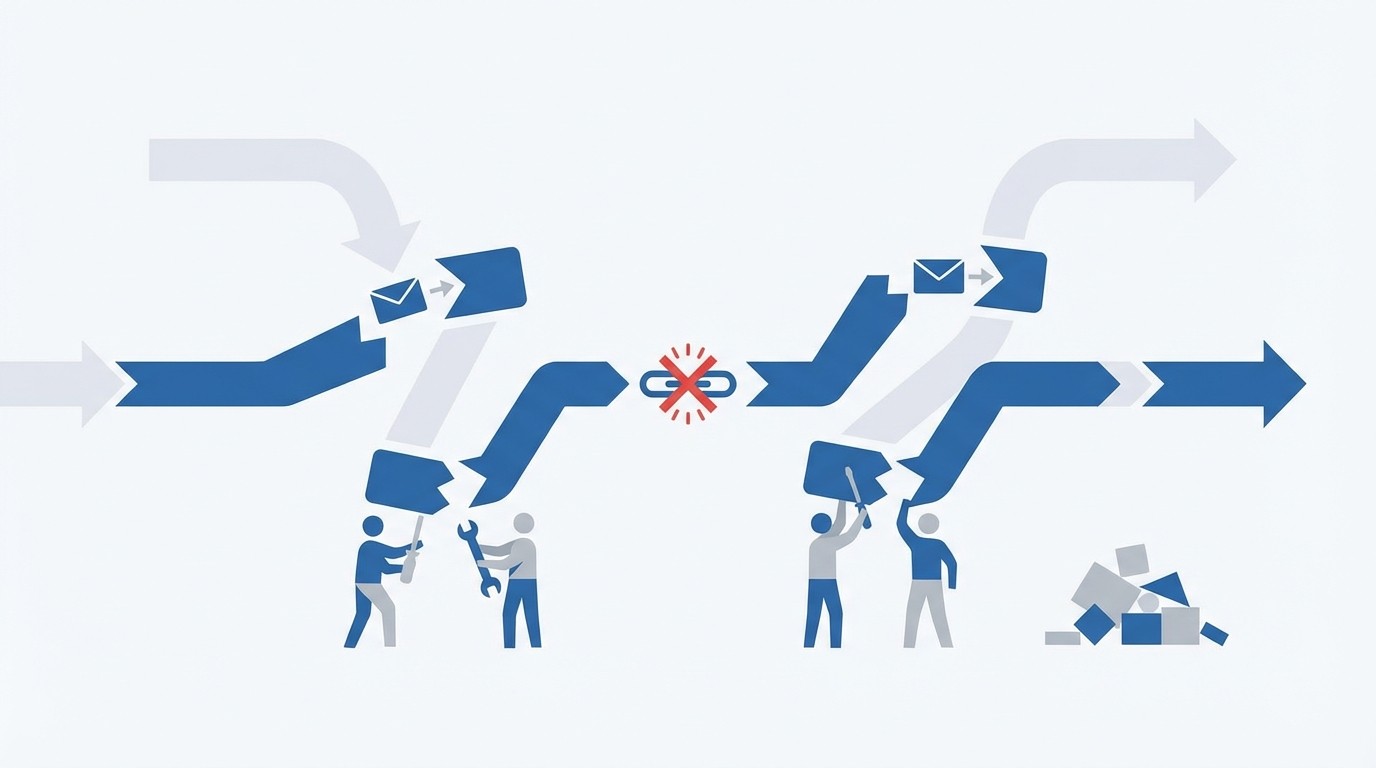
The visible problem is noise, but the real problem is separation
Most teams notice the symptoms first. Response rates wobble. Agent queues stay high. Digital adoption looks mixed. A campaign goes live across SMS, email, or WhatsApp, yet the workload barely moves. On paper, the stack looks modern. In practice, it still behaves like a relay race.
What's really happening is simpler than most postmortems make it sound. Messaging is being treated as outreach, while action is being pushed somewhere else. The customer gets a reminder by one channel, verifies identity in another place, completes the task in a portal, then triggers a note, flag, or balance update that someone inside operations still has to reconcile. That's not one workflow. It's several partial workflows pretending to be one.
I think this is where many teams get stuck. They buy tools that are good at starting conversations and then wonder why routine cases still drain people. The hidden cost isn't just channel sprawl. It's fragmented customer resolution, where no single system owns the outcome from trigger to writeback.
Every handoff creates abandonment and rework
Every handoff reduces completion because it asks the customer to do more at the exact moment you need less friction. A failed payment alert becomes a portal login. A compliance reminder becomes a document upload through a separate flow. A plan setup starts in a message but finishes with an agent because the rule path isn't connected to the system of record.
Research on digital journeys keeps pointing in the same direction: friction kills completion. When McKinsey has written about customer journeys in financial services, the pattern is clear that reducing unnecessary steps improves both experience and operating performance McKinsey. The lesson isn't abstract. It shows up every day in collections and billing teams.
You feel it in the queue build-up, too. Customers were willing to act, but the process made them stop. Then agents inherit work that should never have reached them. After a while, teams stop trusting the automation because it keeps creating cleanup work. That's exhausting, especially when the workflow looked finished at launch.
Conversation metrics can hide a broken operating model
Conversation volume is not the same as progress. You can have healthy send numbers, strong open rates, even decent click activity, and still fail at the thing that matters. Did the customer complete the task? Did the system update correctly? Did the case close without manual wrap-up?
This is where fragmented customer communication becomes dangerous. It creates a false sense of movement. More conversations, bots, and channels can make a dashboard look busy while the underlying process remains broken. Gartner's work on customer service automation has made a similar point for years: automation has value when it resolves work, not when it simply contains or reroutes contacts Gartner.
If your operation is measuring activity while routine cases still leak into manual processes, you're not looking at a communication problem. You're looking at an operating model problem. And that's why the challenges of fragmented customer communication keep showing up as cost, delay, and customer friction.
What High-Performing Operations Teams Do Instead
High-performing operations teams reduce fragmented customer workflows by designing for completion first, then building channels, rules, and handoffs around that outcome. They don't ask how to send more messages. They ask what must happen for the case to finish safely, quickly, and without manual repair. That shift changes everything.
They define resolution before they design outreach
Resolution-first teams start with the completed business outcome. A payment is processed. A plan is established. An address is updated. A compliance attestation is captured. A document is received and recorded. That sounds obvious, but most teams still design from the top of the funnel instead of the end state.
When you start with the outcome, the workflow gets sharper fast. You know what data is required, what policy checks apply, what proof must be captured, and what system must be updated when the customer acts. You're not just planning communication anymore. You're defining a transaction path.
In my experience, this is the first correction that actually sticks. Teams often spend months debating cadence, copy, and channel mix while the more important question sits untouched: what exactly counts as completion, and where does that completion have to land? Until that answer is clear, fragmented customer communication will keep leaking work back into people, especially when evaluating challenges of fragmented customer.
A practical way to do this is to document three things before any build begins:
The trigger that starts the case
The customer action that completes the case
The system update that proves the case is closed
That sounds basic. It isn't. Most broken workflows fail one of those three tests.
They remove portal detours from routine tasks
Routine, policy-bound work should finish where the customer already is. That doesn't mean every interaction belongs in one channel forever. It means the customer shouldn't have to leave the moment of intent just to complete something simple.
A portal can be useful for broad account management. But for a failed payment, a plan selection, a KYC refresh, or an address update, forcing a separate login often creates the exact abandonment you're trying to avoid. NIST guidance on digital identity has long emphasized balancing assurance with usability because extra friction reduces completion NIST. Financial services teams know this already. The trouble is that many workflows still ignore it.
The better approach is friction-right self-service. Validate identity in a way that fits the risk level, then present only the actions the customer is actually allowed to take. That keeps the flow short, clear, and safe. It also cuts one of the biggest challenges of fragmented customer experiences: the switch from message to portal to agent when the task should have finished in one place.
Not everyone agrees that portals are the problem, and fair point. Portals still matter for broad service access. But using them as the default action path for every routine case is where many operations teams lose completion.
They build policy into the workflow, not into agent memory
Routine operations work breaks when rules live in training decks, side documents, or agent judgment instead of the workflow itself. That's when one customer gets offered one path, another gets a different one, and exceptions start swallowing the day.
Strong teams encode policy, thresholds, time logic, and exception handling into the process itself. If a customer is eligible for a payment arrangement, the available options should reflect that. If a missing field blocks completion, the case should follow a defined exception path. If identity checks fail, the next step should be controlled, not improvised.
This matters because fragmented customer communication is rarely just a channel issue. It's usually a rules issue too. One system knows the balance. Another knows the cadence. A third stores documents. Agents bridge the gaps with manual judgment. That may work at low scale. It fails when volume rises.
The teams that handle spikes better don't ask people to remember every branch. They make the workflow carry the logic. Then agents focus on edge cases, disputes, and sensitive scenarios where judgment really matters.
They measure outcomes that expose fragmentation
You can't fix fragmented communication if your scorecard rewards noise. Resolution-first teams track measures that reveal whether the workflow actually finishes. That usually includes completion rate, time-to-resolution, writeback success, exception rate, and agent deflection.
Those metrics do two useful things. First, they expose where the journey breaks. Second, they stop teams from mistaking activity for progress. If a workflow sends more messages but completion stays flat, you know the problem is further downstream. If completion improves but writeback success drops, you've found an integration weakness. If deflection rises but exception handling slows, you've shifted the bottleneck rather than removed it, especially when evaluating challenges of fragmented customer.
Here's a simple scorecard many teams can use:
Completion rate by workflow type
Time-to-resolution from trigger to closed case
Writeback success to the system of record
Exception volume that still needs agent handling
Channel-to-completion patterns by segment
Those numbers tell you where fragmentation still lives. They also make investment decisions easier. After the methodology is clear, Explore Customer Communication Workflows On Autopilot.
They start with one high-volume workflow and prove the model
The best way to reduce the challenges of fragmented customer operations is not to redesign everything at once. It's to pick one routine workflow with real volume, clear rules, and measurable waste, then close the loop properly.
That might be failed payments, payment plan setup, compliance refreshes, or address changes. The point is to choose something repetitive enough to matter and bounded enough to control. When that workflow moves from fragmented outreach to actual resolution, the operational proof becomes hard to ignore.
Honestly, this is usually where skeptical stakeholders change their view. Not because they heard a better pitch, but because they saw one messy process become measurable, faster, and less dependent on manual wrap-up. That's the moment the operating model starts to change.
How RadMedia Turns Fragmented Journeys Into Closed-Loop Resolution for Challenges of fragmented customer
RadMedia turns fragmented customer communication into closed-loop resolution by connecting triggers, in-message action, policy logic, and writeback into one managed workflow. Instead of asking your team to stitch together outreach, portals, and manual follow-up, it is built to finish routine financial services tasks inside the message and record the result where it needs to live.
Managed integration and in-message action reduce the cleanup work
One of the hardest parts of fixing fragmented customer workflows is not message copy or channel setup. It's integration. RadMedia handles managed back-end integration so triggers from billing, collections, policy, and compliance systems can feed the workflow, and outcomes can write back idempotently to the system of record. That matters because many automation projects fail at the exact point where action must update balances, flags, notes, or documents reliably.
RadMedia also uses in-message self-service mini-apps so customers can complete routine tasks without a portal detour. After identity validation through one-time codes, known-fact checks, or signed deep links, the mini-app presents only the policy-eligible actions for that case. That could be updating a card, authorizing a payment, choosing a compliant plan, confirming details, uploading documents, or signing an attestation. The point is simple: the customer acts where they already are, and the process doesn't split in half.
That changes the economics of routine work. The handoff that used to create abandonment becomes a single controlled flow. Start A Conversation About A Resolution-First Workflow.
Orchestration, writeback, and controls make resolution measurable
RadMedia does more than send messages. Its omni-channel messaging orchestration sequences SMS, email, and WhatsApp to drive completion, with timing, cadence, consent, and preferences accounted for in the workflow. The goal isn't more outreach. It's fewer dead ends.
The Autopilot Workflow Engine then advances each case from trigger to completion using policy-aware rules, time-based logic, and exception routing. When a customer action succeeds, RadMedia closes the loop with direct writeback to systems of record through its closed-loop resolution and writeback capability. That is what removes the manual wrap-up that so often makes fragmented customer communication expensive even after digital action appears to happen.
For regulated operations, RadMedia also includes security, identity, and audit controls, plus telemetry, reliability, and data export. That means identity checks, auditability, and operational evidence are part of the workflow rather than afterthoughts. You can measure completion rate, time-to-resolution, deflection, and writeback success with a cleaner line of sight. If your team wants to start with one high-volume workflow and prove resolution, Get In Touch With RadMedia.
A Resolution-First Model Starts With One Workflow
A resolution-first model works because it removes the places where fragmented customer communication usually breaks. It cuts the portal detour, limits unnecessary handoffs, encodes policy into the workflow, and makes completion measurable all the way back to the system of record. That's how routine work stops swelling agent queues and starts resolving cleanly.
You don't need to redesign every customer journey at once. Start with one high-volume workflow where the cost of fragmentation is already visible, then prove what closed-loop resolution looks like in practice. If you're ready to reduce the challenges of fragmented customer operations without adding another layer of tools, Ready For Customer Communication Workflows On Autopilot? Get In Touch.