
AI Chatbots and Automated Follow-Ups for Personalized Support
AI chatbots and automated messaging should focus on completed outcomes, not just message volume. True automation enhances efficiency by resolving tasks without manual intervention, especially in finance, where successful writebacks and completion rates matter most.
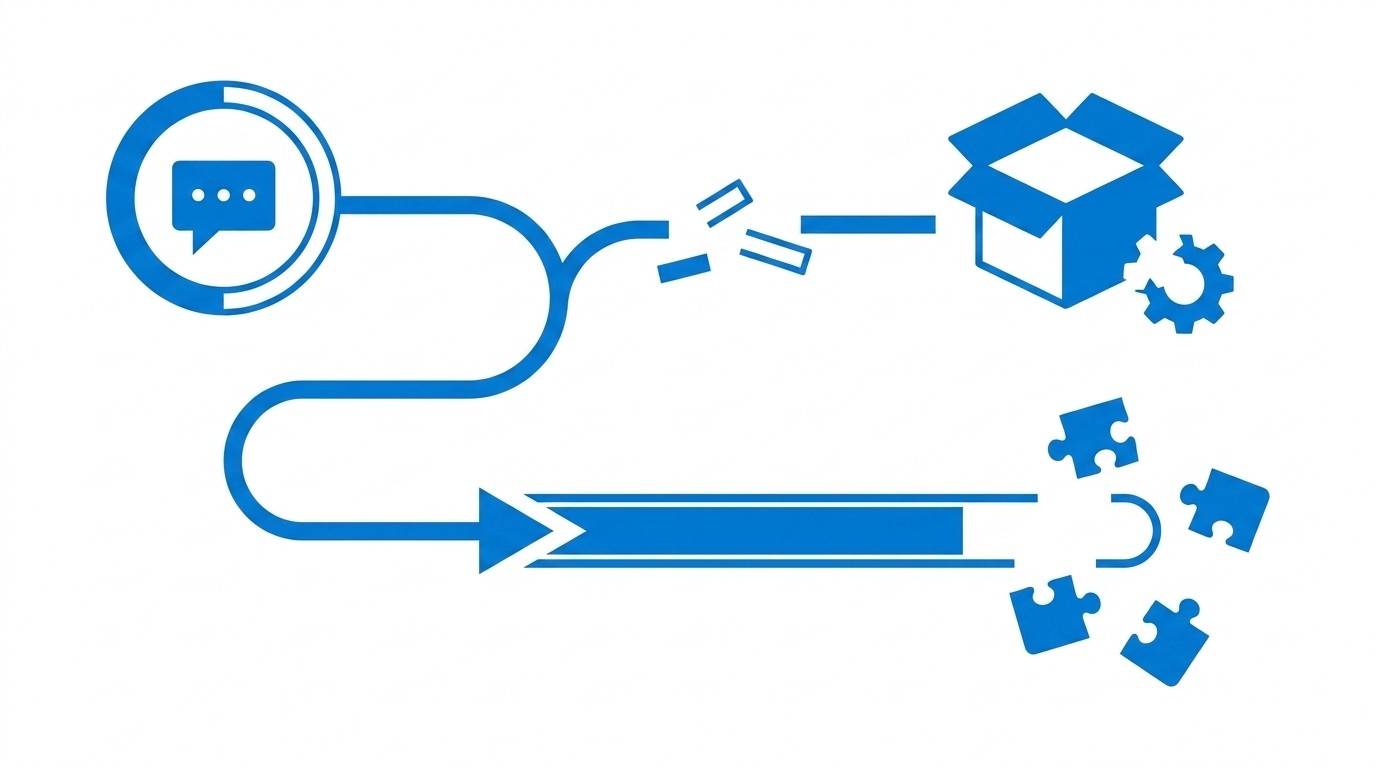
Message volume keeps climbing while resolved cases sit flat, and that gap is where automation quietly stops working. A 4x lift in sends, replies, and bot containment can look like progress on the dashboard while the operation absorbs more manual wrap-up underneath.
Financial services teams know the gap. A customer can receive a reminder, click a link, ask a bot a question, and still end up in a queue because the task didn't finish or write back to the core system. That isn't automation in any useful sense. It's a longer route to the same manual work.
Key Takeaways:
AI chatbots and automated messaging should be judged by completed outcomes, not conversation volume.
Routine, policy-bound work belongs outside the contact centre when rules, identity checks, and writebacks are predictable.
The safest first workflow is high-volume and low-discretion, and you can measure it from trigger to system update.
In-message self-service reduces the portal and login friction that often breaks completion.
Completion rate and writeback success matter more than sends, opens, or bot containment.
Why AI Chatbots and Automated Messaging Miss Resolution
Messaging automation fails when it starts conversations but doesn't complete the operational task. In billing, collections, and compliance, the value sits in the resolved case, not the reply. A message that ends in a manual wrap-up still leaves cost inside the operation.
Conversation Metrics Can Hide Manual Work
A collections manager checks the campaign dashboard at 08:17 after a scaled SMS run. Delivery looks healthy and engagement has jumped, so the automated channel appears to be doing its job. Then the inbound queue tells a different story: customers are calling because the message started action but didn't let them finish it. In one retail banking case, scaling a campaign to 200,000 messages per month pushed call abandonment from under 10% to over 50% once customers hit new inbound lines with queue times of up to two minutes.
That scenario is uncomfortable because the campaign looked automated from the outside. We've seen this pattern more than once: the message performs and the bot responds, but the customer still needs an agent to complete a payment plan or update account details. The real failure isn't customer interest. Customers were trying to act. The failure was asking the contact centre to absorb routine work that should never have reached a person.
Routine Work Doesn't Need a Conversation
Policy-bound work has a different automation profile from open-ended service. If a case has a fixed trigger and a limited set of allowed outcomes, it doesn't need a long exchange. It needs a secure path to completion. That distinction matters because automated service flows often get evaluated as if all customer contact is dialogue.
A practical test works well here: if 70% or more of cases follow the same next action, automate the resolution path before adding more conversational logic. If the exception rate is above 30%, keep agents close and automate the triage and handoff context first. Some teams prefer to keep all customer contact human-led because regulated workflows carry risk. That's a fair concern. The point isn't to remove people from judgment calls, but to stop using trained agents for work where the answer is already defined by policy.
The Last Step Is Where Costs Stay
The last operational step is where automation often breaks. A customer clicks from SMS into a portal, forgets a password, abandons the process, and calls later. An agent then verifies identity, repeats the same questions, and leaves notes for audit. A chatbot may have contained the first interaction, but the case still landed in the queue.
Customer communication in financial services is a bit like card processing. A tapped card doesn't matter until authorization, settlement, and posting happen correctly. Communication works the same way: a delivered message isn't the finished transaction. Until the outcome updates the system of record, the operation is still carrying the work.
How to Build Automated Communication Around Resolution
Automated communication should be designed from the final system update backward. Start with the completed outcome, then work back through identity, eligible actions, and writeback rules. That sequence prevents bot-led workflows from becoming another front door into manual work.
Diagnose Which Workflows Are Ready First
Roughly 60% to 80% of service traffic in many financial services operations is routine work like payment arrangements, address updates, and compliance refreshes. That doesn't mean every workflow should be automated first. We prefer starting with the work that is frequent and rule-based, because early proof matters more than broad coverage.
Use four questions before approving a workflow for automation. Can the trigger be identified without agent interpretation? Can identity be validated without asking the customer to log into a portal? Are the allowed outcomes limited to fewer than five choices? Can the final outcome write back without manual rekeying? If the answer is yes to all four, messaging automation should move toward self-service resolution rather than more back-and-forth conversation.
A quick scoring method keeps the discussion practical:
High fit: predictable trigger, stable policy, fewer than five actions, clear writeback target
Medium fit: predictable trigger, some eligibility logic, agent review needed for exceptions
Low fit: unclear intent, disputed facts, high emotional sensitivity, or no reliable system update path
Start With the Outcome, Not the Message
The strongest automated workflows begin with a simple sentence: "The case is resolved when." For a collections workflow, that might mean a payment is made or a Promise to Pay is captured. For a compliance workflow, it may mean documents are uploaded and a customer flag is cleared. Without that definition, the message sequence can look busy while the operation remains stuck.
A useful rule: don't design the first message until the completion event is clear. We know that sounds backwards to teams used to campaign planning, but it prevents a common mistake. If the completion event requires multiple fields, approvals, and a system update, the message needs to point into a structured action flow rather than a chatbot thread. Automated service flows only reduce cost when the customer can complete the action at the moment of intent.
For a payment arrangement, the workflow might run like this: 1. Define the accepted arrangement outcomes, 2, Check eligibility from account data before presenting choices, 3, Validate identity before showing account-specific details, 4, Capture the selected plan, consent, and timestamp, and 5. Write the arrangement and notes back to the system of record.
Remove Portal Friction at the Moment of Decision
A portal can be secure and still be the wrong place to send a customer. If a customer is already inside SMS, WhatsApp, or email, every channel switch adds a chance to lose them. Login pages and forgotten passwords create work that later reappears as calls. Not always immediately. Often later, after the customer has already abandoned the task.
The better design is to keep the action inside the message flow wherever the risk profile allows it. For routine tasks, that means a secure link, identity validation, and a small action screen that shows only what the customer is allowed to do. If identity proof requires more than two interactions before the customer can act, review the design. More steps may feel safer, but they can also push legitimate customers into assisted channels and increase cost.
A fair limitation belongs here: not every task should be compressed into a small in-message flow. Complex disputes and high-risk account changes need human review. The sharper point is that routine tasks shouldn't inherit the same heavy path as complex ones. Treating every case as complex is one of the hidden ways automated communication loses its savings.
Encode Policy Before You Add AI
AI can classify, route, and respond, but policy decides what should happen next. If eligibility rules live in team knowledge or supervisor judgment, automation will reproduce inconsistency at a larger scale. The order matters. Encode the policy first, then decide where messaging automation can safely support the workflow.
The policy layer should answer three questions before any customer sees an option. Who is eligible for each action? What evidence must be captured? What exception path applies when the customer can't complete the task? Having burned through a few automation plans, we've learned to respect this sequence. Messaging without policy is just faster uncertainty.
A simple threshold helps. If a workflow policy changes more than once a month, keep configuration ownership with an operations and risk working group rather than burying rules inside a technical backlog. If the policy has been stable for 90 days and exceptions are well understood, automation can carry more of the work. That tradeoff is real: stronger control may slow initial rollout, but it prevents the expensive problem of correcting bad outcomes after customers have acted.
Test Writebacks Like Financial Controls
Writebacks deserve the same seriousness as customer-facing design. A case isn't complete because a customer selected an option. The operation must know whether the update posted correctly and whether retries could create duplicate actions. That is where many bot-led workflows run out of road.
Before launch, test three states for every workflow: successful completion, partial completion, and retry after failure. The retry case is often the one that exposes weak design. What happens if the customer submits a payment plan, the network fails, and the system receives the same update twice? If the answer isn't clear, the workflow isn't ready for high-volume automation.
A writeback readiness check should include:
Before state: what the system showed before customer action
Action evidence: what the customer selected, signed, uploaded, or confirmed
After state: what changed in the system of record
Retry behavior: how duplicate or delayed updates are handled
Audit trail: what an internal reviewer can prove later
Measure Completion, Deflection, and Exceptions Together
Send volume tells you reach. Open rates tell you attention. Bot containment tells you how many interactions stayed inside the bot. None of those prove the operational work was done. For financial services operations, the core measurement set should include completion rate, time-to-resolution, writeback success, and exception rate.
A useful readout separates healthy automation from hidden backlog. If sends are high but completion is low, the message is probably creating attention without enough action. If completion is high but writeback success is low, the customer experience is working while the integration layer is failing. If deflection rises while exception quality drops, the workflow may be pushing too much judgment into automation. Those patterns give leaders a more honest view than a single automation score.
One private higher education institution saw the difference when it moved away from passive email statements and low-use portal reminders. Students received mobile statements, verified identity, viewed the balance, and could either pay or request a callback. The important lesson wasn't simply that mobile performed better. The process reduced the gap between notification and action, which is exactly where automated communication usually fails.
How RadMedia Closes the Resolution Loop
RadMedia supports resolution-first automation by connecting secure in-message action to back-end updates. Instead of treating messaging automation as a separate front-office tool, RadMedia turns routine billing, collections, and compliance workflows into managed customer communication flows that finish inside the message.
Secure Mini-Apps Keep Customers in the Flow
RadMedia uses secure in-message self-service mini-apps so customers can complete routine tasks without downloading an app or logging into a portal. After identity validation through one-time codes or signed deep links, the customer only sees policy-eligible actions. That can include updating a card, authorizing a payment, choosing a compliant plan, uploading documents, or signing an attestation.
Security and auditability stay part of the workflow rather than being added later. RadMedia enforces TLS in transitand encryption at rest, with role-based access controls, optional SSO, and PII-aware handlingthat includes masking, configurable retention, and timestamped logs for consents, inputs, and writebacks. For procurement, risk, and compliance teams, that matters. The goal isn't only to reduce que
Managed Writebacks Turn Engagement Into Resolution
RadMedia manages the back-end integration work that often blocks automation projects: adapters, authentication, schema mapping, error handling, and idempotent writebacks to systems of record. The Autopilot Workflow Engine links triggers to outreach, mini-app interaction, policy-aware rules, time-based logic, and exception routing. When a customer completes the task, Closed-Loop Resolution and Writeback updates balances, posts arrangements, clears flags, attaches notes, or records documents without manual wrap-up.
Telemetry then shows the operation what actually happened: deliveries, opens, actions, validations, writebacks, completion rate, time-to-resolution, and deflection. That directly addresses the cost pattern from earlier, where messages created engagement but queues still grew. RadMedia's omni-channel orchestration across SMS, WhatsApp, and email is tuned for completion rather than send volume, while exceptions move to agents with context instead of starting from discovery. If your operations team is ready to replace conversation volume with finished work, get in touch.
What Resolution-First Automation Changes
Resolution-first automation changes the question from "Did the customer respond?" to "Did the case finish correctly?" That shift is small in wording and large in operational impact. It forces AI chatbots and automated messaging to prove value through completion, writeback success, deflection, and audit evidence.
The contact centre still matters. It just shouldn't be the default destination for routine, policy-bound work. Once secure in-message action and reliable writebacks are in place, people can focus on the cases that need judgment, not the ones that only needed a safe path to completion.