
Optimizing Payment Collection Processes with Automation
Optimizing payment collection processes means focusing on completion rather than just increasing message volume. To truly enhance efficiency, eliminate friction by integrating systems and enabling seamless transactions, allowing agents to handle only exceptions.
Most teams working on optimizing payment collection processes think the main job is getting more messages out the door. More reminders. More channels. More chatbot coverage. But if those messages still push customers into portals, queues, or manual follow-up, you haven't really optimized payment collection processes. You've just spread the same friction across more touchpoints.
That gap shows up everywhere in financial services. A team invests in automation, the dashboards light up, and message volume climbs. But payments still stall, agents still intervene, and records still need manual cleanup. The system looks modern. It just doesn't finish the job.
Key Takeaways:
Optimizing payment collection processes starts with completion, not contact volume.
Most payment collection failures happen at the last mile, when customers are forced to switch channels or log in elsewhere.
The root problem is usually disconnected systems, not weak messaging alone.
Better payment collection workflows combine trigger data, policy logic, in-message action, and reliable writeback.
Routine, policy-bound collections work should resolve digitally, while agents focus on exceptions.
The right metrics are completion rate, time-to-resolution, writeback success, and agent deflection.
A pilot works best when it starts with one high-volume workflow and proves operational savings quickly.
Why Payment Collection Workflows Break Before They Scale
Optimizing payment collection processes gets harder when the workflow depends on too many handoffs. A payment reminder can be sent automatically, but the moment the customer has to leave the message, log into a portal, wait for an agent, or repeat information, completion starts to fall. This is why many payment collection programs look efficient in reports but underperform in practice.
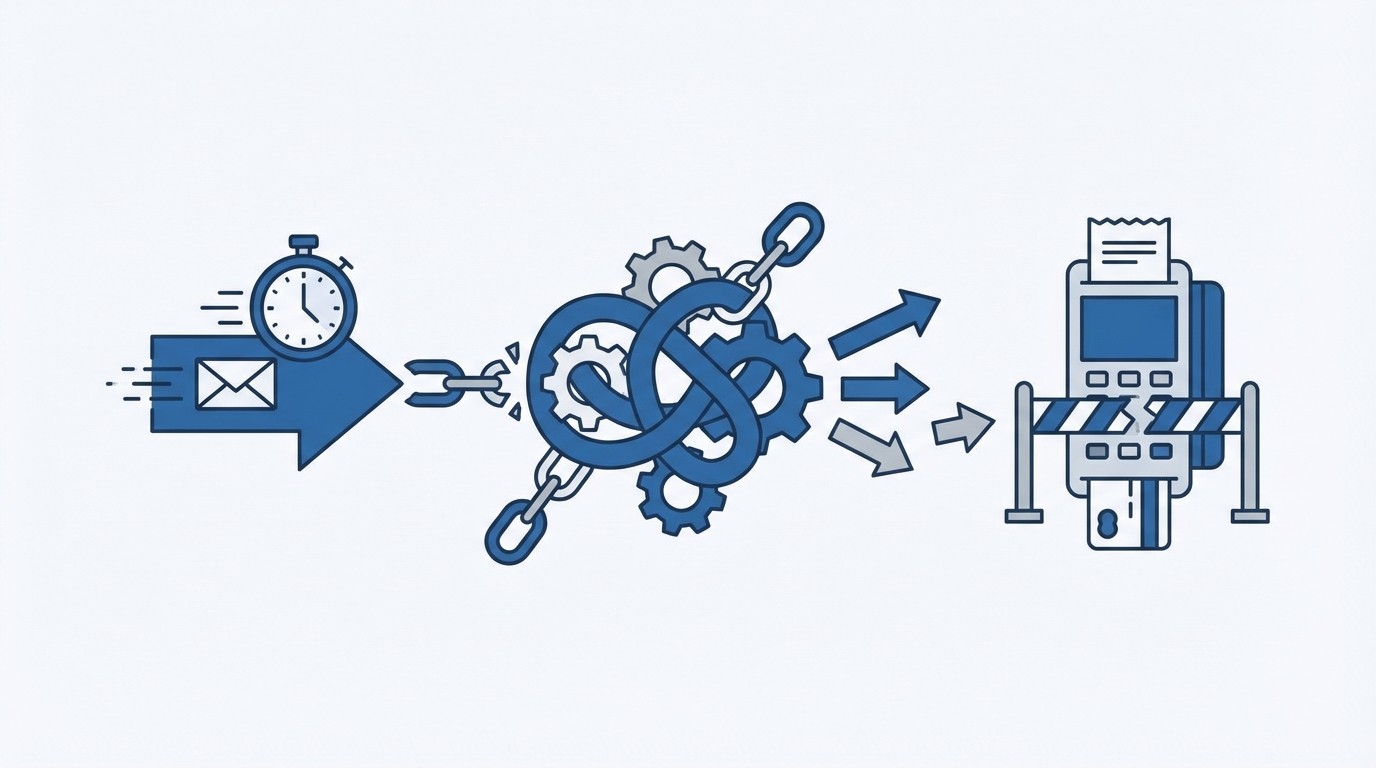
Outreach volume hides the real problem
A lot of collections teams still measure activity as if activity were the outcome. Messages sent. Opens. Clicks. Call volumes. Bot containment. Those numbers can be useful, but they don't tell you whether the payment issue was actually resolved. In my experience, that's where many payment collection workflows go wrong. The team sees motion and assumes progress.
A failed payment is a simple example. The customer gets an email, maybe an SMS too, and taps through to a portal. Then they hit a login problem, abandon the session, or decide to deal with it later. The account remains unresolved, the queue grows, and an agent eventually picks it up. The outreach happened. The resolution didn't.
This isn't a small reporting issue. It's an operating model issue. When payment collection processes are built around starting conversations instead of finishing tasks, cost-to-serve rises quietly in the background. That's the hidden bill.
Portal detours kill action at the moment it matters
Payment collection works best when the path to action is short. The more steps between intent and completion, the more customers drop. That's been true for years, and research on digital friction keeps reinforcing the point. Baymard Institute has consistently shown how checkout friction hurts completion in adjacent digital journeys, and the same pattern applies here. Extra steps cost outcomes.
Collections teams feel this in a very specific way. A customer is willing to update a card, make a payment, or set up an arrangement right now. Then the workflow asks them to switch context. Open another page. Download something. Remember credentials. Wait for a callback. That moment passes fast.
It also wears teams down. When routine payment work keeps bouncing back into the contact centre, people spend their day doing policy-bound tasks that should never have needed human handling in the first place. You can feel the drag in the operation long before it shows up in a board pack.
Integration gaps turn automation into manual reconciliation
A lot of payment collection automation stops at the edge of the core system. The message is automated. Maybe even the response capture is automated. But the actual account update still depends on a person or a brittle handoff. That's where the costs start stacking.
Drawing the customer journey is the easy part. Safe integration and reliable writebacks are the hard part. If a customer sets a payment plan but the system of record doesn't update cleanly, you've created a new risk, not a better workflow. McKinsey has written about automation in service operations, but financial services teams already know the uncomfortable part: automation only counts when the back-office work is finished too.
That pressure gets worse at scale. More accounts mean more edge cases, more exceptions, and more chances for fragmented systems to fail in expensive ways.
The Root Cause Is Not Messaging. It's Incomplete Resolution
Optimizing payment collection processes is not mainly a messaging problem. It's a resolution problem. Many teams assume stronger reminders, smarter sequences, or better channel mix will fix weak outcomes. Those things matter. But they don't solve the core issue if the customer still can't complete the task inside the interaction and have the result recorded properly.
A payment workflow is only as strong as its finish
The real test of a payment collection process is simple: can the customer act, can the system validate that action, and can the outcome write back without manual wrap-up? If any part of that chain breaks, the workflow isn't complete. It's just partial automation.
That's why chatbots, portals, and outbound tools often disappoint operations teams. They create contact. They capture intent. They may even look polished. But when the workflow reaches the point where money moves, arrangements are posted, or account flags need updating, many of those tools hand the case back to people.
I'd argue that's the central misunderstanding in collections automation. Teams keep trying to improve the front of the journey when the real weakness sits at the finish line.
Routine collections work should not live in the contact centre
Most payment collection workloads include a large share of structured, repeatable tasks. Update payment details. Confirm a commitment date. Authorize a payment. Choose a policy-eligible plan. Provide a document. These are not open-ended conversations. They're tasks with rules.
When those tasks still route through agents, the operation absorbs cost it doesn't need. Training gets heavier. Queue management gets harder. Peaks become dangerous. A process that should be predictable becomes fragile.
Some teams prefer to keep a person involved early because it feels safer, and that's a fair concern in regulated environments. But safety doesn't require manual handling of every routine case. It requires strong rules, identity checks, auditability, and clean system updates. That's a very different standard.
Better channel coverage does not fix a broken operating model
Adding SMS, WhatsApp, and email to payment outreach can improve reach. It can also multiply confusion if each channel still points the customer somewhere else to finish the task. More channels without completion are just more paths into the same dead end.
That's why optimizing payment collection processes has to start with one question: where does the task actually finish? If the answer is "later, in another system, with manual review," then the workflow still has a structural problem. That problem won't disappear because the copy improved or because the cadence got smarter.
What Poor Payment Collection Design Really Costs
Poor payment collection design costs time, money, and operating capacity. It also creates risk that many teams undercount because it is spread across queues, repeat contacts, failed self-service attempts, and manual reconciliation. Optimizing payment collection processes matters because incomplete workflows keep charging the business long after the message is sent.
Every extra handoff adds cost
A payment workflow with multiple channel switches usually creates more work than it removes. The customer receives a reminder, tries to act, hits friction, and falls into a different path. Then an agent verifies identity, explains next steps, records the outcome, and updates the account. What looked like digital efficiency becomes assisted service, especially when evaluating optimizing payment collection processes.
Those costs accumulate in familiar places:
Longer handle times for routine tasks
Higher repeat contact rates
More abandoned payment attempts
More manual account updates
More supervisor review on exceptions
None of that is theoretical. If you've ever looked at collections queues after a campaign goes live, you've seen it. Volume rises faster than completion. That's the warning sign.
Delay makes recovery harder
The longer it takes to resolve a payment issue, the harder it often becomes to recover cleanly. Customers lose momentum. Promises go stale. Details change. Agents step in with less context than they need. A simple missed payment grows into a more expensive case.
This is one reason time-to-resolution matters more than most teams think. It's not just a service metric. It's a collections performance metric. Faster, cleaner completion usually protects both customer experience and operational cost.
To improve that, teams need a workflow that shortens the path to action:
Trigger outreach from real account events
Present only relevant next actions
Validate identity inside the journey
Record the result immediately
Escalate only when rules require it
Manual cleanup creates invisible risk
The manual work after a payment interaction is easy to miss because it often sits outside the customer-facing channel. Someone posts notes. Someone updates a balance or flag. Someone checks whether documents arrived. Someone reconciles the result later. That is expensive enough on its own. It also creates consistency risk.
Financial services teams don't need a lecture about audit pressure. They live with it every day. When the payment collection process depends on people stitching together outcomes across tools, confidence drops. The record may be late. It may be incomplete. It may need rework. None of that belongs in a routine workflow.
The wrong metrics protect the wrong decisions
When teams focus on sends, opens, clicks, or bot containment, they can keep funding processes that aren't actually resolving payment issues. Those metrics aren't useless. They're just not enough. The numbers that matter are harder to ignore:
completion rate
time-to-resolution
writeback success
deflection of routine cases
exception rate by workflow step
Learn how resolution-first communication changes payment workflows
How To Redesign Payment Collection Around Completion for Optimizing payment collection processes
Optimizing payment collection processes requires a shift from communication-first design to completion-first design. That means building the workflow backward from the resolved account state, not forward from the outbound message. Once you do that, decisions about triggers, channels, identity, self-service, and escalation become much clearer.
Start with the resolved outcome, not the campaign
A strong payment workflow begins with a precise definition of completion. Is the goal a successful payment, an updated card, a plan established, a confirmed promise to pay, or a flagged exception with enough context for an agent to act? Until that is clear, automation tends to stay vague.
I think this is where the better implementations separate themselves. They define the operational finish first, then build the journey around it. That sounds obvious, but many teams still start with templates and channel plans before they agree on the actual end state.
A useful design checklist looks like this:
Define the exact account state you want at completion
Identify the policy rules that govern eligibility
Decide what evidence must be captured
Determine what must update in the system of record
Set the exception paths before launch
Use trigger data to narrow the customer's next action
Payment collection gets better when each interaction is specific. Generic reminders create noise. Contextual prompts create action. If the workflow knows the amount due, due date, account status, and policy eligibility, the customer should not have to interpret a vague prompt and figure out what to do next.
This is where many teams overcomplicate the experience. They present too many choices, too much text, or too broad a path. But the customer doesn't need a menu of possibilities. They need the next valid action, clearly presented, with as little friction as possible, especially when evaluating optimizing payment collection processes.
That often means narrowing the flow to a small set of policy-safe outcomes:
pay now
update payment details
choose an eligible arrangement
confirm a commitment date
submit required supporting information
Keep the action inside the message flow
The path to completion should stay as close as possible to the original interaction. When customers can act where they already are, payment collection friction drops. When they must leave the interaction for a different environment, abandonment rises.
That doesn't mean removing security or controls. It means applying them in the flow rather than using a portal as a blanket substitute for good workflow design. Identity checks, validation, consent capture, and structured inputs can all exist without forcing a full channel switch.
Honestly, this is the part many operations leaders already suspect. They don't need to be convinced that portal detours hurt completion. They need a practical way to remove them without increasing risk.
Design escalation for exceptions, not for routine work
Agents still matter. They just shouldn't be the default path for policy-bound work. A better payment collection process routes simple, valid cases through straight-through handling and reserves people for disputes, missing data, blocked actions, or special arrangements.
That changes staffing pressure in a meaningful way. Instead of absorbing every routine step, agents start with context on the few cases that actually need judgment. Training gets easier. Productivity improves. And the customer experience gets cleaner because people aren't waiting in line for something that never needed a queue.
A practical exception model usually includes:
rule-based eligibility checks before action
automatic branching for declines or missing information
clear escalation criteria
full case context when a handoff occurs
See how payment collection workflows can resolve inside the message
Where RadMedia Fits In A Resolution-First Collections Model
RadMedia fits this model by handling the parts of optimizing payment collection processes that usually break in real operations: integration, in-message action, policy execution, and reliable writeback. The point is not to add another outreach layer. The point is to finish routine payment tasks inside the message and record the result properly.
Turning trigger data into secure customer action
RadMedia connects back-end systems to customer-facing workflows through Managed Back-End Integration. That matters because collections workflows often fail where legacy cores and modern channels have to meet. RadMedia handles adapters, authentication, schema mapping, and error handling so trigger data from billing, collections, or compliance systems can feed the journey without your team building that plumbing from scratch.
From there, Omni-Channel Messaging Orchestration sequences SMS, email, and WhatsApp around completion, not volume. Messages can respect consent, preferences, timing, and cadence while pointing customers to the next valid action. And In-Message Self-Service Mini-Apps keep that action close to the original interaction. Customers can validate identity and complete policy-eligible tasks inside a secure, no-download experience instead of being pushed into a portal detour.
That combination addresses one of the biggest cost drivers mentioned earlier: the gap between outreach and action. Start a conversation about a high-volume collections workflow
Closing the loop without manual wrap-up
RadMedia also addresses the more difficult half of payment collections: finishing the workflow cleanly in operational systems. The Autopilot Workflow Engine advances cases using policy-aware rules, time-based logic, and exception routing, so routine work can proceed without agent touch while blocked cases move to the right path with context intact.
Closed-Loop Resolution and Writeback is where that becomes operationally meaningful. When a customer completes a mini-app, RadMedia writes outcomes directly to systems of record, including balances, arrangements, flags, notes, and documents, then closes the case without manual wrap-up. That is a direct answer to the reconciliation problem that drags down so many automation efforts.
For regulated teams, Security, Identity, and Audit Controls matter just as much as speed. RadMedia uses TLS in transit, encryption at rest, role-based access controls, optional SSO, signed deep links, and one-time codes or known-fact checks. Telemetry, Reliability, and Data Export then give operations teams the evidence to track completion rate, time-to-resolution, deflection, validations, and writebacks. So the discussion shifts from "how many messages were sent?" to "how many payment issues were actually resolved?"
Payment Collection Performance Improves When Resolution Becomes The Metric
Optimizing payment collection processes gets easier when the team stops treating outreach as the finish line. The better model is simpler to evaluate and harder to fake: can the customer complete the task inside the message, can the result write back correctly, and can agents stay focused on exceptions instead of routine work?
If your current process still creates channel switches, portal detours, and manual cleanup, that's the place to look first. Start with one high-volume payment workflow, define what completion really means, and measure resolution instead of conversation volume. If you want to talk through that kind of design, Ready For Customer Communication Workflows On Autopilot? Get In Touch.